
Seed catalog / Samenkatalog

I have been irritated by sites that give me German if my browser is set to German. One such used to be Thompson and Morgan’s famous seed catalogue. They are famous for promising you can grow all sorts of obscure things that in my experience don’t come up, but the catalogue in English and German, together with colour pictures of the flowers and vegetables, is nice, or would be, if it weren’t for the language problem. Here’s a link to the German version.
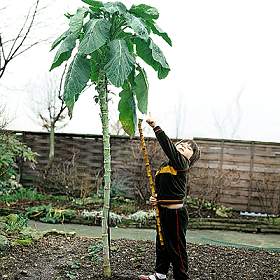
cabbage.jpg

But just now I had the English version, because I had my browser set to US English for Google experiments. Anyway, there now seem to be language flags to click on, although I still find the site a bit confusing. It would be easier just to order the catalogue in two languages – they have a lot there, but it isn’t easy to find. Continue reading

Google US vs. Germany continued

A further discussion in the FLEFO Forum at CompuServe (I’ve been a member since 1994 and it’s where I first learned how useful it was to contact other translators all over the world) confirms that those using google.com in the USA get far more results than those in Europe. One colleague in Germany managed to reproduce this by dialling in via a CompuServe number in the USA. However, she said that although Google announces a large number of results, it will show only about 1000. Thus for Santa Cruz (no inverts):

Results shown ‘in Europe’ 991 – 998 of about 254,000

Results shown ‘in the USA’ 991 – 997 of about 2,670,000 Continue reading

Google US vs. Germany continued

A further discussion in the FLEFO Forum at CompuServe (I’ve been a member since 1994 and it’s where I first learned how useful it was to contact other translators all over the world) confirms that those using google.com in the USA get far more results than those in Europe. One colleague in Germany managed to reproduce this by dialling in via a CompuServe number in the USA. However, she said that although Google announces a large number of results, it will show only about 1000. Thus for Santa Cruz (no inverts):

Results shown ‘in Europe’ 991 – 998 of about 254,000

Results shown ‘in the USA’ 991 – 997 of about 2,670,000 Continue reading

Certify / Attest / Beglaubigen

I’ve been writing a lot in German about the use of the word ‘beglaubigen’ (certify) for translations, and forgetting to discuss how to translate some of these terms into English, as Adrian reminds me in a comment.

There is a Beurkundungsgesetz in Germany. It is all about notaries. I have translated it, sometimes, as Notarial Recording Act. Neither Dietl nor Romain has it, nor von Beseler – Jacobs-Wüstefeld. It is often translated as ‘Documents Act’, which I don’t much like.

German notaries either beurkunden or beglaubigen. If they beglaubigen (öffentliche Beglaubigung), they certify / witness a signature. Or attest. If they beurkunden (öffentliche Beurkundung), or record (the best word I’ve found, but not very transparent, unfortunately), they produce a whole document.

So I normally say:

|Beurkundungsgesetz|Notarial Recording Act|
|öffentliche Beglaubigung|notarial certification|
|öffentliche Beurkundung|notarial recording|

I don’t like to use notarization. Reasons: firstly, the term is associated in the US with a notary public’s witnessing of a signature, and so conjures up the idea of a different kind of notary. In addition, it is not clear whether beglaubigen or beurkunden is meant. – Of course, the word notarization works perfectly well in context, if one is careful – I’m just setting out my own objections. Continue reading