
House of Lords Hansard on Lord Chancellor

On Thursday evening, when Tony Blair announced he was abolishing the office of the Lord Chancellor, there was an angry discussion about it in the House of Lords (in the middle of the discussion of the Water Bill). Hansard transcripts are available at 8 a.m. (British time) or earlier the following day. The beginning of Thursday’s discussion is here :

bq. The Earl of Onslow: My Lords, it has been announced on the television that the office of Lord Chancellor should be abolished. Is it not totally disgraceful that no Statement has been made to Parliament and no discussion has taken place, and that an office of 800 years has been abolished without anyone debating it? At the whim of the Prime Minister, we have altered the constitution. Suddenly we are landed with this, and nobody knows what is happening. It is an abuse of process, of privilege and of office. What can we do about it? I therefore beg to move that the House do now adjourn.

Usually a good read, and now even more so:

bq. Lord Borrie: My Lords, the noble Earl knows that I normally sit in this place. Noble Lords sitting in front of the noble Earl will confirm that I have sat in this place throughout most of the day.

bq. The Earl of Onslow: My Lords, the noble Lord, Lord Borrie, has been glued to that Bench for as long as he has been in this House. I concede that that is his normal place. But suddenly a block of noble Lords appear opposite. They were summoned in by the Whips. We know the origin of the Whips. They were invented by Walpole who was a beagling fanatic. I refer to hunting whippers-in.

bq. I may be flippant as regards Whips and noble Lords opposite sitting in a block in the hope of being seen on television but I am not being flippant when I refer to the abuse of the constitution that we have just witnessed. I am not being flippant when I say that you cannot just change 800 years of British political history at the whim of the temporary—thank God—occupant of No. 10. All occupants of No. 10 are temporary.

bq. Lord Cope of Berkeley: My Lords, unless anyone else wishes to contribute to the debate I should like to make a few points. My noble friend Lord Strathclyde, who would otherwise no doubt speak from this Dispatch Box, is at the moment taking part in a television programme in the north of England.

bq. Noble Lords: Oh!

bq. Lord Cope of Berkeley: My Lords, noble Lords may laugh at that but they know perfectly well that when one is involved in political life one takes on those engagements.

(Lord Williams of Mostyn, Leader of the House, who is the person who might explain the government’s behaviour, has not actually been brought in by the Whips). Continue reading
House of Lords Hansard on Lord Chancellor

On Thursday evening, when Tony Blair announced he was abolishing the office of the Lord Chancellor, there was an angry discussion about it in the House of Lords (in the middle of the discussion of the Water Bill). Hansard transcripts are available at 8 a.m. (British time) or earlier the following day. The beginning of Thursday’s discussion is here :

The Earl of Onslow: My Lords, it has been announced on the television that the office of Lord Chancellor should be abolished. Is it not totally disgraceful that no Statement has been made to Parliament and no discussion has taken place, and that an office of 800 years has been abolished without anyone debating it? At the whim of the Prime Minister, we have altered the constitution. Suddenly we are landed with this, and nobody knows what is happening. It is an abuse of process, of privilege and of office. What can we do about it? I therefore beg to move that the House do now adjourn.

Usually a good read, and now even more so:

Lord Borrie: My Lords, the noble Earl knows that I normally sit in this place. Noble Lords sitting in front of the noble Earl will confirm that I have sat in this place throughout most of the day.

The Earl of Onslow: My Lords, the noble Lord, Lord Borrie, has been glued to that Bench for as long as he has been in this House. I concede that that is his normal place. But suddenly a block of noble Lords appear opposite. They were summoned in by the Whips. We know the origin of the Whips. They were invented by Walpole who was a beagling fanatic. I refer to hunting whippers-in.

I may be flippant as regards Whips and noble Lords opposite sitting in a block in the hope of being seen on television but I am not being flippant when I refer to the abuse of the constitution that we have just witnessed. I am not being flippant when I say that you cannot just change 800 years of British political history at the whim of the temporary—thank God—occupant of No. 10. All occupants of No. 10 are temporary.

Lord Cope of Berkeley: My Lords, unless anyone else wishes to contribute to the debate I should like to make a few points. My noble friend Lord Strathclyde, who would otherwise no doubt speak from this Dispatch Box, is at the moment taking part in a television programme in the north of England.

Noble Lords: Oh!

Lord Cope of Berkeley: My Lords, noble Lords may laugh at that but they know perfectly well that when one is involved in political life one takes on those engagements.

(Lord Williams of Mostyn, Leader of the House, who is the person who might explain the government’s behaviour, has not actually been brought in by the Whips). Continue reading
A Supreme Court for the UK?

There is a website following the possible development of a supreme court in the UK. The site is a criminal-law site but with the name ‘supreme court’ in the URL. Two PDF files in favour, but the bibliography is largely off-line. It’s worth looking at the link to the civil rights organization Liberty (at the moment, their site seems to be down so I only saw it in the Google cache.

Posted in law

Turning lemons into lemonade

When Daihatsu produced the Lemon Edition of its Cuore, coloured lemon-yellow and with smart accessories, it apparently (anscheinend?) wasn’t aware that in U.S. English, a lemon is a dud – most often a car that you buy new but that develops so many problems that the law will allow you to change it for another.

There are lemon laws that define exactly how many defects a car has to have to satisfy this requirement.

Now, via Ernie the Attorney, a new U.S. legal weblog, Out-Of-The-Box Lawyering, claims to teach lawyers how to solve various everyday problems, and ‘turn lemons into lemonade’.

bq. What’s this weblog – blog – blawg – all about? It’s about creativity – how lawyers have come up with unusual solutions in their practices. And, it’s about how lawyers can come up with more. It will also be about general principles of creativity – as used in business, in science, in anything – and how those principles can be and have been applied in the practice of law. Continue reading

Turning lemons into lemonade

When Daihatsu produced the Lemon Edition of its Cuore, coloured lemon-yellow and with smart accessories, it apparently (anscheinend?) wasn’t aware that in U.S. English, a lemon is a dud – most often a car that you buy new but that develops so many problems that the law will allow you to change it for another.

There are lemon laws that define exactly how many defects a car has to have to satisfy this requirement.

Now, via Ernie the Attorney, a new U.S. legal weblog, Out-Of-The-Box Lawyering, claims to teach lawyers how to solve various everyday problems, and ‘turn lemons into lemonade’.

bq. What’s this weblog – blog – blawg – all about? It’s about creativity – how lawyers have come up with unusual solutions in their practices. And, it’s about how lawyers can come up with more. It will also be about general principles of creativity – as used in business, in science, in anything – and how those principles can be and have been applied in the practice of law. Continue reading

The greening of Fürth

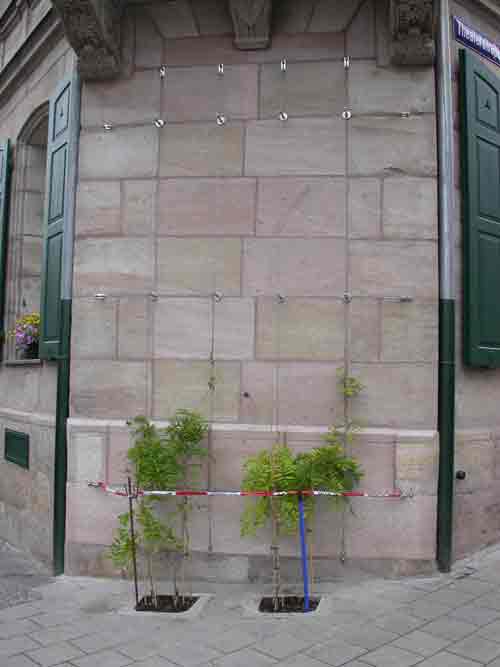
On May 28, I forgot to add my third photo of Fürth. This shows the latest efforts to make the inner city green. Today’s paper shows two people tending their plants. Herr Jahreis of the City planning office says ‘So langsam wird aus der Steinwüste eine Streublumenwiese” (the desert of stone is gradually turning into a flowery meadow).

greenww.jpg

The trouble is, the really striking thing about these turn-of-the-20th-century streets is their very lack of green.

A house owner whose building is in the subsidized area (there are EU funds) can get 100% subsidy for this. A lady in Theaterstraße is strewing pepper on her creeper to keep dogs off. 10,000 euros per year are available for making houses and inner courtyards greener. I can understand the courtyards – there are 750 of those in the inner city alone, and Fürth has more than 2000 listed buildings (I’m sitting in one now), more than practically any other city. But is it right to destroy the sight of beautiful rows of sandstone houses by putting creepers all over them? Perhaps I am just too negative. I wonder what the city historian (Stadtheimatpflegerin) Barbara Ohm (author, inter alia, of ‘Durch Fürth geführt’) thinks of this?

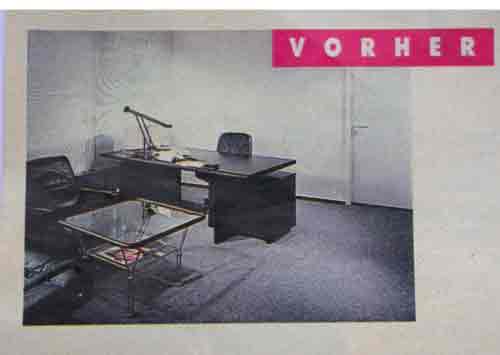
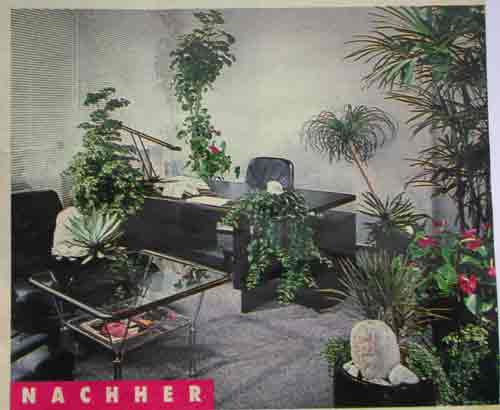
This is my real worry. These before and after pictures on how to improve your office come from a 1995 German magazine.

vorherww.jpg

nachherww.jpg