
Become a certified translator via E-Bay (German) /Zertifizierter Übersetzer über E-Bay

You can become a ‘zertifizierter Übersetzer’ (certified translator, literally – although in BE that sounds as if you were ready to go to a lunatic asylum) – see the item on E-Bay.

The firm appears to have been on ebay for a while. It claims to certify knowledge you already have. It says you train and do a final exam and then you get a certificate. The title can legally be used in Germany. The company was founded in the UK, but of course EU law permits that, no matter whether the object was to save money. But maybe the company does have a lot of English-language operations and I just haven’t found them.

On a cursory search I failed to find an English version.

More activities here (German).

Thanks to Robin Stocks, translator, who is in Bonn and also does a home page for the Bonner Übersetzer- und Dolmetscherforum (German, database of translators and interpreters), and Christiane Sprinz, food technologist and translator.

On the firm’s personal page at E-Bay (registration probably necessary), it says you don’t need to do any training if you confirm by email that you have the necessary experience.

bq. Frage: Ich habe ausreichend Fachwissen muß ich trotzdem an der Schulung teilnehmen?

bq. Antwort: Nein, sofern Sie uns Ihr Fachwissen per Email bestätigen (z.B. “Ich …. bestätige hiermit das ich über genügend Fachwissen in dem zu zertifizierenden Bereich verfüge”).
Survival of Australian English

Via Isabella Massardo, an article from the Sydney Morning Herald about the way Australian English resists U.S. influence, No fries with that, mate.

There’s a link to ABC Online’s Australian Word Map, which shows regional Australian expressions and indicates their spread on a map, with ten words of the month.

bq. A recent inclusion is “blue-tongue”, for small children (because toddlers are close to the ground, like blue-tongue lizards). That one comes from Tasmania. The Brisbane region contributes “desert chicken”, meaning corned beef. From the central coast of Queensland comes “muckadilla”, meaning a disorganised person. From the Sydney region comes the expression “YMCA dinner”, or leftovers (“Yesterday’s Muck Cooked Again”). And, when someone agrees to take part in an activity, they say they’re “thumbs in”.

Old Bush Vernacular will be used in The Aussie Bible, to be published in August (there is already a Cockney Bible).

Romancing the Rosetta Stone

This is about machine translation. An article with this title at the University of Southern California describes a relatively successful machine translation system devised by their Dr. Franz Josef Och (who did a lot of preliminary work at the Rheinisch-Westphälische Technische Hochschule, RWTH, in Aachen, based on late 1980s IBM research).

The idea is to stuff a machine with masses of parallel texts and let the machine work out the translation using statistical comparisons.

Och’s system scored highest of 23 Arabic- and Chinese-to-English systems. It was also entered in a recent competition to devise from scratch an MT system for Hindi as fast as possible. The results are not out yet.

Creation of the parallel texts needed for Och’s system to work was complicated by the fact that Hindi is written in a non-Latin script, which has numerous different digital encodings instead of one or two standard ones.

You’re not kidding! And I wonder what the quality of the input translations was.

I also think of translation memory problems where segments in one language don’t always match those in the other in different texts.

This method ignores, or rather rolls over, explicit grammatical rules and even traditional dictionary lists of vocabulary in favor of letting the computer itself find matchup patterns between a given Chinese or Arabic (or any other language) texts and English translations.

Such abilities have grown, as computers have improved, by enabling them to move from using individual words as the basic unit to using groups of words — phrases.

Different human translators’ versions of the same text will often vary considerably. Another key improvement has been the use of multiple English human translations to allow the computer to more freely and widely check its rendering by a scoring system.

And I wonder how many versions they had for Hindi, Chinese and Arabic.

Via Slashdot and Roland Piquepaille’s Technology Trends.

Nuremberg War Crimes Trials materials

Via beSpacific, Harvard Law School Library runs the Nuremberg Trials Project,

bq. The Harvard Law School Library has approximately one million pages of documents relating to the trial of military and political leaders of Nazi Germany before the International Military Tribunal (IMT) and to the twelve trials of other accused war criminals before the United States Nuremberg Military Tribunals (NMT). …

bq. In this project only the English language trial documents and trial transcripts will be presented, but the evidence file documents are usually in both English and German.

German documents are online at the Oberlandesgericht Nürnberg.

Virtual tour of the Nazi party rally grounds in English or in German. A museum, the Dokumentationszentrum opened there in 2002.

Translating ‘Rechtsverordnung’ into English

In a recent comment, the term Rechtsverordnung was mentioned, and it reminded me of an article by Geoffrey Perrin, then of the Sprachendienst, Bundesministerium der Justiz, in an issue of Lebende Sprachen so long ago that the cover was still blue (LS No. 1/1988, pp. 17-18). It is one of the best things I have ever read on German-English legal translation. There was a later article on the vocabulary of juvenile crime and prosecution that was good too. I found Perrin translated the Nationality Act (Staatsangehörigkeitsgesetz) for Inter Nationes, who have published English versions of numerous statutes both on paper (I ordered some free of charge by post once) and online. This translation is also available at the German Law Archive.

The article takes the problems of translating the term Rechtsverordnung into English as examples of the problems of translating legal terminology in general. For a summary, see the continuation. Continue reading

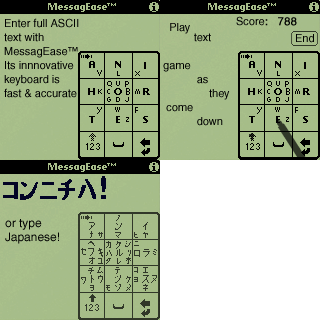
Messagease PDA text entry

I just discovered Messagease, a superior system for entering text on a Palm device (freeware). It’s intuitive, that’s to say, it works although I haven’t read the instructions yet.

7167.gif

The system is a grid as for noughts and crosses, containing these letters:
A N I
H O R
T E S
123 space

These are the most frequently used letters and you tap the square to enter them. For other letters, you stroke the square outwards: for instance, around the O are smaller letters:
q u p
c O b
g d j

On the 123 square you can switch to a numbers keypad.

You have to copy the text into memory and paste into another application.

I discovered this in the comments on Philip Greenspun’s weblog, where he reports his Handspring Treo has died and wonders whether to get a Pocket PC. The comments are worth reading. I suspect the best advice comes from those who advise ‘neither’. I don’t use a PDA much, but it’s very useful if I am away for a while.

The program was recommended by Ted Marcus. Continue reading