
‘Impressum’ in English revisited

(LATER NOTE, added in June 2004: I would translate Impressum as ‘Legal notice’, or at a pinch as ‘Contact us’ or some such. A Google search on “legal notice” site:uk reveals many examples).

In an earlier entry I mentioned this problem: the German word Impressum, referring to the details web site owners are required to quote on their sites, is often mistranslated (e.g. as imprint or masthead).

A German translator asked on a mailing list what the English equivalent is, since the Impressum is required under EU law.

In England and Wales, the Electronic Commerce Directive (00/31/EC) was implemented by the Electronic Commerce (EC Directive) Regulations. I quote those:

General information to be provided by a person providing an information society service
6. – (1) A person providing an information society service shall make available to the recipient of the service and any relevant enforcement authority, in a form and manner which is easily, directly and permanently accessible, the following information –

(a) the name of the service provider;

(b) the geographic address at which the service provider is established;

(c) the details of the service provider, including his electronic mail address, which make it possible to contact him rapidly and communicate with him in a direct and effective manner;

(d) where the service provider is registered in a trade or similar register available to the public, details of the register in which the service provider is entered and his registration number, or equivalent means of identification in that register;

(e) where the provision of the service is subject to an authorisation scheme, the particulars of the relevant supervisory authority;

(f) where the service provider exercises a regulated profession –

(i) the details of any professional body or similar institution with which the service provider is registered;

(ii) his professional title and the member State where that title has been granted;

(iii) a reference to the professional rules applicable to the service provider in the member State of establishment and the means to access them; and

(g) where the service provider undertakes an activity that is subject to value added tax, the identification number referred to in Article 22(1) of the sixth Council Directive 77/388/EEC of 17 May 1977 on the harmonisation of the laws of the member States relating to turnover taxes – Common system of value added tax: uniform basis of assessment[13].

(2) Where a person providing an information society service refers to prices, these shall be indicated clearly and unambiguously and, in particular, shall indicate whether they are inclusive of tax and delivery costs.

So the only word is ‘information’.

The word Information is also used in Austria. Here’s an example on an Austrian translators’ web site.

Every bit as detailed as the German, but no Impressum as far as the eye can see.

ADDED LATER: I did conclude after this that the word ‘information’ alone would not do in English and I would use ‘Contact information’. Klaus points out in the comments that the word ‘Impressum’ is widely used in Austria, if not in the law (I seem to have hit on an unusual website, which says ‘Informationen gemäß § 5 Abs. 1 E-Commerce Gesetz’, rather heavy for most purposes. Incidentally, it gives this information on the page labelled ‘Home’). – The word ‘Impressum’ probably isn’t in the German law either – I haven’t checked where it comes from.
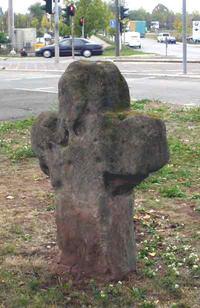

Medieval cross of expiation/Sühnekreuz

I don’t know what to call this in English.

It isn’t a wayside or roadside cross, put there for pilgrims, but a relic of an old practice before criminal offences were recognized as punishable by the state. There are several of these crosses in Franconia and further afield, and a Google image search will show more.

I photographed this today on the last day of guided tours of Fürth by the Stadtheimatpflegerin Barbara Ohm, who is retiring from her honorary position (it entails encouraging knowledge of local history and traditions). Unfortunately she seems to have cleared her website too. I can recommend the books ‘Durch Fürth geführt’, with guided walks and pictures.

I don’t know what to believe about the cross. We heard that before 1532, when Emperor Charles V introduced a system of law where criminal offences were punished by the state, voluntary manslaughter (Totschlag) was dealt with privately, by a contract between the killer and the family of the deceased. The killer had to pay the funeral expenses, provide for the survivors, have masses read, set up one of these crosses near a public road so people can see it when they pass, and go on a pilgrimage. This had various advantages: it avoids revenge killings, and the killer can be reintegrated into society when he comes back from his pilgrimage.

Another source is a book called Justiz in alter Zeit, published in German and English (Criminal Justice through the Ages) by the Kriminalmuseum in Rothenburg ob der Tauber (site, and museum, have German, English and Japanese texts). The book shows interesting pictures, especially for those interested in forms of punishment and torture (like me). The English version is shorter, and I found these crosses in the German version. It says that under old Germanic law, voluntary manslaughter was expiated by wergeld (OED: In ancient Teutonic and Old English law, the price set upon a man according to his rank, paid by way of compensation or fine in cases of homicide and certain other crimes to free the offender from further obligation or punishment). The introduction of christianity introduced the idea of penance. This book says that in order for a killer to be obliged to submit to this process of expiation or penance, there had to be a functioning court system, so the king ensured that every six weeks there was a ‘genuine thing’ (echtes Thing) lasting three days. There were sometimes other things, and a judge (often called a Thungin!).

So I don’t know if these crosses were private, but I suppose the consequences were between the private parties.

This was a walk through Unterfarrnbach, rather wet, with rural episodes.

Nigerian Connection man arrested in Berlin

From Schockwellenreiter via AdvobLAWg: here is a link to the German-language press release from the Berlin police President, of 9th October, which I quote in summarized form:

bq. A 28-year-old Nigerian had 50,000 euros confiscated by the customs when he entered Germany from Switzerland recently. This was done because the man was receiving state welfare assistance and it wasn’t clear how he came to have the money. On the afternoon of 8th October, he went to the police in Berlin to reclaim the money.

bq. During the questioning, he gave his address, and a search of his flat in Friedrichshain was immediately carried out. The investigators found a large number of indications that he was involved in a large-scale fraud.

bq. The Nigerian, according to present knowledge, told at least 30 people from various countries that he wanted to have large amounts of money taken out of Africa. He promised his victims about 30% of the sums (which amounted to many millions of dollars) if they would remit to him money for fees, transport and deposit of the sums with security firms. All this was done by cashless transfer, so there was no personal contact with him. As far as is known, he used a fake South African passport to collect the money. To keep his victims happy, he sometimes sent them fake cheques. In the few cases where there was personal contact, he took large sums of money from his victims for a chemical. He claimed that the money had been coloured black to disguise it for transport, and this chemical would remove the colour. One victim from Bavaria alone (oh dear!) transferred over 200,000 euros to memebers of the Nigerian Connection from 1995 on.

bq. This Nigerian is part of a world-wide network that causes damage in the amount of many billions (i.e. thousands of millions) of euros every year. He already has a conviction for fraudulent transfer (Überweisungsbetrug) and is receiving unemployment benefit. He will be brought before a judge today (that is 9th October) for an arrest warrant/committal order.

Here is a humorous site on replying to the Nigerians.

German laws in English translation

At Carob, Robin Stocks has uploaded a huge list of links to German laws (i.e. both statutes and delegated legislation) in English translation. It is most impressive. Carob seems like a weblog to me, but Robin says he isn’t sure. Anyway, it has no possibility to leave comments, so let me just say here I think it’s fantastic.