IATE central EU terminology project

I’m recording this for my own interest. Last November, a message on the Usenet group sci.lang.translation mentioned the test version of a projected centralized terminology database for the EU, called IATE or Inter-Agency Terminology Exchange. Here is more information.

At that time it was said that IATE would probably be going live in March, at which time the database would be moved elsewhere before going live. But it seems not to have moved yet.

To access the database, go to this site, and use the Username w0300005 and Password w03005.

I had a quick look at Vertragsstrafe, and it wasn’t particularly helpful. There’s a general recommendation to translate this into English as liquidated damages see earlier entry) – also being discussed on ProZ at present.

Translating German contracts into English

Someone wrote to me recently asking for advice and book recommendations for starting to translate contracts DE>EN. I wrote back to say I would probably blog it, and now I can’t find the email, nor my reply. The reason I wanted to blog it was to save myself typing in future, but it’s a big field and there’s no special advice here.

Procedure:

Understand the original contract. That might mean reading the Civil Code or some other statutes, or getting information from Creifelds Rechtswörterbuch or a book on standard-form contracts with footnotes. I’ve got some here, but they’re out of date so I’m not going to recommend one.

See if it’s from Germany, Austria or Switzerland. Is the translation going to a specific English-speaking country, or will it be read by all and sundry in Germany who understand English?

Make sure it says it is governed by German law, and that the German-language version is binding. Converting a German contract into a contract under English or any other legal system is work for lawyers. Even if you’re insured, you’re probably not insured for practising law without a licence.

You can use one of the standard bilingual law dictionaries, but you can’t trust it. You need monolingual German and English references to decide which alternative, if any, to use.

Translate the contract, conveying the meaning of the German in English appropriate in a written style (neither colloquial and slangy, nor pompous and outmoded). Don’t translate word for word, but keep close to the original.

If you want to use the kind of standard-form phrases (boilerplate) used in English or American contracts, you must know what you’re doing. Often, standard expressions will be phrased differently from the original and you need to be certain they have the same meaning as the German before you use them. Continue reading

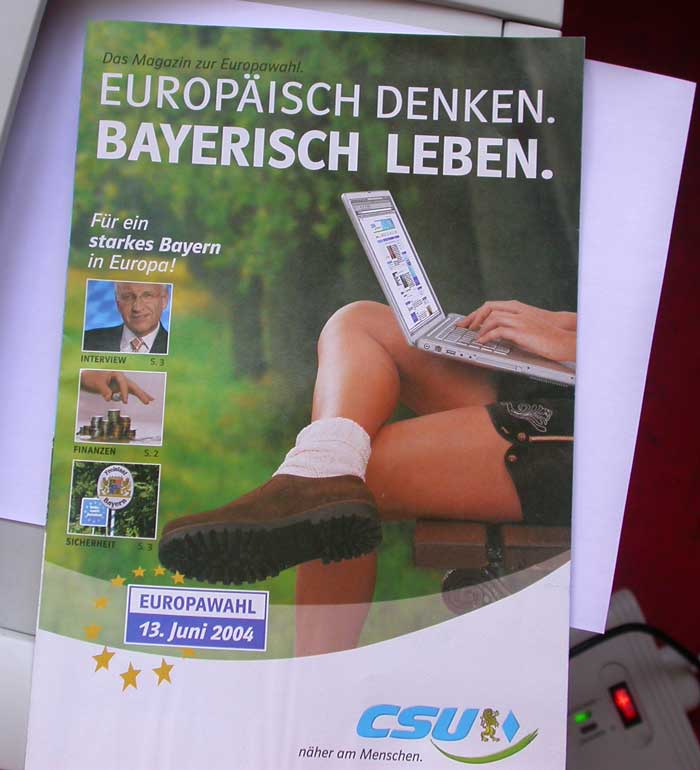
CSU EU election leaflet/CSU-Werbung für EU-Wahl

This leaflet was in my newspaper today (click to enlarge):

csu1w.jpg

(‘Think European – Live Bavarian’)
There are more here.

This is ridiculous. Real Bavarian women don’t shave their legs! (Or is it supposed to be a man?)

LATER NOTE: it’s been pointed out to me that the hands are rather big for a woman. I think it must have been a very young Bavarian, and even then there was a lot of retouching of the photo. I find the image mystifying: what is it telling us about Bavarians (fortunately I’m not in Bavaria proper).

Insurgents/Aufständische/WebCorp

There’s been an interesting discussion on the Forensic Linguistics mailing list about why the U.S. press reports about Iraq have for some time been using the term insurgents. This seems to be parallel to the German use of Aufständische, which had struck me. Was the term chosen for political reasons?

There are certain terms in international law with a specific meaning: insurgents are distinguished from belligerents.

Wikipedia thinks the term insurgent is hard to use without taking a political position.

Janet Cotterill recommended WebCorp, which searches the whole Web and produces concordances and collocates around a node search word of your choice. This is great. You can have it email you the results if you don’t want to hang around waiting. However, it doesn’t reveal much about insurgents at a cursory glance, except that many of them are Iraqi insurgents.

At all events, in international law there are subjects of law, such as nations, and belligerent and insurgent communities may sometimes be regarded as subjects of the law. To quote Brownlie, Principles of Public International Law:

bq. A subject of the law is an entity capable of possessing international rights and duties and having the capacity to maintain its rights by bringing international claims.

or Ignaz Seidl-Hohenveldern, Völkerrecht:

bq. Völkerrechtssubjekte sind diejenigen natürliche und juristischen Personen, auf die die im vorigen Abschnitt behandelten Völkerrechtsregeln … unmittelbar Anwendung finden, denen daraus also unmittelbar Rechte und/oder Pflichten erwachsen.

Belligerent communities seem to be in control of an area and some way further towards possible independence.

This (see sidebar) was also quoted, from Newsweek, May 24th, italics by me:

bq. PRISONERS OF WAR
Geneva III defines the rights of POWs, including not only captured armed forces, militias and resistance groups but civilian support staff. POWs can refuse to answer questions beyond name, rank and serial number and are guaranteed basic levels of humane treatment. Two 1977 protocols, not U.S.-signed, extend coverage to insurgents as long as they obey the laws of war.

Courts martial / Militärgerichte

Es geht um das Plural von court-martial (Militärgericht), normalerweise courts-martial, aber man sieht auch court-martials. The Discouraging Word ist nicht ganz glücklich, und die New York Times brachte am Sonntage beide Versionen.

The Discouraging Word, reading about Iraq courts-martial and also court-martials in the papers, wonders whether the plural has to be the former. The entry (May 18th) cites the standard dictionaries.

I will cite Garner’s Dictionary of Modern Legal Usage.

It says that court-martial is hyphenated both as noun and as verb. ‘The OED lists the verb as colloquial, an observation now antiquated.’

bq. In order texts, the term is sometimes rendered martial court – e.g.: “[A] martial court must needs in the present case confine its attention to the blow’s consequence ….” Hermann Melville, Billy Budd.

There is also an entry on what are called post-positive adjectives:

accounts payable
accounts receivable
act malum in se
annuity certain
appearance corporal
attorney general
body corporate
body politic
brief amicus curiae
chattels personal
chattels real
condition precedent
condition subsequent
corporation de facto
corporation de jure
court martial [where’s the hyphen gone?]
date certain
decree absolute
easement appurtenant
fee simple
fee simple defeasible
fee simple determinable
fee tail
gap certain
heir apparent
law merchant
letters patent
letters rogatory (U.S.)
letters testamentary
notary public
offense mala prohibita
parties defendant
parties litigant
postmaster general
president-elect
queen regent (or regnant)
secretary general
sum certain
sum total
twelve men good and true

I also thought of Governor General, who represents the Queen as head of state in former commonwealth countries that do not want to have their own president. Or something like that.