Swearing a translation / Bestätigungsvermerk

Sworn and/or certified translators in Germany are governed by the law of the individual Länder. In Bavaria, according to the Dolmetschergesetz, the form of words we place under a translation is prescribed.

bq. Als in Bayern öffentlich bestellter (bestellte) und allgemein beeidigter (beeidigte) Dolmetscher (Übersetzer, Dolmetscherin, Übersetzerin) für die … Sprache bestätige ich: Vorstehende Übersetzung der mir im … (Original, beglaubigter Abschrift, Fotokopie, usw.) vorgelegten, in … Sprache abgefassten Urkunde ist richtig und vollständig.

The wording has changed slightly over the years.

Apparently (I heard in Munich) the BDÜ was promoting a particular English translation of this wording a few years ago. It presumed a translation was headed (Auszugsweise) Beglaubigte Übersetzung (although many reject the term beglaubigen for a mere humble translator, as discussed ad nauseam elsewhere). Here it is:

bq. Certified Translation (in Excerpts)
In my capacity of a translator and interpreter for the English language duly registered and commissioned by and sworn to the State of Bavaria I hereby certify that the foregoing translation is a true and complete translation of …. whereof the original/a copy/a fax copy has been submitted to me.
IN WITNESS WHEREOF I have hereunder set my hand and seal at …

I wonder if anyone uses this wording?

Seeing red / Dietl Lorenz CD-ROM

The new Dietl-Lorenz German – English CD-ROM is now out. It’s still under the Acolada interface. (Creifelds has its own interface and is really clunky).

Unfortunately, I can’t find a way to change the red colour that Beck Verlag seems to have taken as its trademark.

dietlw.jpg

I emailed Acolada (the link is given with the CD), and they sent me a small file to reduce the colour in part.

dietl2w.jpg

Advent calendar / Adventskalendar

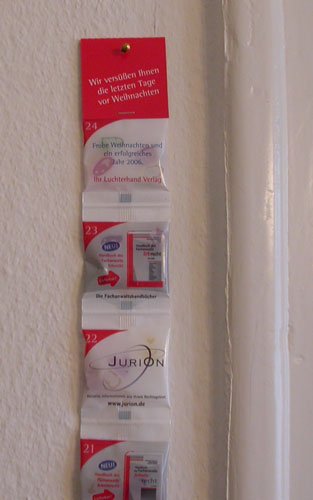
When I was about to pick up my update of the Dietl Lorenz CD-ROM at Büttner in Nuremberg, even before I asked for it, I was given this Luchterhand advent calendar with jelly (gummy) sweets in it.

lh1_20051129.jpg

They seemed to be hard to hang up in the bookshop, so anyone else thinking of going to a German law bookshop might considering scrounging one too.

I wanted to advertise a book by Luchterhand so I looked on my bookshelves and all I found at a glance was Jakoby/Kruse, Handbuch für Rechtsanwaltsgehilfen, and they don’t publish that any longer. Well, never mind, I will eat their sweeties anyway.

lh2_20051129.jpg

You say tomayto and I say tomato

At the legal translation seminar in Munich I learnt that people at the European Patent Office don’t mind whether they or I write trade mark or trademark. (I had learnt that trade mark is British and trademark is American – perhaps I’m too much affected by the neue deutsche Getrenntschreibung).

I also gathered that everybody always says patent as in cat (I will call that ‘short’), rather than paytent (I will call that ‘long’ – does the IPKAT, as a cat, do that too?). This is worrying, as I always use the long pronunciation, but persons close to the patent office only say that for patent-leather shoes.

Longman’s Pronunciation Dictionary (first edition) says the standard BrE pronunciation is the long one, and the standard AmE pronunciation is the short one. It also says that when the short A is used in BrE it is mainly restricted to technical use (which is the use I’m concerned with), and when the long A is used in AmE it is only in the sense of ‘open, obvious’ (as in the latent / patent contrast).

Collins English Dictionary has an equally long note to the same effect. It does say that even in the technical sense, the long A pronunciation is commoner in BrE. So am I not alone?