Kafka references by US courts/US-Gerichte und Kafka

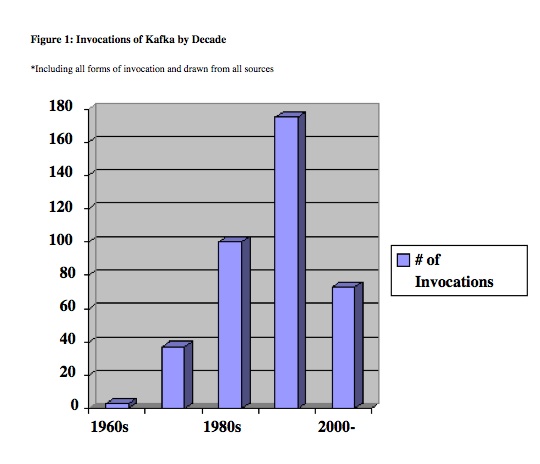
From Brian Pinaire: Invocations of Kafka in American Law: An Empirical Examination

In this paper, Brian Pinaire looks at American courts’ citations of Kafkaesque, or sometimes Kafka, Kafkan or Kafkian, especially prevalent in California, New York and Ohio. He classifies the references into invocations of authority, absurdity or predicament.

Some examples of the last category concern those without (adequate) language assistance.

…the case of Mtumbo Balinka. Kafka could not have written it better.
A Sudanese immigrant arrested on misdemeanor charges, Balinka was first sent to
Riker’s Island. Fearing deportation and rape, he lost control and wept uncontrollably—a
not irrational response, for which he was sent to a mental hospital. There he stayed for a
longer period of time than he would have had he simply been found guilty of the
misdemeanor charges. In part, this was due to the fact that he had the double misfortune
of barely speaking English, and then being examined in prison by the state’s
psychiatrist—a Korean immigrant who spoke the language even less well. Dr. Wong
noted in the patient chart that Balinka “has delusions of arriving at the hospital by train.”
In fact, what he’d said was, “Doc, I was railroaded here.” Woychuk notes dryly: “What
we had here was a failure to communicate” [emphasis added].

(I must admit the story sounds apocryphal – ‘railroaded’ suggests rather good English to me)

While I’m on this topic, let me return to something I’ve mentioned before. The Internet is full of references to a quotation allegedly by Kafka, for instance here:

“A lawyer is a person who writes a 10,000-word document and calls it a ‘brief.’” So said legendary author Franz Kafka, who happened to be an attorney himself.

This seems fishy to me. Can anyone pin down the original?

(Thanks to Brian Pinaire for permission to quote)

Domain change/Domainaufgabe

I am about to abandon the domain www.margaret-marks.com.
The weblog has long since been at https://transblawg.co.uk. Anyone who entered the old address was redirected.
I gather that not everyone has noticed the change, so I may lose some readers!

Die Domain www.margaret-marks.com wird bald nicht mehr funktionieren.
Das Weblog ist seit Oktober 2007 unter der URL https://transblawg.co.uk zu finden. Die alte Adresse leitete weiter.
Anscheinend war diese Änderung nicht allen Lesern klar, daher werde ich wohl ein paar Leser verlieren.

What I didn’t like about the domain name: firstly, it had the old-fashioned hyphen in the middle, and secondly, the email address was hard to dictate on the phone (scarcely any Germans can spell Margaret, which explains why I once went to New York without a credit card and was once in hospital with several dozen misprinted name labels).

Prosecution misspeaks through speech recognition software/Augsburger Arschloch leugnet Unterstellung der Staatsanwaltschaft

The Augsburger Allgemeine reports the case of the Augsburger charged with smuggling 180 Greek tortoises into Germany.

The public prosecutor’s office produced the following text in the indictment:

Dem angeschuldigten Arschloch ist ein Pflichtverteidiger zu bestellen.

(Defence counsel shall be assigned to the accused arsehole.)

This was apparently the result of speech recognition software and office incompetence. The error was corrected but the correction not properly saved to disc (I think it should simply have read ‘Dem Angeschuldigten’ (the accused).

Leitender Oberstaatsanwalt Reinhard Nemetz ist betroffen. Er spricht von einem “nicht akzeptablen” Fehlverhalten seiner Behörde. “Ich muss mich bei dem Bürger ausdrücklich und in aller Form entschuldigen”, sagte Nemetz am Montag unserer Zeitung. Der Behördenchef hat eine penible Überprüfung des Vorgangs angekündigt und betont: “Ich will wissen, wer dafür verantwortlich ist.”

The case has been stayed for witnesses to be summoned from abroad. The defendant has a previous tortoise-smuggling conviction, but denies the present charge.

I suppose it makes a change from blaming it on the interpreter.

(From Digital Diktieren – the speech recognition blog – which reports that Dragon Naturally Speaking contains such words in the new version, but some programs delete them).

‘Bad French’ in Ossetia/Übersetzungsprobleme in Ossetien

It appears from an article in the Telegraph that something went wrong with the translation of the Russia-Georgia ceasefire agreement from French into Russian.

Bernard Kouchner told a meeting of EU foreign ministers at the weekend that the ceasefire agreement was written in French before being translated into English and then Russian. Asked what problems surrounded the buffer zones, Mr Kouchner replied: “The translation, as always.”

The Russian version allegedly speaks of security ‘for’ South Ossetia and Abkhazia, whereas the English version speaks of security ‘in’ the two areas. There is no mention of a Georgian version.

The Telegraph seems to view the problem not as the translation, but as the very fact that the agreement was written in French. Hmm. If French speakers were involved, that doesn’t sound very convincing.

The farce is a huge blow to the French belief that theirs is a lingua franca, spoken and understood the world over.

In fact French has long been replaced by English as the language of diplomacy, and is becoming increasingly irrelevant to the international community.

It’s also hard to see what is the relevance of the Académie française objecting to ‘le weekend’ and ‘le parking’ in French.

LATER NOTE: Here’s a quote from an article in Le Monde:

Le ministre français des affaires étrangères Bernard Kouchner a confirmé samedi 5 septembre qu'”un problème de traduction” contribuait à des interprétations différentes, par les Russes et les Géorgiens, du plan de paix négocié le 12 août par le président Sarkozy. Il confirme ainsi ce qu’avait déjà indiqué, sous couvert de l’anonymat, un responsable russe, expliquant que “dans la version russe, le texte évoque la sécurité DE l’Abkhazie et DE l’Ossétie du Sud”, alors que “dans le document transmis à Saakachvili”, en version anglaise, “cela a été présenté comme EN Abkhazie et EN Ossétie du Sud”.

Thanks to Marc

Names in court decisions/Namen in Gerichtsentscheidungen

A recent article in the Toronto Star discusses whether the names of parties in administrative tribunal reports, and also in court case reports, should be anonymised.

But the power of the Internet is also raising privacy alarms. In a recent speech to the Canadian Bar Association, federal Privacy Commissioner Jennifer Stoddart raised concerns that “highly sensitive personal information” is making it onto the Internet in documents and rulings posted online by federal tribunals. “The open court rule, which is extremely historically important, has now become distorted by the effect of massive search engines,” Stoddart later told reporters.

Names are traditionally replaced by initials in German court reports. The concern for privacy seems to outweigh the public’s right to know. This is discussed comparatively at some length by Gerhard Knerr in a 2004 article, Die Namensnennung bei der Publikation gerichtlicher Entscheidungen

In der Bundesrepublik Deutschland wird der ganz überwiegende Teil der Gerichtsentscheidungen ohne die Nennung der in den Originalen enthaltenen Namen veröffentlicht. Mindestens seit den 70er Jahren erfolgt die Entscheidungspublikation durchgängig anonym. Allerdings gilt dies nicht ganz ohne Ausnahmen. So werden etwa die Namen Prominenter, insbesondere absoluter Personen der Zeitgeschichte, bis in die jüngste Zeit regelmäßig genannt. Eines der bekanntesten Beispiele sind die zahlreichen Entscheidungen bezüglich Caroline von Monaco.

In Germany, most court decisions are published without the names. Since at least the 1970s, there has been anonymity – but with exceptions, for example the names of famous people (Princess Caroline of Monaco is a well-known example).

Ganz anders sieht die Praxis der europäischen Gerichte, also des Europäischen Gerichtshofs (EuGH) und des Europäischen Gerichtshofs für Menschenrechte (EGMR), aus. Der EuGH veröffentlicht seine Entscheidungen in aller Regel unter voller Nennung der Namen aller Parteien und sonstigen Verfahrensbeteiligten sowie der Richter. Bekannte Beispiele sind etwa die Fälle Stauder (Ulm), Francovich und Keck. Nur ganz ausnahmsweise sieht der EuGH von einer Namensnennung ab, bisweilen jedoch nicht einmal dann, wenn die Entscheidungen Informationen aus der Privat- und Intimsphäre der Betroffenen beinhalten, etwa im Fall Lisa Jacqueline Grant gegen South-West Trains Ltd(. Auch der EGMR nennt von wenigen Ausnahmen abgesehen die Namen der Parteien, etwa in den Fällen Axen und Pretto.

The practice is different in the European Court of Justice and the European Court of Human rights. The parties are usually named.

Auch in anderen Staaten, insbesondere denen des angelsächsischen Rechtskreises, werden die Entscheidungen namentlich veröffentlicht und in späteren Rechtsstreitigkeiten und der Literatur nach den Namen der Parteien zitiert. Beispiele sind Erie R. R. v. Tompkins oder Carl-Zeiss-Stiftung v. Rayner & Keeler Ltd. Hiermit auch ein verfassungspolitischer Zweck verfolgt, nämlich die Kontrolle der Rechtsprechung durch die demokratische Öffentlichkeit. Nur in Ausnahmefällen werden die Parteinamen durch fiktive Bezeichnungen ersetzt, so in dem Abtreibungsfall “Roe v. Wade”.

Parties are usually named in other countries too, especially in the common-law jurisdictions. It’s very rare to use pseudonyms – this was done in the Roe v. Wade abortion case, for example.

This is sometimes a problem when one translates decisions. It can be useful to know the names, for example to work out which is a company or to determine if male or female, or to look up the case in the newspapers for more background. I can even recall a case where the judges’ names had been blacked out (I’m told this may be done in certain cases to protect the judge, for instance terrorism matters, but this wasn’t the case here). And I can remember being able to read the names when I held a fax against the light once, surprisingly.

(Thanks to Isabella)