Beerbikes banned/BierBikes in Düsseldorf verboten

Bierbikes hadn’t really registered with me until the city of Düsseldorf banned them recently and the order was confirmed by the Düsseldorf administrative court on October 6.

Meter für Meter schiebt sich das eigentümliche Gefährt über die Straße. An der Theke des “Bierbikes” ist die Stimmung prächtig, bei den genervten Autofahrern dahinter ist sie auf dem Tiefpunkt. Ob feuchtfröhlicher Junggesellenabschied oder umweltfreundliche Stadtrundfahrt: In immer mehr deutschen Städten rollen sogenannte Bier- oder Partybikes. Nun hat Düsseldorf die 16-Sitzer verboten: Kein Betrieb ohne Sondergenehmigung – und die werde nicht erteilt, so sieht es die Stadtverwaltung. Das Düsseldorfer Verwaltungsgericht gab ihr Recht (Az: 16 K 6710/09).

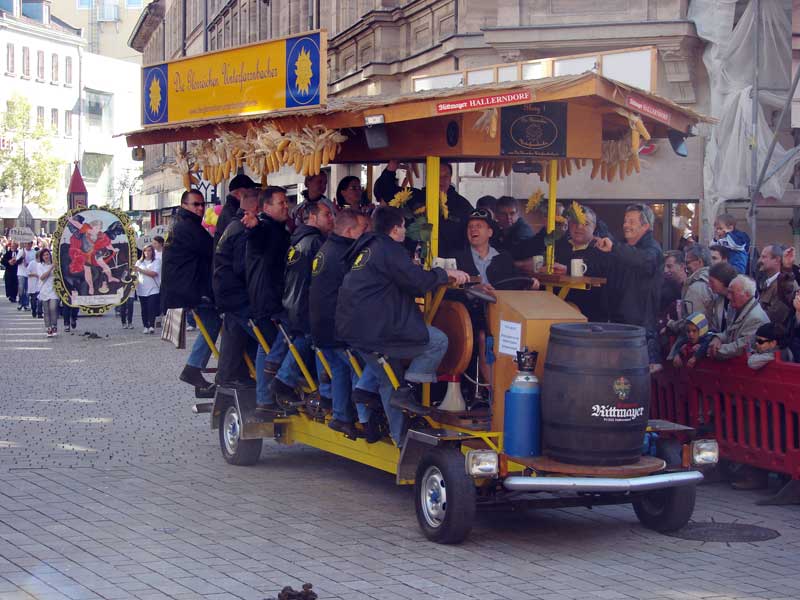
The judgment only affects Düsseldorf, and it is not yet final and non-appealable (rechtskräftig) there, so they can still be used. The idea is that one allegedly sober man steers the vehicle while up to sixteen sit along the sides, peddling – make that pedalling – and imbibing.

Here is a picture of one I took at the harvest festival procession yesterday (the following group represent the church of St. Michael):
The Guardian reported on the matter very promptly:

The bizarre contraptions hail from the Netherlands but are a particular hit in Germany, where they are offered to tourists in 34 different cities. Beer bikes, also known as “pedal pubs” or “mobile conference tables”, allow up to 16 drinkers to sit around a beer-barrel table, help themselves to on-tap beer, and listen to music while pedalling around the city. They are steered by a non-drinker employed by the operator. More than half of those who rent them are on stag parties.

The court in Düsseldorf issued the ban this morningafter complaints from other drivers about rowdiness. Complainants maintain that the bikes caused traffic jams, which intensified the longer a beer bike journey lasted – in effect, the more the revellers drank – and the more their pedal power tended to be reduced.

Changes at register office/Änderungen beim Standesamt

I wrote about the types of German birth certificate in 2005.

The practice of German register offices changed on January 1 2009.

Here is my earlier summary with the changes:

Geburtsschein (minimum details) – now gekürzte Geburtsurkunde
Geburtsurkunde (most details) – now Geburtsurkunde
Abstammungsurkunde (most details – including natural parents) – now beglaubigter Geburtsregisterausdruck

This shows that you can usually translate both Geburtsurkunde and Abstammungsurkunde as birth certificate, but there will be circumstances in which you need to distinguish them and can add ‘showing natural parents’.

Another problem I mentioned then was that some Geburtsurkunden say ‘mit der Abstammungsurkunde identisch’. This means that if you want to get married, you can use the certificate as evidence of your biological parents.

At least the translation is straightforward: we now have a short birth certificate, a (full) birth certificate (to use the UK terms) and a certified extract from the register of births.

There are more changes to the system. There is no longer a Familienbuch, but an Eheregister. I haven’t read these up in detail, but here is some information from Braunschweig.

Pencils/Bleistifte

This is a view of the Faber Castell pencil factory, or part of it, at Stein. I go through Stein most Fridays so this time I got out to take a picture.

The occasion for the picture is an article in the Economist in September, Faber-Castell:
The future of the pencil – An eight-generation family firm shows how innovation need never stop
.

Apparently it was Faber Castell that invented the hexagonal pencil, which won’t roll off the table, and various other things.

I got this from IPKAT, where Neil Wilkof is disturbed by the Economist’s claim that Faber Castell stole the idea of putting a rubber (that’s an eraser, for US readers) on a pencil (someone else had patented the idea, but the judge thought it was obvious).

What did The Economist mean by “stolen”? I mean, in today’s world, the bad guys, at least under one view of things, are the patent trolls, who are accused of seeking to enforce a patent solely for the purposed of extracting “unfair” rents from unsuspecting users of the patented invention. No one would go so far as to say that patent trolls are “stealing” from the third parties who agree to pay the troll a sum to settle. Be that as it may, the pejorative context of the patent troll is exactly the opposite from the Faber situation in the 1870’s. All that Faber apparently did was defend itself from an infringement claim by alleging that the patent was invalid. If that is theft, then virtually every defendant in a patent litigation action is candidate to be of a “thief”, if it succeeds in invalidating the patent at issue.

Meanwhile, for those who read German, have a look at Lexikaliker’s blog, mainly about pencils. Even if you don’t speak German, the photos are interesting.

Cattle egret/Kuhreiher/Bubulcus ibis

This is a bit of a cheat as I see it in Nuremberg Zoo, in an en closure that the public can go into, with ibis, black stork and spoonbill.

But they are beginning to breed in England, along with little egrets. I just wanted to link to this brilliant headline: Egrets? We’ve had a few, in the Independent (the yellowish-brown colouring is in the breeding season, apparently).