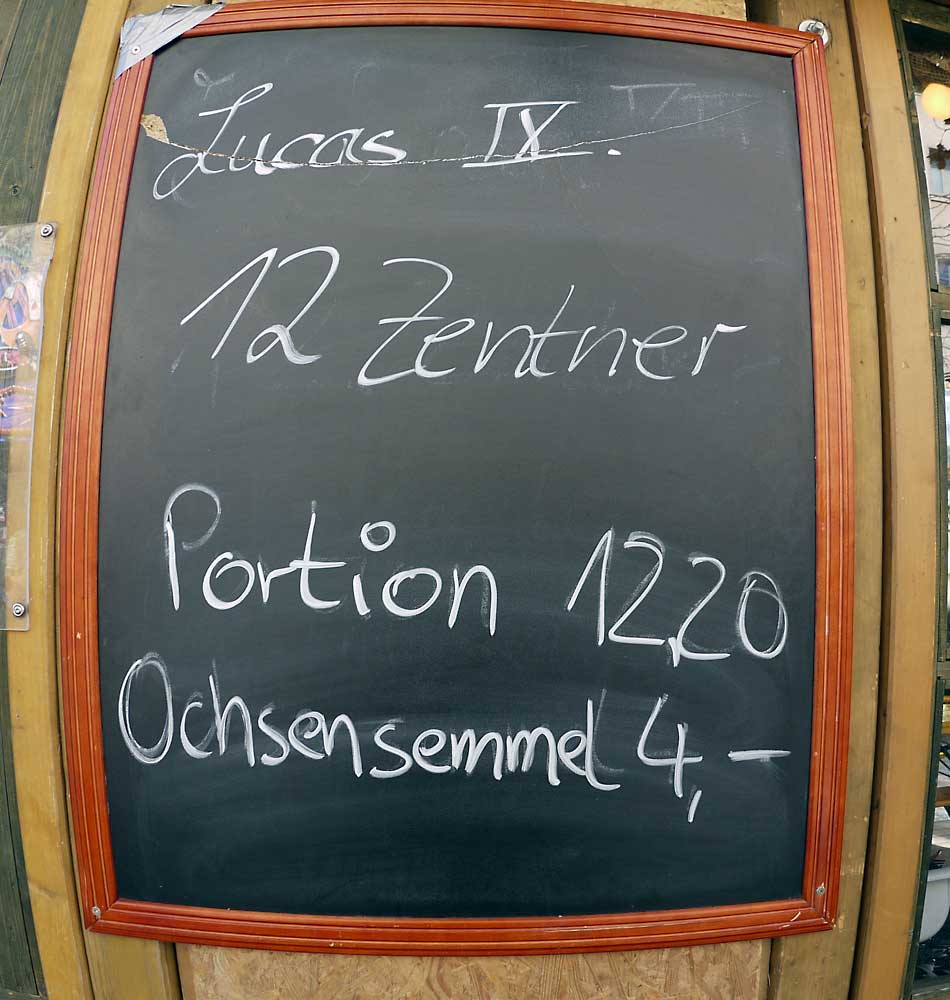
We always know the name of who we’re eating at the Kirchweih. Though this year they didn’t tell us his age.
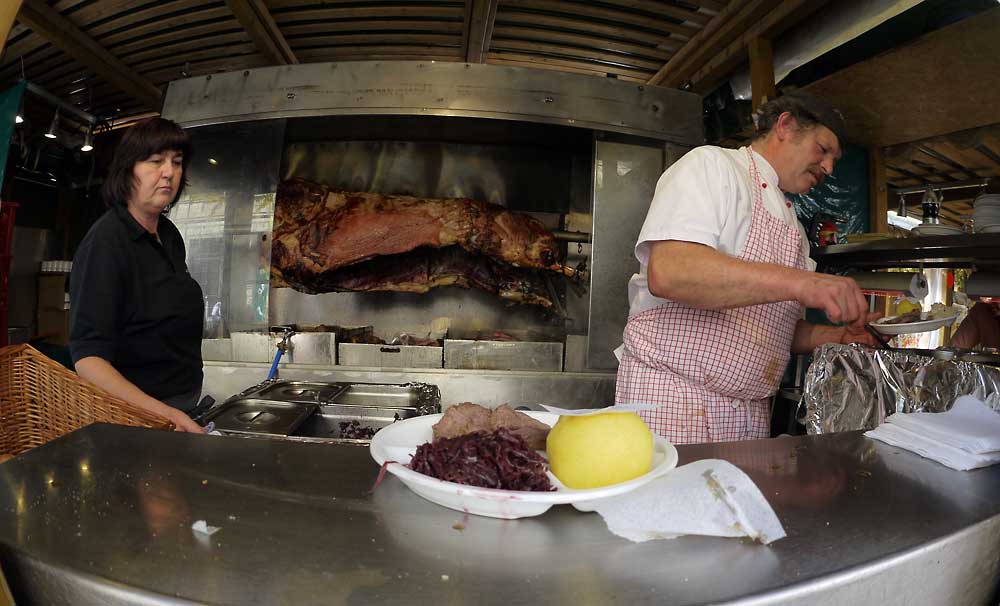
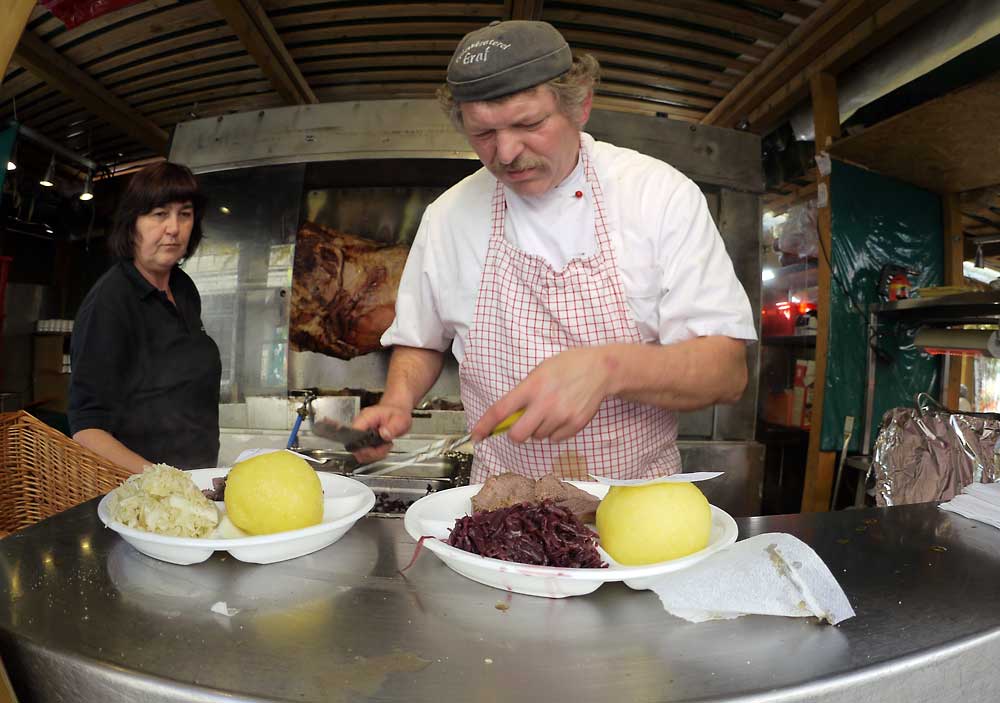

We always know the name of who we’re eating at the Kirchweih. Though this year they didn’t tell us his age.
The Art of Procrastination, by John Perry
I can’t remember who recommended this – I see it was on Lifehacker last week, but I didn’t see it then – anyway, it is a very amusing read. Here is a quote from the Structured Procrastination website:
Procrastinators seldom do absolutely nothing; they do marginally useful things, like gardening or sharpening pencils or making a diagram of how they will reorganize their files when they get around to it. Why does the procrastinator do these things? Because they are a way of not doing something more important. If all the procrastinator had left to do was to sharpen some pencils, no force on earth could get him do it. However, the procrastinator can be motivated to do difficult, timely and important tasks, as long as these tasks are a way of not doing something more important.
Structured procrastination means shaping the structure of the tasks one has to do in a way that exploits this fact. The list of tasks one has in mind will be ordered by importance. Tasks that seem most urgent and important are on top. But there are also worthwhile tasks to perform lower down on the list. Doing these tasks becomes a way of not doing the things higher up on the list. With this sort of appropriate task structure, the procrastinator becomes a useful citizen. Indeed, the procrastinator can even acquire, as I have, a reputation for getting a lot done.
This is from the essay Structured Procrastination, which won Perry (an emeritus philosophy professor) the Ig Nobel Prize.
Of course, my whole blog and internet postings are based on this system. I was a bit shocked a few weeks ago when a colleague offered me some fairly urgent work. She probably thought because I post so much on mailing lists that I didn’t have a huge amount of real work waiting for me.
In general English one might distinguish between:
in time: rechtzeitig
on time: pünktlich
If you arrange to record a TV programme at 9.00 a.m., you want to start recording on time – on the dot of nine.
If you have to do something by / before December 31, you need to do it in time – before the final date.
(I bought a jar which had the wording ‘Eat the contents until December 2014’ instead of ‘Eat the contents before December 2014’)
In legal texts, there are often deadlines, and the word rechtzeitig comes up for translation, both as an adverb and as an adjective.
In BrE I would say: in good time or within the prescribed period.
One also encounters, in AmE but also in BrE: in a timely manner. (timely is an adjective, not an adverb)
I’ve just been reminded of a word that works better grammatically if you need an adverb: timeously.
Laddie J … said that, at the end of the opposition period and in the absence of opposition, the Registrar was obliged to take steps timeously to place the mark on the register.
There’s a complex of further vocabulary here, for German Frist: a period of time but also a time limit / deadline. I believe deadline is regarded as more AmE usage, but I see no problem with using it. It’s probably more common in general usage than legal texts, though.
I must be almost the last person to discover the origin of the Made in Germany label. (At least it doesn’t suffer from spelling or translation mistakes like Made in Hungaria or Fabriqué en Dinde).
It was introduced in 1887 in the British Merchandise Marks Act (the link incorrectly describes it as ‘americana’). To combat a flood of imports, these were ordered to be labelled by their country of origin. ‘Made in Germany’ was meant to show people that these were not good British goods, but inferior foreign goods. However, the opposite effect was achieved, because ‘Made in Germany’ became a mark of quality. On www.ndr.de, Henry Rieck writes:
Ursprünglich handelte es sich bei dem Herkunftshinweis “Made in Germany” um eine Warnung. Er wurde von 125 Jahren in England erfunden, um die damals oft minderwertigen Waren aus Deutschland zu kennzeichnen. Doch schnell wurde die Qualität deutscher Produkte ausgesprochen gut. Und so wurde aus der Warnung ein “Gütesiegel”. Ab den 1970er-Jahren bis zur Wiedervereinigung wurde für Waren aus der Bundesrepublik die Kennzeichnung “Made in West Germany” und für Waren aus der DDR “Made in GDR” verwendet.
He goes on to remark on how many current ‘German’ products are largely made of imported materials.
This reminds me of the current complaints in the USA about ‘made in China’ (hm, my Honda was made in China).
Two Spiegel Online articles (in German) on how German products conquered the world.
Wikipedia (English) on Made in Germany.