Wikipedia on German law

The English Wikipedia deals with German law among other topics, and how it’s put into English might be of interest.

In mid-December, the daily article featured was on Paragraph/Section 175 of the German Criminal Code, which made homosexual acts illegal. It had been abolished in East Germany but was not abolished in West or united Germany till 1994. It was pointed out to me that some of the discussion dealt with translation into English.

Today, the featured article was on Henry VIII, who introduced the first legislation against homosexuality in England or any other ‘Germanic country’.

bq. Some have suggested that zoophilia was specifically included because of the fear of hybrid births.

The mooted translation relates to the version of June 28, 1935 and the problem term is “Unzucht treiben”, which replaced “widernatürlich Unzucht treiben”.

I can’t see a huge problem in comparison with other legal translation. If the change from the earlier version of the statute is important, there will have to be a translator’s note. It is suggested that

“…mit einem anderen Mann Unzucht treibt oder sich von ihm zur Unzucht missbrauchen lässt”.

is translated as:

“commits lewdness (as the active partner) with another man or allows such an abuse to be done to him”
or
“engages as the active or passive partner in lewdness with another man”.

Lister and Veth and Dietl give for Unzucht “sexual offence”, “illicit sexual act”, “illicit sexual practices”; Romain has, inter alia, “indecency, lewd acts, debauchery, fornication”. Von Beseler/Jacobs-Wüstefeld has a number of these too.

It’s interesting to see this on Wikipedia, partly because there’s evidence of some discussion on the translation. The references include a link to the German-language Wikipedia article. That adds the factoid that May 17th was sometimes called the gays’ holiday (17.5 / 175).

Here’s part of the discussion:

bq. Jmabel 07:04, Sep 9, 2004 (UTC)
I’ve written most parts of the German article and will review the English translation within the next few days (you’ve really done good work as far as I can see!). I’ve already corrected some slight mistakes. But I hope, you will check my corrections, too, with respect to linguistics, because I’m never sure if “one can say that in English”. One last question: Is it really necessary to provide so much German vocabulary in brackets? I don’t think, it necessarily helps understanding to know the legal terms in the original. –Amys 21:28, 9 Sep 2004 (UTC)

bq. I’ve kept them because legal terms don’t always line up exactly. If you are confident that the English term is a precise equivalent, feel free to delete the German. However, for example, I think it is absolutely necessary to include the discussion of Unsucht, on which so much turns, and I think honesty requires including the problematic Schutzhaft, which can be translated to two very different meanings in English, as we’ve discussed at Image talk:Gestapo anti-gay telex.jpg. It’s one thing for me to translate it as “preventive detention”, it’s another to hide the fact that I’m translating an ambiguous phrase. — Jmabel 23:55, Sep 9, 2004 (UTC)

I agree about the use of German terms in brackets.

There’s another interesting article on German legal citation. Goodness gracious, it even quotes me (a messy entry of mine on quoting statutes).

Spenden statt Böllern/Donations instead of fireworks

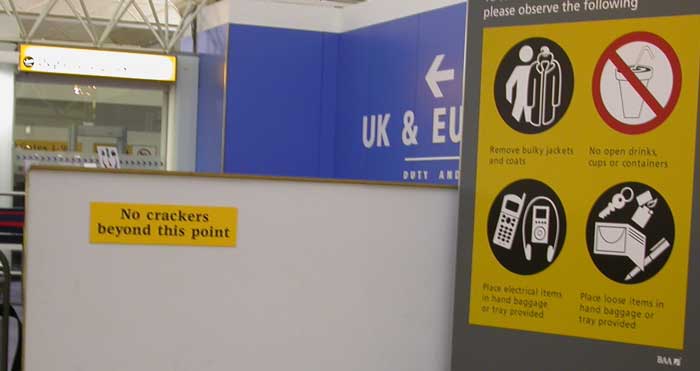
Photographed at London Stansted airport on December 28th:

crackersw.jpg

Does this mean fireworks? But surely they aren’t allowed on the other side either, most of the time?

A couple of days ago, Gerhard Schröder and Joschka Fischer suggested to the Germans that they should donate money to help those affected by the Asian tsunami instead of on fireworks: Spenden statt Böllern. Böller is a colloquial word for (noisy) fireworks); böllern usually means firing a gun noisily, but here it means letting off fireworks. Report:

bq. The German foreign minister, Joschka Fischer, and the Austrian chancellor, Wolfgang Schuessel, on Wednesday called on their citizens to donate to relief for the Asian disaster rather than spend money on traditional New Year’s fireworks.

After that it seemed as if letting off fireworks meant you hadn’t donated. And fireworks manufacturers are part of the economy too – why should they be the ones to lose sales? So some people are saying they’re doing both: ‘Böllern und Spenden – ich mache beides’.

Or you could have a silent festival of light like the one at Nankendorf:

bq. Traditionell gefeiert wird heute noch in einigen Regionen Deutschlands. In Nankendorf (Fränkische Schweiz) etwa ist Silvester das katholische Fest der ewigen Anbetung, das man mit einer Lichterprozession, brennenden Holzstößen, bengalischen Leuchtfeuern und elektrisch beleuchteten Kreuzen auf Berghängen begeht.

Is this Catholic festival related to the bonfires in Louisiana? Seemingly not, because that comes before Christmas.

Mind you, I just watch fireworks. No Bleigießen this year, only Bibelstechen.

Emac website now in comprehensible English

In Baden-Württemberg heißt es, “Wir können alles, nur kein Hochdeutsch”. Aber Englisch können sie auch nicht alle, und manche von ihnen haben vielleicht Schwierigkeiten, eine gute Übersetzung zu finden – da muss man sich aber nicht schämen, sondern bereit sein, Korrekturen zu machen.

In September, I reported on the Landesmedienzentrum Baden-Württemberg and the quality of the English on its website. From the Impressum:

bq. All rights lie with the Landesmedienzentrum Baden-Württemberg. As far as in the individual case in a different way regulated and untill foreign laws are not concerned, the spreading of the documents lying on this server is desired as a whole or in parts of it in electronic and printed form under the condition that the source (Landesmedienzentrum Baden-Württemberg) and the URL are named. Without previous written approval by the LMZ a commercial spreading of the documents lying on this server is strictly prohibited.

This now reads:

bq. All rights are owned by the Baden-Württemberg State Media Center. Unless otherwise agreed in individual cases, and provided that the rights of third parties are not affected, the distribution of the documents on this server is desired, in whole or in part, in electronic and printed form under the condition that the source (Baden-Württemberg State Media Center) and the URL are specified. Commercial distribution of the documents on this server is expressly prohibited without prior permission from the State Media Center.

How did this change come about? Well, for one thing, Sabine Lockner-Schadek, a professional translator on the pt mailing list at Yahoo groups, wrote an email to the Landesmedienzentrum pointing out the poor quality. She received a rather unfriendly email reply ans was asked not to bother the Director with this information. The site remained unchanged. Then Sabine wrote to the minister Frau Dr. Schavan, who was in charge of a ministry that provided some funding for the project. She was then informed that after her first approach, the LMZ had engaged an expert translation dcompany to do the corrections. The quality was described as being the result of text passages from drafts being wrongly put online. And the LMZ told the ministry it had informed Sabine of this change, which is apparently not true.

There has recently been a meeting of the European Broadcasting Union in Basle, and the LMZ would have made quite a fool of itself without Sabine Lockner-Schadek’s helpful comments. So let’s thank her here on behalf of the taxpayers of Baden-Württemberg at least.