Eurodicautom

The Frankfurt Rechtsanwaltskammer (chamber of lawyers) has recently given a link to Eurodicautom, describing it as follows:

Ein sehr nützliches Rechercheinstrument im Internet ist das interaktive Wörterbuch der EU zu allen EU-Begriffen. Es übersetzt aus jeder beliebig gewählten europäischen Ausgangssprache in jede beliebig gewählte Zielsprache.

A very useful research instrument in the Internet is the interactive EU dictionary on all EU terms. It translates from any chosen European source language into any chosen target language.

I find this a bit odd. When I first encountered Eurodicautom in the early nineties, I was warned it was a huge conglomeration of varying quality, not giving all languages. It was said it was put online free of charge because the vocabulary had begun to be collected (in the 1980s?) but no note of the source had been taken, so the EU couldn’t copyright it. I hardly ever use it – on the few occasions I might, I tend to forget it’s there – but some translators use it a lot, and its movings from place to place are keenly followed on mailing lists. I would not think of it as a database purely of EU terminology (if I understand that correctly), but of technological vocabulary too. It most certainly has its uses.

Of course it doesn’t have the latest EU languages, by the way.

I wondered how to describe Eurodicautom for someone who’d never seen it, and my search took me to Wikipedia, which has an entry. But what do I find? Just as thin a treatment as above. Of course it’s wrong to criticize Wikipedia without improving it, but I really am not the expert on this subject.

Eurodicautom is the terminology database of the European Union. There are web interfaces as gateways to this free service, allowing the translation of the EU-vocabulary between the official languages of the EU.

Incywincy has a better definition:

The European Commission’s multilingual term bank. Particularly rich in technical and specialized terminology related to European Union policy.

That’s right. It was the Commission that started it. And the specialized terminology is not so much just political, but about anything that EU policy may be about.

There are other terminology databases in the EU, and here is a useful article about them by Alistair Macphail. This article calls for a central EU terminology database to be set up. Eurodicautom is not it.

(Via Handakte WebLAWg)

Purity of German beer/Reinheitsgebot in Deutschland

s_a.gif

Bundesverwaltungsgerichtentscheidung zu Schwarzbier (Az. BVerwG 3 C 5.04).

The German Federal Administrative Court today decided that a German beer to which sugar was added can be called beer nonetheless. It overruled a decision of the Frankfurt an der Oder Administrative Court.

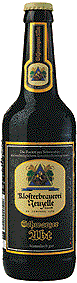
A brewery in Neuzelle applied ten years ago to market its ‘Schwarzer Abt’ (Black Abbot) as a beer. Traditionally, beer may contain only hops, malt, yeast and water. The brewery argued that special beers are permitted, and that there was discrimination against domestic firms, since under EU law beer brewed outside Germany can be sold as beer in Germany even if it doesn’t comply with the Reinheitsgebot (purity law). Apparently, however, the provision for special beers applies to herbs rather than sugar.

Schwarzer Abt is based on a traditional recipe and sweetened with sugar syrup.

LATER NOTE: Streitsache quotes Beck Aktuell, which gives a more detailed report.

The court said that the Reinheitsgebot does not protect health, but tradition and quality. It was necessary to be generous with exceptions. The Schwarzer Abt beer is brewed using malt. The sugar is added only after the brewing is complete. 2 – 3% sugar syrup is added. The beer is permitted as a special beer. And if the brewery is allowed to brew it, it must also be allowed to market it.

German legalese

In an earlier entry I linked to a site showing how to create a long German legal sentence. I believe that must have been a plagiarism, because jurabilis now quotes a file with that material in it as being by Oliver Elzer.

Elzer shows how to get from this:

Vielen Dank für Ihren Brief. Wir beantworten Ihre Fragen, sobald wir mit Herrn Müller darüber gesprochen haben.

to this:

Bezugnehmend auf das vorgenannte Schreiben möchten wir unseren Dank aussprechen. Die Unterfertigten werden in alsbaldiger Erledigung der darin aufgeworfenen interessanten Fragen umgehend auf diese Bezug nehmen, sobald unsererseits die unverzichtbare Rücksprache mit dem derzeit auf einer Reise befindlichen Mandanten gehalten werden konnte.

According to the comments, Elzer is very widely known among law students in Germany. There is a lot of useful material on his site, for instance on civil procedure.

Portuguese law blog portal/Portugiesisches Blog-Portal

Wahrscheinlich die weltgrößte Sammlung von Links an Lawblogs.

The Instituto Politécnico de Beja in Portugal has a portal (possibly the world’s largest) for legal weblogs in several languages. Here’s an entry page in English.

Deutsche Einführungsseite zur Site. Dieser Internetauftritt soll als Grundlage für Unterricht im WWW dienen.

Thanks to Professor Manuel David Masseno for the information.

In dubio pro reo: translation

New comment added and comments opened temporarily on an earlier entry:

On May 12 2004, I wrote an entry which now seems a complete mess to me. The springboard was the question, ‘Are the words “In dubio pro reo” (Im Zweifel für den Angeklagten) used in English?’, and the answer is ‘No’, because the Latin used in one legal system is often different from the Latin used in another legal system. It would be possible to make a list of Latin terms used in England, the USA, Germany, Austria and Switzerland (to name but a few), and I have a small collection of books from various jurisdictions for this purpose.

How to translate it into English? ‘Giving the defendant the benefit of the doubt’ seems a bit colloquial but certainly does the trick.

The conclusion of the entry was, or was meant to be, that the Latin words ‘in dubio pro reo’ are not used in English, nor can the principle of ‘in dubio pro reo’ be translated as ‘the presumption of innocence’.

I gave details of Google results on the term, and there was some discussion, in the comments too, about the myth among common lawyers that Continental Europe has no presumption of innocence (this point was originally mentioned by Clemens Kochinke in an article to which I refer).

The latest commenter takes issue with what he sees as the suggestion that common law is superior to civil law in this respect. What’s more worrying is that I didn’t think I or anybody else had actually said that! But perhaps the first comment did – it is rather cryptically worded.

If anyone wants to join the fray they should look at the original article and comments.