Survival of Australian English

Via Isabella Massardo, an article from the Sydney Morning Herald about the way Australian English resists U.S. influence, No fries with that, mate.

There’s a link to ABC Online’s Australian Word Map, which shows regional Australian expressions and indicates their spread on a map, with ten words of the month.

bq. A recent inclusion is “blue-tongue”, for small children (because toddlers are close to the ground, like blue-tongue lizards). That one comes from Tasmania. The Brisbane region contributes “desert chicken”, meaning corned beef. From the central coast of Queensland comes “muckadilla”, meaning a disorganised person. From the Sydney region comes the expression “YMCA dinner”, or leftovers (“Yesterday’s Muck Cooked Again”). And, when someone agrees to take part in an activity, they say they’re “thumbs in”.

Old Bush Vernacular will be used in The Aussie Bible, to be published in August (there is already a Cockney Bible).

Nuremberg War Crimes Trials materials

Via beSpacific, Harvard Law School Library runs the Nuremberg Trials Project,

bq. The Harvard Law School Library has approximately one million pages of documents relating to the trial of military and political leaders of Nazi Germany before the International Military Tribunal (IMT) and to the twelve trials of other accused war criminals before the United States Nuremberg Military Tribunals (NMT). …

bq. In this project only the English language trial documents and trial transcripts will be presented, but the evidence file documents are usually in both English and German.

German documents are online at the Oberlandesgericht Nürnberg.

Virtual tour of the Nazi party rally grounds in English or in German. A museum, the Dokumentationszentrum opened there in 2002.

Translating ‘Rechtsverordnung’ into English

In a recent comment, the term Rechtsverordnung was mentioned, and it reminded me of an article by Geoffrey Perrin, then of the Sprachendienst, Bundesministerium der Justiz, in an issue of Lebende Sprachen so long ago that the cover was still blue (LS No. 1/1988, pp. 17-18). It is one of the best things I have ever read on German-English legal translation. There was a later article on the vocabulary of juvenile crime and prosecution that was good too. I found Perrin translated the Nationality Act (Staatsangehörigkeitsgesetz) for Inter Nationes, who have published English versions of numerous statutes both on paper (I ordered some free of charge by post once) and online. This translation is also available at the German Law Archive.

The article takes the problems of translating the term Rechtsverordnung into English as examples of the problems of translating legal terminology in general. For a summary, see the continuation. Continue reading

Messagease PDA text entry

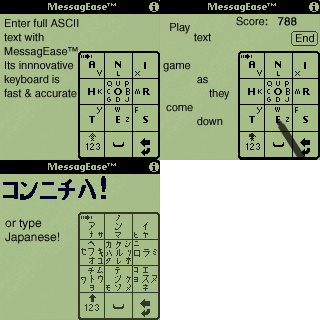
I just discovered Messagease, a superior system for entering text on a Palm device (freeware). It’s intuitive, that’s to say, it works although I haven’t read the instructions yet.

7167.gif

The system is a grid as for noughts and crosses, containing these letters:
A N I
H O R
T E S
123 space

These are the most frequently used letters and you tap the square to enter them. For other letters, you stroke the square outwards: for instance, around the O are smaller letters:
q u p
c O b
g d j

On the 123 square you can switch to a numbers keypad.

You have to copy the text into memory and paste into another application.

I discovered this in the comments on Philip Greenspun’s weblog, where he reports his Handspring Treo has died and wonders whether to get a Pocket PC. The comments are worth reading. I suspect the best advice comes from those who advise ‘neither’. I don’t use a PDA much, but it’s very useful if I am away for a while.

The program was recommended by Ted Marcus. Continue reading

Good Bye Lenin

The film ‘Good Bye Lenin’ (the space in ‘Good Bye’ must be the German spelling) opened in the UK on July 25th and there is a review in The Observer. Has it been dubbed or subtitled? There must have been a fair number of cultural references there. I remember that after awaking from her coma, the mother continues to compose complaints about ill-fitting mail-order clothes, but now they go to Otto Versand (unknown to her, since she believes the GDR still exists).

I enjoyed the film more than I thought I would. East Germany offers a lot of visual interest and makes me homesick for England in the 1950s. (I don’t think Sonnenallee was distributed for English-speaking audiences but there are clips at its website – the sort of site where you press Skip Intro and get the impression you didn’t skip it). My favourite part was the story that so many West Germans had grown tired of their consumerism and meaningless lives that they begged to be allowed into East Germany.

‘Translating’ court names DE>EN

Some basic notes as background to anything I record later (for instance, further notes on Austrian courts).

What is the purpose of the translation?
Who is going to read it?

1. If it’s just a newspaper article, the name of the German court may be irrelevant.
e.g. BBC News on Ryanair:

bq. A German court has ruled that the budget airline Ryanair cannot use the word “Duesseldorf” for an airport 70 kilometres (42 miles) from the city.
The court in Cologne said that Ryanair’s term “Niederrhein (Duesseldorf)” was deceptive advertising because the airport was too far from the city.

(It was a Landgericht, a court of first instance dealing with more serious matters).

But if the court is of any significance whatever, the German name should be quoted at least once.

(For further tactics, read on) Continue reading