German translators petition for protection of ‘Übersetzer’/Übersetzer, Dolmetscher suchen Schutz der Berufsbezeichnung

Jessica Antosik at the Übersetzerportal reports (in German) on a petition sent by young translators and interpreters to the Petitions Committee (Petitionsausschuss) of the German Bundestag. The Committee is a place people can complain to or petition, with a sort of ombudsman function.

The request was to protect the words Übersetzer, Dolmetscher and Sprachmittler. This would mean that the only people who could call themselves the equivalent of translator or interpreter would have to have some sort of training or pass some sort of exam.

This petition was developed on a social network called Xing, where there is more to read, and members can see more than I can. A representative of the BDÜ is there quoted as saying that if the petition had been granted, the effect would not have been as desired (more work for the petitioners?).

The Committee turned down the petition, inter alia because there is a trend towards encouraging occupations rather than restricting them.

The BDÜ wanted something like this for many years, but as far as I know doesn’t any longer. It amazes me that anyone would want this. I have not yet found that passing or failing a particular exam made anyone a good or bad translator. Do these people look at the many unqualified and incompetent translators and overlook the qualified and incompetent ones? whatever that means, since a translation may work without being brilliant. And presumably non-translators could still translate for money, so you could say ‘I had this translated not by a translator, but by a teacher’. (I have passed the Bavarian and Hesse translators’ exams and the Hesse interpreters’ exam, although I think I learnt more from teaching and online forums than anything else)

Wir, die gezeichneten Übersetzer und Dolmetscher der Bundesrepublik Deutschland, fordern den Schutz der oben genannten Berufsbezeichnung und deren weiterführenden Fachbezeichnungen. Als Qualifikation zur Ausübung der Berufe fordern wir ein abgeschlossenes (Fach-)Hochschulstudium oder eine abgeschlossene Ausbildung an einer anerkannten Ausbildungsstätte. Quereinsteiger sollen fortan ihre Sprach-, Fach- und Sachkompetenz durch entsprechende Nachweise oder eine qualifizierende Prüfung vor einer anerkannten Stelle (z. B. IHK oder staatliches Prüfungsamt) belegen. Sollte eine Person weder eine abgeschlossene Ausbildung noch eine qualifizierende Prüfung vorlegen können, darf sie nicht unter den Berufsbezeichnungen Übersetzer, Dolmetscher oder Sprachmittler tätig werden.

From the grounds:

Übersetzen und Dolmetschen ist mehr als die reine Übertragung in eine andere Sprache. Es erfordert sowohl linguistisches Wissen, stilistisches Feingefühl als auch die richtige und korrekt angewandte Technik des Übersetzen und Dolmetschens. Diese Kenntnisse erwirbt man nur durch eine qualifizierte mehrjährige Ausbildung.

Sorry, but show me someone straight from a university translation diploma course who has linguistic knowledge, stylistic sensitivity (in their mother tongue) and the right and properly applied techniques of translating and interpreting – it takes years of practice.

They also object to translators and interpreters working at very low rates, which they think is more common among unqualified people. But I think our economic system permits it. Personally, I would rather work as a cleaner than translate for peanuts – if only I were fitter, then I might even do some cleaning here.

Novelist and translators discuss/Autorin-Übersetzer-Gespräch in Straelen

The novelist (also lawyer, and daughter of a translator) Juli Zeh has been having a discussion with her translators at the Europäisches Übersetzer-Kollegium in Straelen. One can’t be sure whether the press got it right, but the Rheinische Post reports:

1. Chinese has no word for gesunder Menschenverstand (common sense). (One has one’s doubts):

“Man macht sich beim Schreiben keine Vorstellung davon, dass der Begriff des gesunden Menschenverstandes in anderen Sprachen nicht existiert”, sagt Juli Zeh. “Menschen können nur das denken, wofür es auch ein Wort gibt. Es fehlt nicht nur das Wort, es fehlt die ganze Idee dazu. Welt wird erst durch Sprache definiert.”

2. There are several terms for gesunder Menschenverstand in English. Juli Zeh prefers The Healthy Mind.

Doch die Auswahl an Übersetzungen für den Zeitungstitel “Gesunder Menschenverstand” ist groß: The Common Sense, The Healthy Mind oder Logic Dictates. “Mir gefällt The Healthy Mind” sagt Zeh. “Das passt zu meiner Idee.”

The healthy mind? Mens sana in corpore sano?

3. The novel (it was a play originally, I think) is called Corpus Delicti. The many legal terms are particularly hard to translate into other languages, so rponline quotes the Belgian translator Hilde Keteleer. She translates for Belgium and the Netherlands. In the Netherlands there are no Schöffen (lay judges). So she takes the Belgian term Hof van assisen and the Dutch will have to put up with it.

(Wikipedia says this Court of Assize consists of three judges with a jury of twelve, but that’s just by the way).

(via uepo.de)

Internet miscellany/Vermischtes aus dem Internet

1. The Guardian Books Blog invited readers to translate. See comments. A comment by smpugh:

Don’t let’s forget Ogden Nash, btw, who was once told by a lady at some event that she liked one of his books but preferred it in the French translation. “Yes”, he murmured, “my work does tend to lose something in the original”.

The entry links to Fitzgerald’s Rubaiyat of Omar Khayyam. I don’t suppose that is a close translation, but I did grow up with it as my mother was always quoting it, and I can picture the leather cover of the copy we had. It looks as if it was the first version.

Here with a Loaf of Bread beneath the Bough,
A Flask of Wine, a Loaf of Bread,–and Thou
Beside me singing in the Wilderness–
And Wilderness is Paradise enow!

(via Unprofessional Translation)

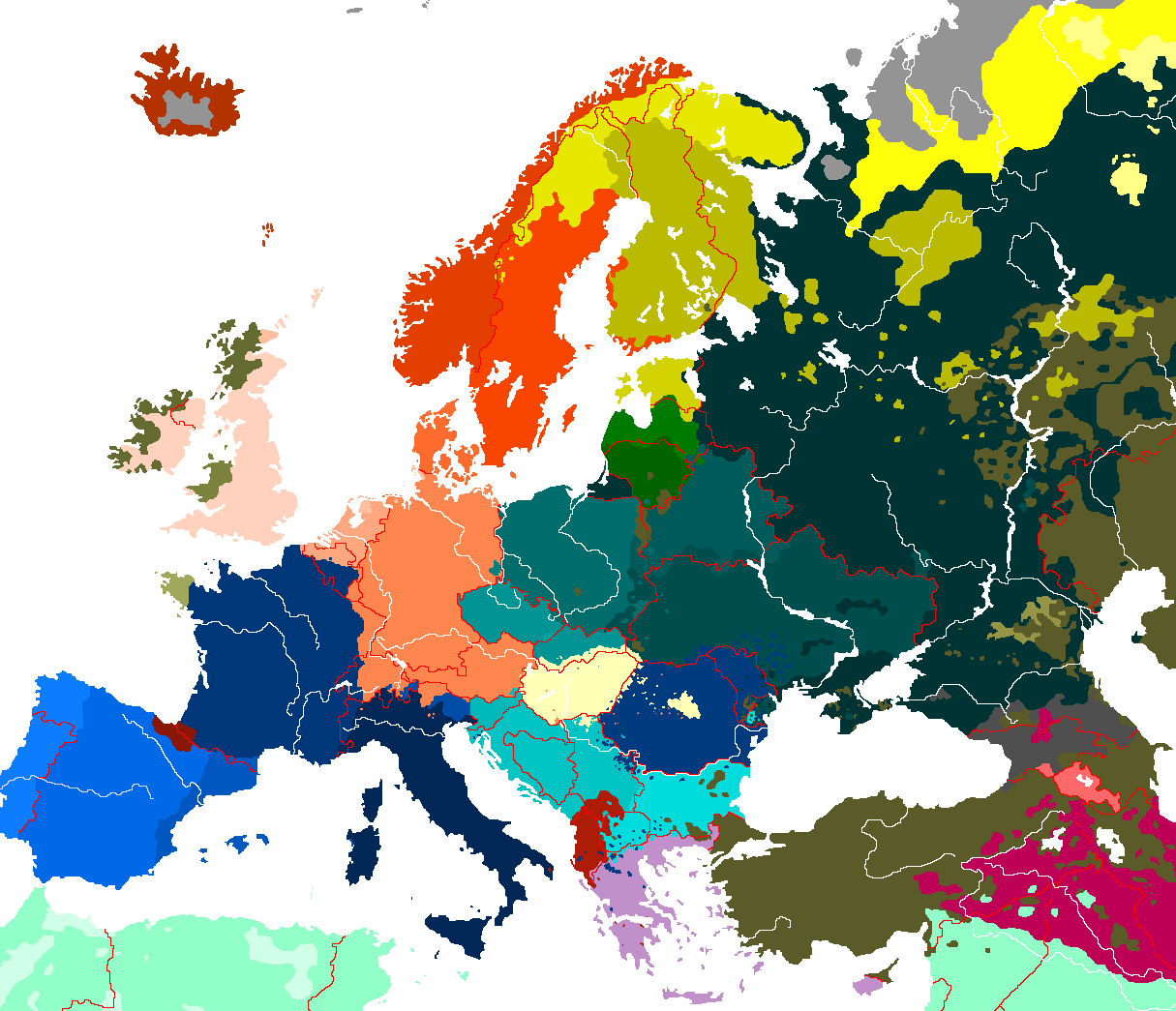
2. A map of the languages of Europe, on Wikimedia Commons (you need to see the large version). This was tweeted by Sarah Dillon from elsewhere, and was discussed on Siberian Light.

One amazing thing about this map is how no English is spoken in the whole of Ireland, in most of Wales, and in large parts of Scotland.

3. You can read the whole of the Tamara Drewe comic by Posy Simmonds, which was published in the Guardian, starting here. One of the narrators is ‘Dr. Glen Larson, translator (MFA, University of Arkansas, PhD, Columbia, currently Visiting Professor at London Medial University)
(via Baroque in Hackney)

4. Nevada Legislator Proposes Bill on How to Pronounce ‘Nevada’

Whereas there are two common pronunciations of the name of our great state:

(1) the provincial pronunciation utilized by approximately two-million Nevadans, using a flat A-sound — a sound not unlike the bleating of a sheep, and;

(2) the cosmopolitan or Spanish pronunciation used by the other seven-billion inhabitants
of our planet, using a soft “A” intonation—not unlike a sigh of contentment, and . . .

Whereas it is becoming a continuous, prodigious, and daunting task for the two million colloquial-speaking inhabitants to interrupt and correct the other seven-billion inhabitants of the Planet who utilize the Spanish/cosmopolitan pronunciation . . .

Therefore; be it resolved, that henceforth, there will be two acceptable pronunciations for the name of our great state:

(1) the preferred pronunciation will be the colloquial pronunciation, and;

(2) the less-preferred pronunciation will be the charitably-tolerated
Spanish/cosmopolitan pronunciation.

Cornish pasties and Euromyths/Euromythen wieder

Cornish pasties (note to Americans: nothing to do with nipple ornaments) are being considered by the EU. There has been an application for Protected Geographical Indication to request that only Cornish pasties made in Cornwall and to the traditional recipe, ingredients and manner are called Cornish pasties. It is not the EU, however, that defines a Cornish pasty, but the Cornish Pasty Association.

The Euromyths site now has a warning that the allegedly correct recipe is not, contrary to stories in the UK national press, dictated by the EU:

Contrary to news reports in the national press, the European Commission does not dictate ingredients or names of ingredients for products seeking EU quality recognition.

Products from the UK looking to get protected status prepare their applications stipulating the criteria, description and recipe of their food products. The EC evaluates the applications once they are revised by Defra. The EC provides the final approval on any particular product.

In the case of Cornish pasties, it was The Cornish Pasty Association who dictated the recipe and ingredients for the genuine Cornish Pasty. The Association has applied for Protected Geographical Indication to request that only Cornish pasties made in Cornwall and to the traditional recipe, ingredients and manner are called Cornish pasties.

A Google search soon reveals what they are talking about. BBC ‘Bogus “Cornish” pasties face ban’ (this one probably OK), ‘EU says Cornish pasties can’t contain carrots …’ (oohbrussels.wordpress.com), ‘Turnip or swede? Brussels rules on ingredients of Cornish pasty …’

On August 19, the Daily Telegraph reported on The turnips of Brussels, asking what is the difference between a turnip and a swede. Apparently the Cornish call swedes turnips:

It has proved one of the great culinary conundrums: what is the difference between a turnip and a swede? They are both members of the cabbage family, but the former is a small, white astringent vegetable, while the latter is large, yellowy-orange and sweeter-tasting. They should not be that difficult to tell apart. However, just to confuse matters, the Scots call swedes “neeps”, and the Cornish also insist that they are filling their pasties with turnips, when in fact they are swedes.

Who cares? Well, the European Commission does, because it needs to know the precise ingredients of the pasty in order to give it protected status. For it to be a genuine Cornish pasty, it must contain only one of these vegetables, or the wrath of Brussels will descend on some hapless cook. So listen up, this is very important: the turnip, for the purposes of the pasty, is a swede. Or is it the other way round?

For some sense, see Tabloid Watch.

Google Street View

As widely reported in Germany and abroad, it seems that a lot of vocal Germans hate the idea of Street View.

I must say I enjoy it – I like looking at places in the UK that I know, and that I don’t know.

It’s also been widely reported that some of the opponents of Street View have revealed more about themselves than had they done nothing – for example, there’s a photo of some of them outside their home! A picture can be seen here in a German-language NDR TV blog entry.

The first pro-Google account I remember was by Anatol Stefanowitsch on his Sprachblog. And there is a c’t Editorial too (also German – but I’m not sure if the content will remain at this link).

It’s been pointed out elsewhere that opponents of Street View are ignorant about what Google is doing and what is already done by other services. Germany had a minister of justice who didn’t know what a browser is, and the suggestions in recent years of protecting privacy on the internet have been worrying. Jeff Jarvis on BuzzMachine summarizes some of the issues.

Jarvis at one and the same time asks ‘What makes Germans go bonkers about Street View?’ and yet quotes several Germans who don’t. Our problem is some of the media and some of the politicians and how they define ‘Germany’ and ‘the USA’. It is a very fruitful row to hoe if one looks at media clichés about a country.

Yesterday, Jeff Jarvis tweeted some amusement at the German word Verpixelungsrecht (thanks to the ever mysterious Ed of Blawg Review), which probably looks odd to people who don’t know that German makes portmanteau words. Verpixeln is the normal German word for pixelate.

Amazing (new) German word in its privacy mania: Verpixelungsrecht: The right to be pixelated? http://bit.ly/d8vbPX

For genuinely odd German words, see Wortistik (a taz blog).

LATER NOTE: so much for my scorn – Wortistik has now posted an entry on Verpixelungsrecht as a snappier term for das Recht auf informationelle Selbstbestimmung, usually translated by me as the right to informational self-determination.

EU e-justice portal online/E-Justiz-Portal online

e-Justice Portal – hope I spelt that right. You can change the language, and you can look at topics for all EU Member States.#

For instance, if you click through to Legal professions and justice networks, and then further to legal professions, you get a general page on lawyers, but in the right margin you can click on the relevant flag, and see, for instance for UK, then England and Wales, under The Judiciary:

# Lords Justices of Appeal sit in the Court of Appeal, which deals with both criminal and civil cases.
# High court judges sit in the High Court, where the most complex civil cases are heard. They also hear the most serious and sensitive criminal cases in the Crown Court (for example, murder).
# Circuit judges normally hear criminal, civil and family cases.
# District judges deal with civil law cases. Most of their work is conducted in chambers (not in open court trials). They also have the power to try any action in a county court, with a sanction below a specified financial limit (which is reviewed from time to time): cases above the limit are generally heard by a circuit judge. District judges dispose of more than 80 percent of all contested civil litigation in England and Wales.
# District judges (magistrates’ courts) – formerly known as ‘stipendiary magistrates’. They sit in magistrates’ courts and deal with the types of cases dealt with by magistrates (see below). However, they assist particularly in cases dealing with lengthier and more complex matters.
# High court masters and registrars are procedural judges who deal with the majority of the civil business in the Chancery and Queen’s Bench divisions of the High Court.

Resetting the language (on the Home page) gives this:

# Lords Justices of Appeal (Richter am Court of Appeal): Sie beschäftigen sich am Court of Appeal mit straf- und zivilrechtlichen Fällen auf der Rechtsmittelinstanz.
# High Court Judges (Richter am High Court): Die Richter am High Court verhandeln schwierige Zivilsachen und übernehmen schwere und heikle Strafsachen des Crown Court, beispielsweise Mordfälle.
# Circuit Judges (vorsitzende Richter am Crown Court bzw. County Court): Sie verhandeln in der Regel Straf-, Zivil- und Familiensachen.
# District Judges (Richter am County Court): Sie sind mit Zivilsachen befasst. Ein Großteil ihrer Tätigkeit wird im richterlichen Dienstzimmer (nicht in öffentlichen Verhandlungen) verrichtet. Sie sind zur Verhandlung sämtlicher Fälle vor einem County Court berechtigt, solange deren Streitwert unter einer vorgeschriebenen, von Zeit zu Zeit angepassten Grenze liegt. Fälle, die diese Grenze überschreiten, werden im Allgemeinen von einem Circuit Judge verhandelt. Die District Judges erledigen über 80 % aller streitigen Zivilrechtsprozesse in England und Wales.
# District Judges (Richter am Magistrates’ Court): Die District Judges an Magistrates’ Courts (früher Stipendiary Magistrates genannt) verhandeln dieselben Fälle, wie sie auch von den dortigen Laienrichtern (siehe unten) verhandelt werden. Ihnen werden vor allem die etwas längeren und komplexeren Fälle übertragen.
# High Court Masters und Registrars (zuständig für Vorverfahren am High Court): Sie bearbeiten einen großen Teil der Zivilsachen, die in der Chancery Division und der Queen’s Bench Division des High Court im Vorverfahren anfallen.

I found it a bit odd that they don’t mention the Supreme Court justices, isn’t it? I know the House of Lords was always a separate institution, but still. It does say:

You can find information about the judiciary in England and Wales on the Judiciary of England and Wales website.

That link gives a 404 Page not found, but at least with further links. And here they are. This page also has nice links like ‘A day in the life of’, although again the justices are not represented there.

I had a look at the German and Austrian equivalent pages in English. Could be useful. Mind you, there is a stiffness about the English texts. And the terminology has to be taken with a pinch of salt – at one point they constantly refer to Länder courts etc., as I do, but the Webseiten der Justizministerien der Länder are rendered The various websites of the county ministers of justice. So one must hope that these versions are not given too much credence.