Ferdinand von Schirach, Der Fall Collini

(This post is a recreation of one that was originally dated 14.11.25 and was lost)

This novel was recently discussed online by the ITI GerNet book group run by Kate Sotejeff-Wilson. I did write a review of it for the ITI Netzblatt, but if anyone likes reading crime fiction, go ahead and try it. It is well paced and easy to read. From the start we know who the murderer was – the novel is about why Collini killed.
Spoilers may follow.

Schirach was a 45-year-old lawyer when he first published fiction. He wrote short real-crime stories, and he also created theatre productions with audience involvement. All were widely translated and globally successful. But this was his first novel.

The novel was well received in the UK and USA. Reviewers liked the plain style. (This huge success outside Germany as opposed to more complex treatment inside reminds me of the praise heaped on Jenny Erpenbeck’s Kairos).
But rather than repeating my own review and giving away most of the story, I am interested in two points which need not hold the reader up.

<!--nextpage-->

Change in German law
Firstly, the main focus of this novel was probably the 1968 German law that changed the time limits for prosecution of accessories to Third-Reich crimes. Suddenly, some time limits were reduced to 20 years, meaning that no prosecutions of these offences could be started later than 1965-ish. Thus, for example, if Italian partisans were killed by Germans as revenge, the only person guilty of murder was the person who ordered the killing; the actual killers were seen as accessories to murder and after twenty years had passed, they were now exempt from prosecution.
Unfortunately, it is not easy to embed this law in a crime novel.
And it would be good for readers first to have an overview of the approach of criminal law to Third-Reich atrocities from the very beginning. In both West Germany and East Germany.
The change in time limits is known as the Dreher-Gesetz, after Eduard Dreher, a former Nazi judge who was an official in the Justice Ministry. It was smuggled into a multi-purpose statute called Einführungsgesetz zum Gesetz über Ordnungswidrigkeiten (Introductory Act to the Act on Administrative Offences), which dealt with criminal offences too. It was mainly intended to decriminalize trivial offences, but in fact it also decriminalized some more serious ones.
This is the subparagraph (Absatz) inserted in 1968, as quoted at the end of the novel:

(2) Fehlen besondere persönliche Eigenschaften, Verhältnisse oder Umstände (besondere persönliche Merkmale), welche die Strafbarkeit des Täters begründen, beim Teilnehmer, so ist dessen Strafe nach den Vorschriften über die Bestrafung des Versuchs zu mildern.

In Andrea Bell’s translation:

2. If none of the special personal qualities, circumstances or conditions (special distinguishing features) forming grounds for the penal liability of the perpetrator of a crime are present in an accessory to it, then the accessory’s penalty is to be mitigated in line with the regulations on the penalty for an attempted crime.

The situation was more complex than stated here, in that the West German parliament was in the process of changing the law on limitation: this subparagraph undermined this process, though it was voted through by the Bundestag in 1968, its effect being downplayed or overlooked.

An excellent and full source of information is Bundeszentrale für politische Bildung – here is an article on this subject, Amnestie von NS-Tätern – Das “Dreher-Gesetz” von 1968.
An article by Richard A. Fuchs, Germany’s Justice Ministry and its Nazi past.
This refers to the Rosenburg files, the 2016 result of an investigation into the change of law initiated by Sabine Leutheusser-Schnarrenberger in 2012, the year after Der Fall Collini was published.

Translation difficulties

Comments on the English translation of the novel follow in the next post.


Even lawyers do not like legalese

Even lawyers do not like legal language according to this article.

I found the reference through a colleague who subscribes to Frankfurter Allgemeine Zeitung (thanks, Marisa!) and quoted this, from 31.05.2023:

Warum so kompliziert?

Von Sibylle Anderl

Wer Texte von Anwälten liest, ist hinterher selten schlauer. Die Motivation dahinter haben nun US-Forscher entschlüsselt.

Wie naiv die Vorstellung ist, menschliche Sprache diene stets dem möglichst reibungsfreien Austausch von Informationen zwischen Sender und Empfänger, illustriert wohl kaum etwas besser als die Ausdrucksweise von Juristen. Das Missverständnis, dem Leser solle im juristischen Schriftverkehr Verständnis ermöglicht werden, ist meist nach wenigen Worten vom Tisch. Die Gründe dafür sind gut erforscht: Der Trick liegt in der Kombination von Schachtelsätzen mit unüblichen Fachtermini. …

The article referred to appeared in PNAS: Even lawyers do not like legalese (paywall but I paid the $10). Here’s the abstract:

Across modern civilization, societal norms and rules are established and communicated largely in the form of written laws. Despite their prevalence and importance, legal documents have long been widely acknowledged to be difficult to understand for those who are required to comply with them (i.e., everyone). Why? Across two preregistered experiments, we evaluated five hypotheses for why lawyers write in a complex manner. Experiment 1 revealed that lawyers, like laypeople, were less able to recall and comprehend legal content drafted in a complex “legalese” register than content of equivalent meaning drafted in a simplified register. Experiment 2 revealed that lawyers rated simplified contracts as equally enforceable as legalese contracts, and rated simplified contracts as preferable to legalese contracts on several dimensions–including overall quality, appropriateness of style, and likelihood of being signed by a client. These results suggest that lawyers who write in a convoluted manner do so as a matter of convenience and tradition as opposed to an outright preference and that simplifying legal documents would be both tractable and beneficial for lawyers and nonlawyers alike.

The text types referred to are contracts and statutes (judgments and correspondence are my favourites though).

I wondered what the German Schachtelsätze referred to specifically. It seems the villain is the centre-embedded clause (“leading to long-distance syntactic dependencies”), which I hadn’t heard of but does seem similar to the convoluted German sentences.

The authors cited five hypotheses as to why lawyers write in a more complex manner than they themselves would prefer:

1. Curse of knowledge hypothesis – curse of knowledge is assuming other people know as much as you do and so failing to explain enough.

2. Copy-and-paste hypothesis – when you are putting a contract together, you use archaic clauses by copying them rather than amending or adapting them. I suppose that cut and paste predates word processing.

From Wikipedia:
The term “cut and paste” comes from the traditional practice in manuscript-editings whereby people would cut paragraphs from a page with scissors and paste them onto another page. This practice remained standard into the 1980s. Stationery stores sold “editing scissors” with blades long enough to cut an 8½”-wide page. The advent of photocopiers made the practice easier and more flexible.

I hadn’t heard of editing scissors, an exciting term.

3. In-Group signalling hypothesis: signalling to other lawyers that you’re part of the tribe, sounding more “lawyerly”.

4. It’s just business hypothesis: writing in a convoluted way to preserve your monopoly on legal services and justify your fees.

5. Complexity of information hypothesis: thinking that law is so complex that only complex language can do justice to it.

Most of these hypotheses are debunked in the article, but the copy-and-paste idea seems to stand up.It’s a problem for translators since you are translating for someone who doesn’t really understand what they wrote.

Here is an example of contract language in tradition legalese (left) and simpler language (right), highlighting the differences:
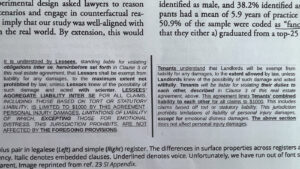
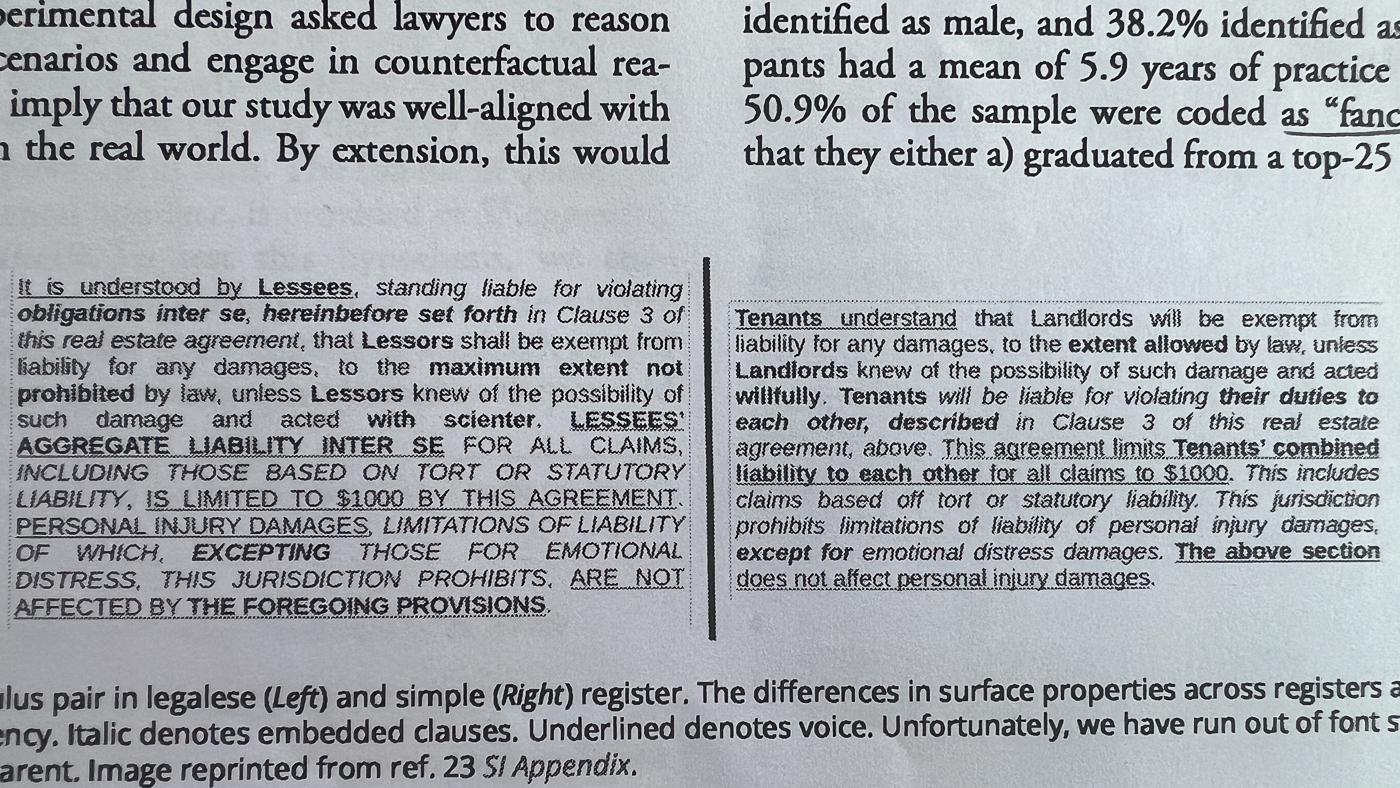
No participant saw those paired versions – the traditional and simpler versions did not match. There are details of how the study was recruited for and conducted. See the article for these. For example, in one experiment, 60% of participants identified as male, 38% as non-White. Lawyers were further categorized, for example 50% were coded as “fancy” lawyers, meaning that they either graduated from a top-25 law school according to US News and World report or worked at a top-200 law firm according to American Lawyer magazine.

How to translate numbers

Victor Dewsbery has added a post in his blog Language Mystery going into great (and alas necessary) detail on millions, milliards, billions, trillions etc.

Translating numbers: 1. How much is a billion?

This history of the number systems has also created “false friends” for translators. A German “Billion” is not the same as an English “billion”. The words “Trillion” and “Quadrillion” are also misleading. And a German “Milliarde” is not a “milliard”.

This much I remember, and I am very grateful to Victor for setting it out so well. Take a look around for other topics while you’re there.

Book recommendation: Triebel/Vogenauer, Englisch als Vertragssprache

Here is a strong recommendation for a book I have not yet read, only skimmed, myself. Unfortunately I have too many books on the go (rereading Die Emigranten and the Patrick Melrose novels, reading the Secret Barrister, Cotton on Photography as Contemporary Art and two books on literary theory, which we were only just dipping our toes into in the 60s and 70s, to say nothing of a translation of Willehalm and The Romance of the Three Kingdoms  – I can’t remember ever wanting to read so much and having so little time to do it).

Volker Triebel, Stefan Vogenaur, Englisch als Vertragssprache, Beck Verlag 2108

Thanks to Inge Noeninger for pointing it out on Twitter (note the bust of Goethe on her bookshelves – I only have Marx). I had waiting ages, from 1995 to 2012, for the new edition of Englisches Handels- und Wirtschaftsrecht, which was not quite appropriate to my direction of translation, and missed this one.

Please read the table of contents (PDF) via Beck Verlag. Scroll down to see it. The foreword is there too.

The book is intended for lawyers, not legal translators (whereas most of the more pedestrian Legal English books are always advertised to be suitable for translators, interpreters, lawyers and anyone else with a few euros to spare).

The first swection deals among other things with how lawyers actually learn English and how much they do both on LL.M. courses and in big international law firms. This is something I can’t remember reading anywhere else. There is also a bit on the niche role of German as a legal language. There is then a section on what can go wrong, both linguistically and semantically, and a section on problems of general English, followed by one on the special problems of the English language in contracts. Section 5 deals with problems in translating English contract terms into German, Section 6 with problems where the language and the legal system diverge, and section 7 advice on safer drafting. At the end is a bibliography in eight sections. There are indexes in both German and English.

Looking at the bibliographies, I have noted Christopher Hutton, Word Meaning and Legal Interpretation: An Introductory Guide, 2014, but perhaps I should not buy it until I have read this one, which warrants close examination and a large part of which is of direct interest to me. I know most of the books on legal English for non-English-speaking lawyers. I am quite ignorant of how much has been published on Auseinanderfallen von Vertragssprache und anwendbarem Recht – whenever I translate a contract into English, it is governed by German law, so my translation is just for information, and if anyone asked me to help draft a contract in English I would refuse as I’m not a practising lawyer – still, it is interesting, and I recognize some names, not just Triebel himself (several articles) but Suzanne Ballansat-Aebi, who has written well about legal translation, and Gerhard Dannemann.

I’m not sure I’m brainy enough to read Heikki Mattila on Comparative Legal Linguistics, translated from the Finnish, though the history of legal abbreviations is a big temptation, and another element of great interest to me is legal Latin, which varies from jurisdiction to jurisdiction so is part of what needs translating too. It’s a bit expensive even in Kindle, so I may be safe for the time being.

Draußen nur Kaninchen – miscellaneous

1.A thread on Twitter had English speakers recount their mistakes speaking German. Two of them had understood Kännchen Kaffee as Kaninchen Kaffee. Another remembered being in a restaurant and saying Die Reinigung bitte. There was also a request for Ein Glas Leistungswasser – no one mentioned that you would be looked at oddly in Germany even if you asked for Leitungswasser. There was a request for a Crevettenhalter. And someone used to nod to indicate she understood the other speaker even if she could not speak so well; later she replaced the nod by saying Ich verstecke.

2. The German American Law Journal (American edition) reports that a German court recently held that it is OK for tax purposes in Germany for invoices to be in electronic form. I still have two clients who want paper invoices rather than PDFs. Let’s see if this changes now. Invoicing Germany – AirMail or EMail

A customer had claimed a right of retention based on the alleged insufficiency of an emailed scan of an invoice, arguing that only the original could render the invoice due and payable. The Aachen District Court disagreed and on January 9, 2018 issued its de­cision under docket number 41 O 44/17, available in German from the North-Rhine-West­fa­lia justice portal. The court lists the applicable tax regulations as well as court de­ci­si­ons including a 2017 ruling by the Supreme Court for Tax Matters.