
You have to have lived here for a while before you can understand this kind of thing.

You have to have lived here for a while before you can understand this kind of thing.
I’ve added to the blogroll love german books, a weblog by a translator in Berlin. Good links to sites on German books, their translators, literary prizes and so on.
I mentioned Charlotte Roche’s bestseller Feuchtgebiete earlier. It’s now being translated into English as Wetlands, by Tim Mohr, who is apparently from New York and spent six years as a DJ in Berlin (for more, see the weblog love german books).
This was mentioned in two weblogs I follow, by Werner Siebers and Dirk Nolte, who both quote the Swiss source 20minuten.ch, which in turn quotes Bild.
Bild has a list of terms for which an English equivalent had to be invented. I’m not sure why Perlenrüssel (clitoris) should not become pearl trunk but snail tail. And Hahnenkämme for inner labia translated as dewlap – a term usually applied either to cattle or people with huge double chins – is extremely bizarre.
What really led me to add another entry to the heap, however, was this text on the Swiss site:
Und wo wir gerade beim anderen Geschlechtsteil sind: Das für die Vagina benutzte Wort «Perlenrüssel» wird zu «snail tail», was soviel wie Schneckenschwanz bedeutet. «Klingt gut und ist ein schönes Bild für die Klitoris», meint Mohr.
Do the Swiss not distinguish between vagina and clitoris? Or have I missed something in my education?
Granta interview with Charlotte Roche.
This advert for legal expenses insurance appeared in the print edition of Stern last week:

The small print says that Dr. Wolfgang P.J. Peters is one of 1800 attorneys who work on behalf of the insurance company. In fact, he can be seen online in video clips giving advice.
What I don’t understand is what the message is behind the photo of him, which might even be a photoshopped version of the picture on his website:

Does it mean they will help you if you break your glasses?
And judging from the plaster, it looks as if he was lucky not to break both lenses.
From the website Typography for Lawyers:
Some lessons on this website will involve discretionary choices. This one is mandatory.
You must always put exactly one space between sentences.
I understand that many people were taught early in life to double-space their sentences. I was too. But double-spacing is a habit held over from the typewriter age. It has never been part of standard typography. Because typewriter fonts were unusually proportioned, a double space helped set off sentences better. Today, since we don’t use typewriter fonts, double spaces aren’t necessary or desirable.
Let’s see that paragraph again, but with double spaces:
I understand that many people were taught early in life to double-space their sentences. I was too. But double-spacing is a habit held over from the typewriter age. It has never been part of standard typography. Because typewriter fonts were unusually proportioned, a double space helped set off sentences better. Today, since we don’t use typewriter fonts, double spaces aren’t necessary or desirable.
Do you see the problem? The extra spaces between sentences disrupt the overall balance of white space in the paragraph.
You have to look at the website to see the difference!
(Via the (new) legal writer)
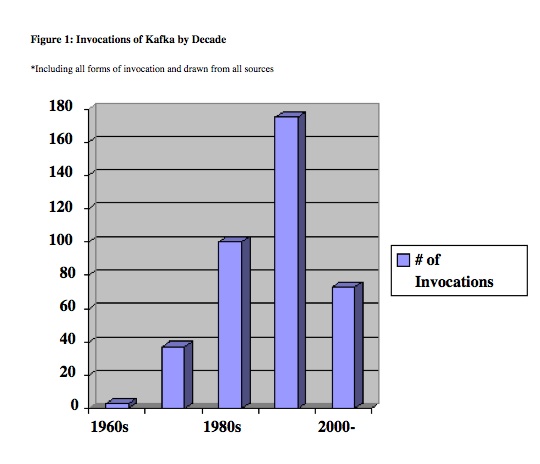
From Brian Pinaire: Invocations of Kafka in American Law: An Empirical Examination
In this paper, Brian Pinaire looks at American courts’ citations of Kafkaesque, or sometimes Kafka, Kafkan or Kafkian, especially prevalent in California, New York and Ohio. He classifies the references into invocations of authority, absurdity or predicament.
Some examples of the last category concern those without (adequate) language assistance.
…the case of Mtumbo Balinka. Kafka could not have written it better.
A Sudanese immigrant arrested on misdemeanor charges, Balinka was first sent to
Riker’s Island. Fearing deportation and rape, he lost control and wept uncontrollably—a
not irrational response, for which he was sent to a mental hospital. There he stayed for a
longer period of time than he would have had he simply been found guilty of the
misdemeanor charges. In part, this was due to the fact that he had the double misfortune
of barely speaking English, and then being examined in prison by the state’s
psychiatrist—a Korean immigrant who spoke the language even less well. Dr. Wong
noted in the patient chart that Balinka “has delusions of arriving at the hospital by train.”
In fact, what he’d said was, “Doc, I was railroaded here.” Woychuk notes dryly: “What
we had here was a failure to communicate” [emphasis added].
(I must admit the story sounds apocryphal – ‘railroaded’ suggests rather good English to me)
While I’m on this topic, let me return to something I’ve mentioned before. The Internet is full of references to a quotation allegedly by Kafka, for instance here:
“A lawyer is a person who writes a 10,000-word document and calls it a ‘brief.’” So said legendary author Franz Kafka, who happened to be an attorney himself.
This seems fishy to me. Can anyone pin down the original?
(Thanks to Brian Pinaire for permission to quote)