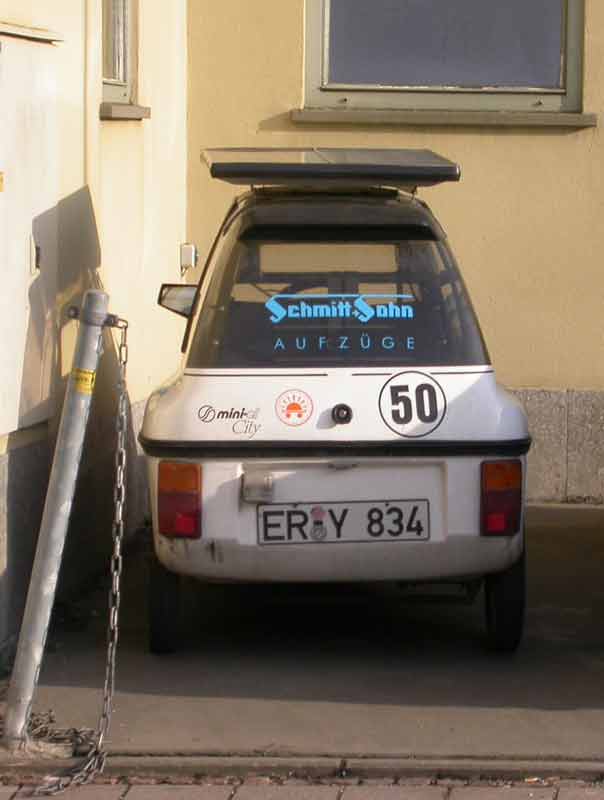
Solar-powered vehicle from Erlangen

schmitt1w.jpg

I’m not sure how this got here, nor what function it has other than to advertise lifts.

LATER NOTE: I photographed this on Friday February 20th, and I now see that the solar-power company solid had an open day on Saturday. Perhaps this vehicle had to make the long trip from Erlangen (20 kilometres or thereabouts) a day early?

Germans told to ‘brain up’/Verwirrende Anglizismen

Soeben erreicht mich folgendes (erschienen in der FAZ am 21.2.2004):

bq. Aus einem Leserbrief in der FAZ (von einem Prof. Dr. Dieter Mindt, Berlin):
“Bundesministerin Edelgard Bulmahn (studierte Anglistin) verkündet allenthalben: ‘Brain up! Deutschland sucht seine Spitzenuniversitäten.’ Eine Suche in großen Datenmengen des britischen und amerikanischen Englisch hat nur ein einziges Vorkommen der Verbindung von ‘brain’ mit ‘up’ ergeben. Die Fundstelle aus dem British National Corpus lautet: ‘He’s got no brain up here.'”

bq. From a reader’s letter to the Frankfurter Allgemeine Zeitung, from Professor Dr. Dieter Mindt, Berlin: ‘Federal Minister Edelgard Bulmahn (who studied English at university) is announcing everywhere: ‘Brain up! Deutschland sucht seine Spitzenuniversitäten.’ (‘[Incomprehensible English embellishment] German is looking for its top universities’). I searched British and U.S. English corpora and found only one example of “brain” together with “up”. It was in the British National Corpus and read: “He’s got no brain up here.”‘

Zur teilweise Entlastung der Ministerin: es gibt sehr wohl “brain up” im britischen Englisch. Collins English Dictionary gibt es im Sinne von ‘den Lehrplan geistig anspruchsvoller machen’, allerdings nur mit Objekt. Ich verstehe immer noch nicht, was Frau Bulmahn sagen will, kann es also nicht ins Englische übersetzen. Die Suche sollte aber nach ‘brain’ und ‘up’ mit ein paar Wörtern dazwischen sein.

Collins English Dictionary does give ‘brain up’: to make more intellectually demanding or sophisticated: We need to brain up the curriculum. However, it is a transitive verb and takes an object. So the minister’s use of the term is still quite mysterious.

I think I’ve come to this topic rather late: see ‘Brain up? Shut up!’

Incidentally, the reference to top universities relates to the current ideas about creating universities in Germany more like the Ivy League or Oxbridge, free to design their own programmes and funded privately.

Court decision on number of forenames/BVerfG-Entscheidung zur Zahl der Vornamen

The German Federal Court of Justice held on January 28th that there is a limit to the number of forenames (I can’t really call them first names, and Christian name is not PC) a child can have.

bq. Die Beschwerdeführerin hatte beim Standesamt erklärt, ihrem neugeborenen Sohn zwölf Vornamen geben zu wollen. Nachdem sie die Vornamen beziehungsweise deren Reihenfolge im Laufe des Verfahrens mehrmals geändert hatte, beantragte die Bf schließlich mit der Beschwerde, das Kind solle die Vornamen “Chenekwahow, Tecumseh, Migiskau, Kioma, Ernesto, Inti, Prithibi, Pathar, Chajara, Majim, Henriko und Alessandro” erhalten. Dabei sollte die von ihr gewählte Reihenfolge der Namen deren jeweilige Vorrangigkeit bei der Namensgebung zum Ausdruck bringen. Das Landgericht wies das Standesamt an, dem Kind die vier Vornamen “Chenekwahow, Tecumseh, Migiskau und Ernesto” beizuschreiben. Die Namenswahl dürfe nicht dem Kindeswohl widersprechen. Zwölf Vornamen hätten aber einen erheblich belästigenden Charakter für das Kind. Es müsste sich die richtige Reihenfolge und Schreibweise der größtenteils ungewöhnlichen Namen merken und würde durch diese immer wieder auffallen. Das weiter angerufene Oberlandesgericht (OLG) Düsseldorf änderte den Beschluss der Vorinstanz geringfügig dahingehend ab, dass dem Kind zusätzlich der Name „Kioma“ zu geben sei. Das OLG machte sich die Begründung des Landgerichts zu eigen und stellte zusätzlich darauf ab, dass die Selbstidentifikation des Kindes mit zunehmender Zahl seiner Vornamen nicht mehr gewährleistet sei. Mit ihrer dagegen gerichteten Verfassungsbeschwerde rügt die Bf die Verletzung ihrer Grundrechte unter anderem aus Art. 2 Abs. 1 und Art. 6 Abs. 2 Satz 1 GG.

bq. The complainant, at the registry office (after changing her mind about names and their order several times), wanted her son to have twelve forenames:
Chenekwahow, Tecumseh, Migiskau, Kioma, Ernesto, Inti, Prithibi, Pathar, Chajara, Majim, Henriko and Alessandro.

bq. The court admitted only four, on the grounds that the son would later be made fun of otherwise. The four names were Chenekwahow, Tecumseh, Migiskau and Ernesto, so he has a good chance of being made fun of anyway. The court of intermediate appeal added a further argument: the more names a child had, the less it could identify with them. So it allowed him one more name: Kioma.

Bad interpreting in Lost in Translation/Schlechtes Dolmetschen in Lost in Translation

The film ‘Lost in Translation’ has led to a discussion as to whether it is racist, for instance in German at [bov] (via Anke Gröner). Also at asianmediawatch and by Kiku Day in The Guardian.

Blogalization (iggy), however, cites the blog are you awake, which gives a translation of the Japanese when the Suntory ad is being made, the director speaks at length in Japanese and the interpreter translates only a few words. There are no subtitles to the Japanese, but it is very funny. Here’s a little bit:

bq. DIRECTOR (in Japanese to the interpreter): The translation is very
important, O.K.? The translation.

bq. INTERPRETER: Yes, of course. I understand.

bq. DIRECTOR: Mr. Bob-san. You are sitting quietly in your study. And then
there is a bottle of Suntory whiskey on top of the table. You
understand, right? With wholehearted feeling, slowly, look at the
camera, tenderly, and as if you are meeting old friends, say the
words. As if you are Bogie in “Casablanca,” saying, “Cheers to you
guys,” Suntory time!

bq. INTERPRETER: He wants you to turn, look in camera. O.K.?

I read that some people think this scene is hackneyed because the original speech is so long and the interpreting so short, but I don’t think every judge who has an interpreter in court would notice!

House of Lords debates judicial reforms /Oberhaus des britischen Parlaments bespricht Justizreform

On Thursday February 12th, there was a debate in the House of Lords (parliamentary chamber) on the proposed changes to the judicial system.

bq. The Secretary of State for Constitutional Affairs and Lord Chancellor (Lord Falconer of Thoroton) rose to move, That this House takes note of Her Majesty’s Government’s proposals for a United Kingdom Supreme Court, an independent Judicial Appointments Commission and the abolition of the office of Lord Chancellor.

Incidentally, the debate includes the maiden speech of Lord Cullen of Whitekirk, who was made a life peer in June 2003. As Lord Justice General, he is the chief judge of Scotland, a new one on me (but probably not to Adrian).

Frances Gibb, in The Times Online, in its law section (Tuesday, February 17th; registration should still be free of charge) summarizes the main points of dispute in an article entitled ‘Why wait 1,000 years and then rush the job?’

From the debate, Lord Lester of Herne Hill on appointing judges:

bq. It is also essential to avoid political patronage, or anything like the “advise and consent” system in the politically polarised Senate of the United States, in which, during Clinton’s presidency, the Republicans held up more than 60 nominees to the federal judiciary. As my noble friend Lord Goodhart has pointed out, the Government’s recent suggestion that the Supreme Court appointments commission will recommend a minimum of two and a maximum of five to the Secretary of State for Constitutional Affairs is unacceptable. In England and Wales, we believe that only one name should be recommended by a broad-based independent commission for acceptance or rejection for appointment to the Supreme Court, in our quasi-federal system of law and government.

bq. Plainly, appointments to the senior judiciary should be drawn from a more diverse pool of well qualified candidates than at present, in terms of the different legal systems of the United Kingdom as well as gender, ethnic spread and range of experience and practice. However, that can and should be done by the appointments commission and not by politicians. The under-representation of women has long been an unacceptable feature of the system. Justice Ruth Bader Ginsburg noted in a recent lecture that, in 1890, when Columbia University denied admission to three female applicants, a member of the university’s board of trustees is reported to have said:

bq. “No woman shall degrade herself by practising law in New York especially if I can save her. The clack of those possible Portias will never be heard in”,
the university’s “Moot Court”. Although I hear chuckles, similar views were current in some quarters when I became a member of the English Bar almost 40 years ago.

bq. Justice Ginsburg points out that the Chief Justice of the Supreme Court of Canada is a woman, as are two of that court’s other justices. The Chief Justice of New Zealand is a woman. Five of the 16 judges in Germany’s Federal Constitutional Court are women, and a woman recently served as president of that court. Five women are members of the European Court of Justice. The American Supreme Court has only two women justices. As for the United Kingdom, the appointment of the noble and learned Baroness, Lady Hale, as the first ever female Law Lord is most welcome and long overdue.