Is it well known that she is Gregor Gysi’s aunt?
Doris Lessing
Reply

Is it well known that she is Gregor Gysi’s aunt?
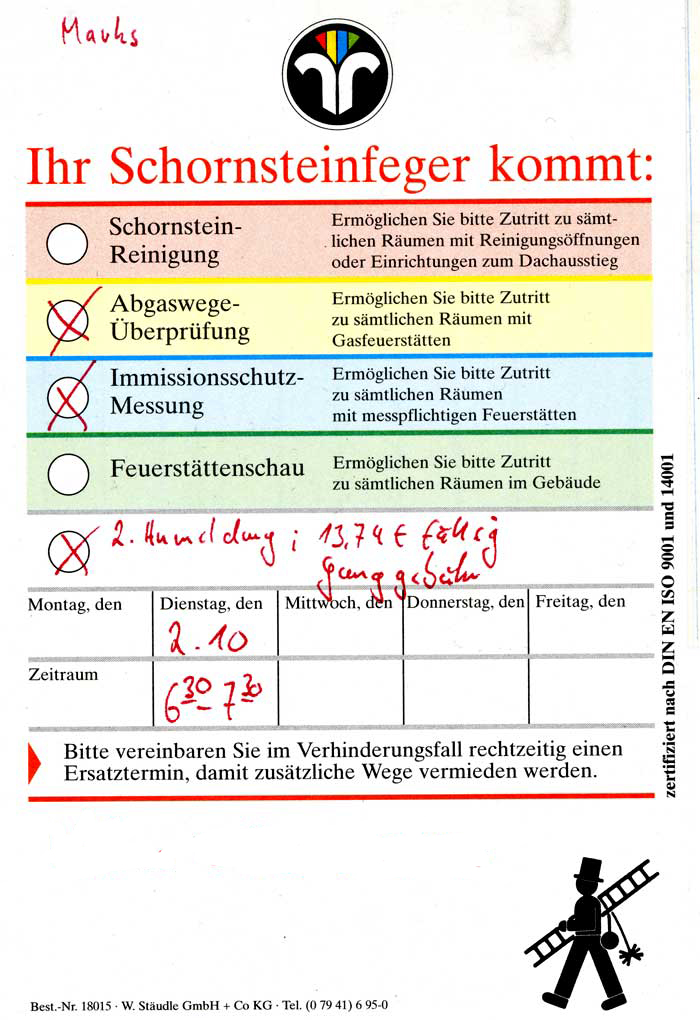
I was a bit worried about the 13.74 euros for Ganggebühr, but when I phoned up to complain I was told ‘Die Ganggebühr entfällt, wenn Sie in Urlaub waren’.
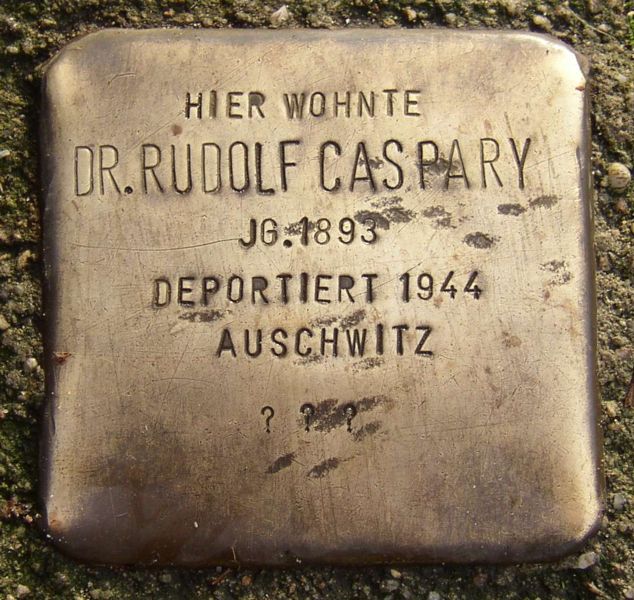
For years, Günter Demnig, a Cologne artist, has been creating bronze stones embedded in the pavement outside the former homes of Jews murdered in the Holocaust.
They are called Stolpersteine – stumbling blocks.
On September 14th the first stone was laid in Berlin for an African, Mahjub bin Adam Mohamed. So the Observer reports today, under the heading first memorial to black victims of Nazi genocide. Here’s a picture of one from Wikipedia (German, English):
It’s a sad story, but there’s more to it than the Observer spotted from Vienna.
Husen, as he was later called (a Germanized form of Hussein), was born in Dar-es-Salaam in German East Africa in 1904 and was an Askari – sort of East African Gurkhas. He fought for Germany in the First World War, although he was a child. He later made a living in Germany, was given a German passport (later taken away), married a German woman, had three children. Before and during the war he worked teaching Swahili at the Seminar für Orientalische Sprachen in Berlin and playing the ‘good African’ in German films.
From about 1936 on, the German Ministry of the Interior secretly had policemen taught Swahili, to be ready to take back the former German colonies. Husen taught these policeman from 1937, in great secrecy.
He was arrested for miscegenation in 1941 and died in Sachsenhausen concentration camp.
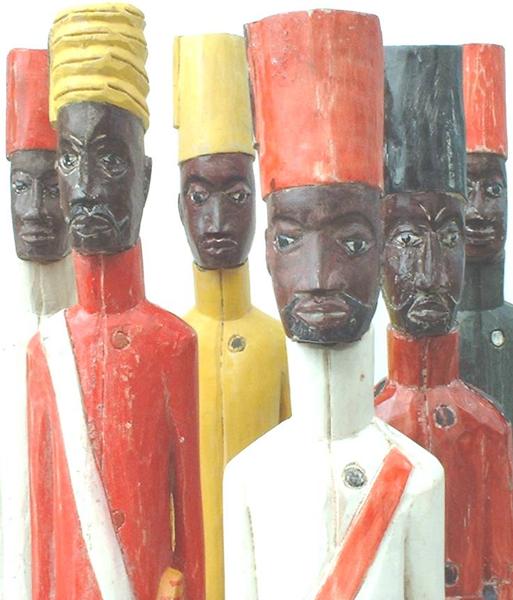
You can order handcarved British East Africa Askari soldiers here.
Here, from a page about foreign language assistants at the Oriental Languages school in Berlin, an earlier Swahili teacher from Africa encounters German bureaucracy for the first time:
An einem anderen Tag standen wir auf und gingen, bis wir an einen Platz kamen, und an diesem Platz waren viele Menschen, und ich fragte: Was sind das für Menschen? Und man sagte mir: Diese Leute sind deshalb hingesetzt, wenn jemand geboren wird oder stirbt, oder wenn ein Fremder kommt, so ist ihr Geschäft (solcher Leute sind siebentausend): wenn ein Fremder kommt, so fragen sie ihn: Wann bist du geboren, an welchem Tage oder Monat, aus welchem Lande kommst du, und was ist dein Geschäft. Und dann musst du alles sagen. Und wenn du sagst: Ich habe keine Beschäftigung, dann wirst du sogleich auf die Reise gebracht werden; und wenn du nicht weißt, an welchem Tag du geboren bist, so wirst du sogleich auf die Reise gebracht werden. Das ist die Nachricht von diesen Leuten, die dort sind. Und wir gingen heraus und gingen nach Hause.
(Thanks to Trevor)
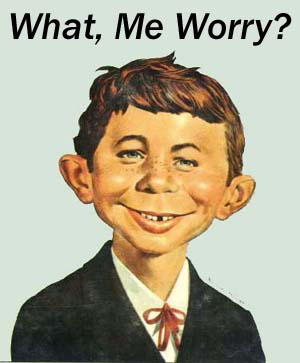
I remember Mad Magazine – it looks as if it is still running – and Alfred E. Neuman.
Since his debut in Mad, Neuman’s likeness, distinguished by jug ears, a missing front tooth, and one eye disquietingly lower than the other, has graced the cover of all but a handful of the magazine’s 450+ issues. His face does not translate well to profile, and thus he has almost always been shown in full frontal view or in silhouette.
Why does his face keep passing through my mind now?

‘Comedian Stewart Lee’ writes in the Guardian on German humour. This analysis arises from a trip to Germany with Richard Thomas, who wrote Jerry Springer the Opera, who was commissioned to write a musical of that type set in a British stand-up comedy club which then had to be translated into German. (Why am I laughing already?)
Lee says that Germans do have humour, but it is hard for us to recognize, and vice versa. He claims that English humour is facilitated by the English language. Putting verbs at the end of the sentence and using a lot of compound words kill humour, he says (apparently seriously). He now concentrates on the humour of ideas:
On my first night in Hannover I had gone out drinking with some young German actors. “You will notice there are no old buildings in Hannover,” one of them said. “That is because you bombed them all.” At the time I found this shocking and embarrassing. Now it seems like the funniest thing you could possibly say to a nervous English visitor.
At all events, Germans are invited to submit their own jokes in English, to show there is German humour. The four quoted have failed to do this. (Thanks to Trevor for the link).

Things have obviously changed a lot in the past two thousand years.
These people produce 3.5 million host wafers a year and have baked 653,000 for the World Youth Day (sic) in Cologne.
In unserer Hostienbäckerei werden alle gängigen Oblatentypen hergestellt:
* dünne, weiße Priesterhostien mit Kreuzsymbol und Brechzeichen
* dünne, weiße Laienhostien mit Kreuzsymbol
* Brothostien mit 6,5 cm Durchmesser (Priesterhostien)
* Brothostien als Laienhostien
* Brothostien für die Konzelebration: Durchmesser 9 cm und 12 cm und 20 cm
* Es können auch ganze Brotplatten zum Brechen (z. B. für Gruppenmessen) bestellt werden: 25 x 30 cm.bq. Auf Bestellung liefern wir für Zöliakiekranke glutenarme Oblaten, die gebacken werden aus der Weizenstärke Cerestar.