Even lawyers do not like legal language according to this article.
I found the reference through a colleague who subscribes to Frankfurter Allgemeine Zeitung (thanks, Marisa!) and quoted this, from 31.05.2023:
Warum so kompliziert?
Von Sibylle Anderl
Wer Texte von Anwälten liest, ist hinterher selten schlauer. Die Motivation dahinter haben nun US-Forscher entschlüsselt.
Wie naiv die Vorstellung ist, menschliche Sprache diene stets dem möglichst reibungsfreien Austausch von Informationen zwischen Sender und Empfänger, illustriert wohl kaum etwas besser als die Ausdrucksweise von Juristen. Das Missverständnis, dem Leser solle im juristischen Schriftverkehr Verständnis ermöglicht werden, ist meist nach wenigen Worten vom Tisch. Die Gründe dafür sind gut erforscht: Der Trick liegt in der Kombination von Schachtelsätzen mit unüblichen Fachtermini. …
The article referred to appeared in PNAS: Even lawyers do not like legalese (paywall but I paid the $10). Here’s the abstract:
Across modern civilization, societal norms and rules are established and communicated largely in the form of written laws. Despite their prevalence and importance, legal documents have long been widely acknowledged to be difficult to understand for those who are required to comply with them (i.e., everyone). Why? Across two preregistered experiments, we evaluated five hypotheses for why lawyers write in a complex manner. Experiment 1 revealed that lawyers, like laypeople, were less able to recall and comprehend legal content drafted in a complex “legalese” register than content of equivalent meaning drafted in a simplified register. Experiment 2 revealed that lawyers rated simplified contracts as equally enforceable as legalese contracts, and rated simplified contracts as preferable to legalese contracts on several dimensions–including overall quality, appropriateness of style, and likelihood of being signed by a client. These results suggest that lawyers who write in a convoluted manner do so as a matter of convenience and tradition as opposed to an outright preference and that simplifying legal documents would be both tractable and beneficial for lawyers and nonlawyers alike.
The text types referred to are contracts and statutes (judgments and correspondence are my favourites though).
I wondered what the German Schachtelsätze referred to specifically. It seems the villain is the centre-embedded clause (“leading to long-distance syntactic dependencies”), which I hadn’t heard of but does seem similar to the convoluted German sentences.
The authors cited five hypotheses as to why lawyers write in a more complex manner than they themselves would prefer:
1. Curse of knowledge hypothesis – curse of knowledge is assuming other people know as much as you do and so failing to explain enough.
2. Copy-and-paste hypothesis – when you are putting a contract together, you use archaic clauses by copying them rather than amending or adapting them. I suppose that cut and paste predates word processing.
From Wikipedia:
The term “cut and paste” comes from the traditional practice in manuscript-editings whereby people would cut paragraphs from a page with scissors and paste them onto another page. This practice remained standard into the 1980s. Stationery stores sold “editing scissors” with blades long enough to cut an 8½”-wide page. The advent of photocopiers made the practice easier and more flexible.
I hadn’t heard of editing scissors, an exciting term.
3. In-Group signalling hypothesis: signalling to other lawyers that you’re part of the tribe, sounding more “lawyerly”.
4. It’s just business hypothesis: writing in a convoluted way to preserve your monopoly on legal services and justify your fees.
5. Complexity of information hypothesis: thinking that law is so complex that only complex language can do justice to it.
Most of these hypotheses are debunked in the article, but the copy-and-paste idea seems to stand up.It’s a problem for translators since you are translating for someone who doesn’t really understand what they wrote.
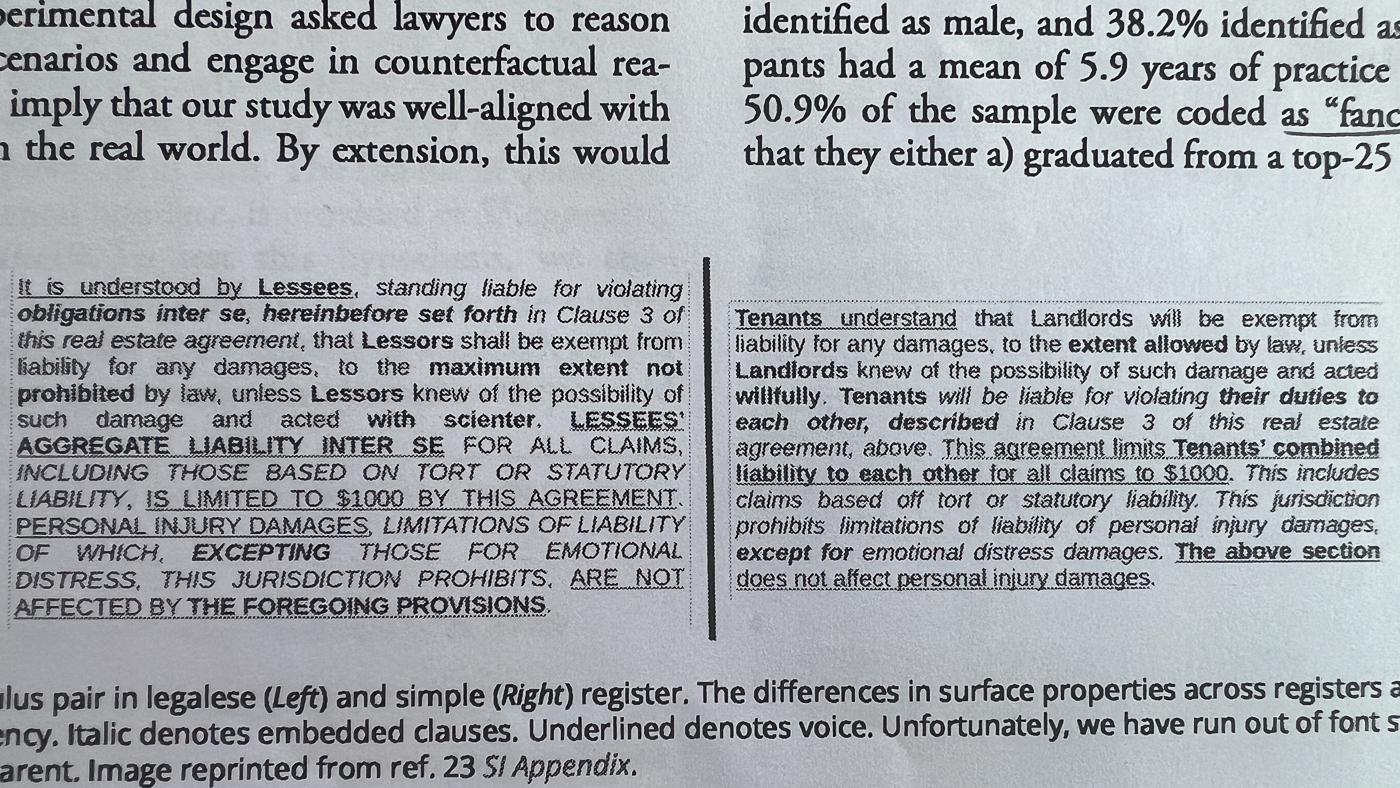
Here is an example of contract language in tradition legalese (left) and simpler language (right), highlighting the differences:
 No participant saw those paired versions – the traditional and simpler versions did not match. There are details of how the study was recruited for and conducted. See the article for these. For example, in one experiment, 60% of participants identified as male, 38% as non-White. Lawyers were further categorized, for example 50% were coded as “fancy” lawyers, meaning that they either graduated from a top-25 law school according to US News and World report or worked at a top-200 law firm according to American Lawyer magazine.

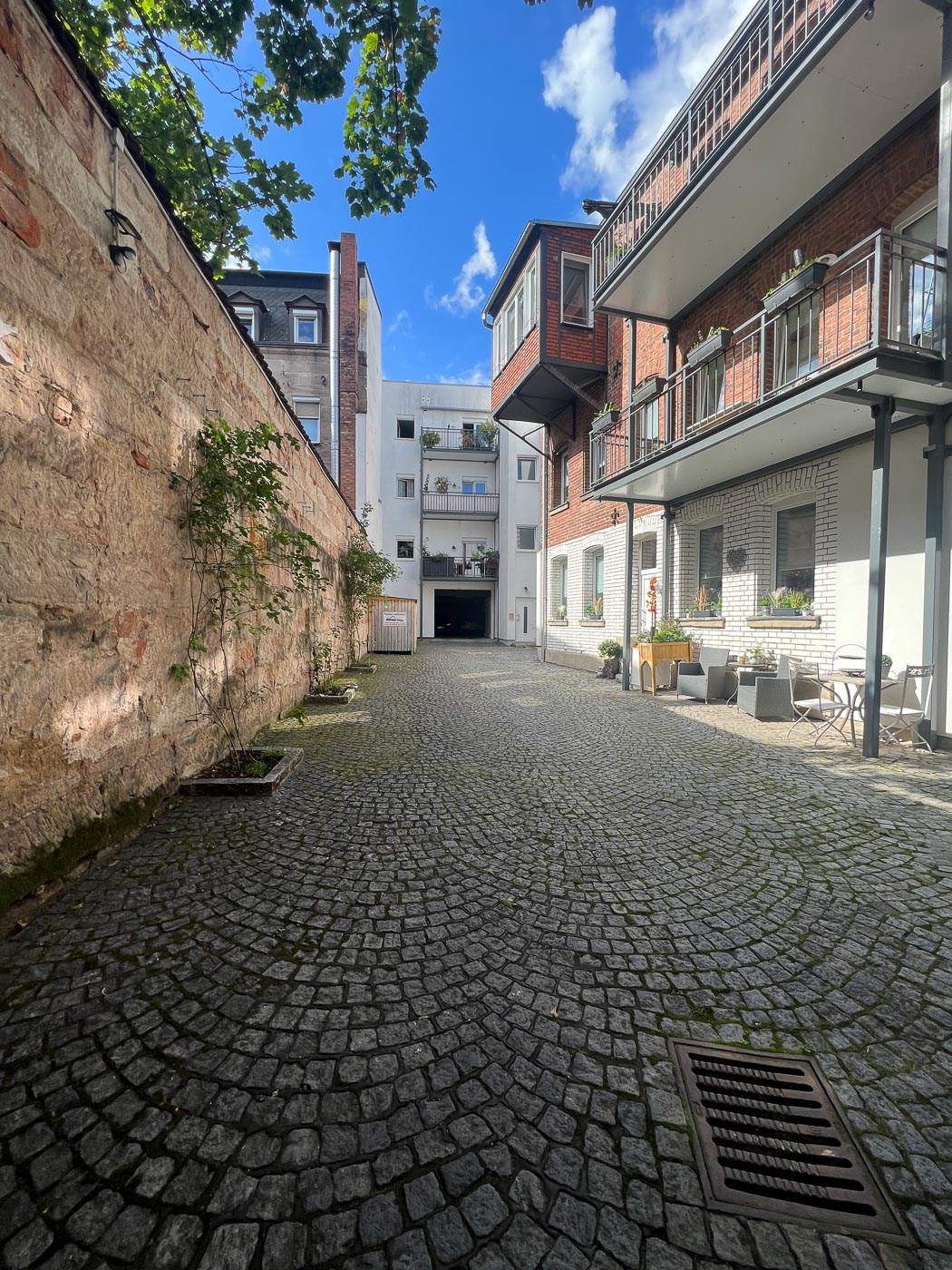
 This is a balcony in Friedrichstraße – according to the famous FürthWiki this is a tabernacle, built in 1907: “Balkonanbau, vermutlich Sukka, von Adam Egerer, 1907″:
 And here is an advert for the Fürth football team, Greuther Fürth, as seen in Nuremberg Airport in both February and September 2023: