Dutch law blog

From Bag & Baggage: a Dutch law firm has started a blog, claiming to be the first European law firm to do so. Also linking to a Dutch chocolate page, Denise says, ‘Yet another reason to learn Dutch’. Hasn’t she heard about Belgian chocolate? But I do remember being taken to try cherries in liqueur and chocolate in Amsterdam, with the stalks still on.

I tried to learn Dutch at evening classes two years ago. I only went for the pronunciation, but it was a very frustrating experience. If you know German, Dutch is so easy, but being asked to tell a story and realizing every word you were saying was pidgin was quite irritating. Isabella Massardo recently mentioned a vocabulary book for learners of Dutch as a second language, i.e. immigrants, that looks really useful for speakers of German and probably English too.

British-American English translation

I’m fascinated by the lengths to which U.S. publishers sometimes go to ‘localize’ British novels, and I gather it happens the other way round too.
There is a very interesting paper written in English by a German, Helge Nowak, on the changes demanded of A.S. Byatt’s Possession, not my favourite novel but one that was very successful. Nowak looks at every possible aspect of difference between U.S. and British versions, including dustjacket and typography.

Here is just one example of a change. British version:

he saw himself as a failure and felt vaguely responsible for this.
He was a small man, with very soft, startling black hair and small regular features. Val called him Mole, which he disliked. He had never told her so.

U.S. version:

he saw himself as a failure and felt vaguely responsible for this. He was a compact, clearcut man, with precise features, a lot of very soft black hair, and thoughtful dark brown eyes. He had a look of wariness, which could change when he felt relaxed or happy, which was not often in these difficult days, into a smile of amused friendliness and pleasure which aroused feelings of warmth, and something more, in many women. He was generally unaware of these feelings, since he paid little attention to what pe/ple thought about him, which was part of his attraction. Val called him Mole, which he disliked. He had never told her so.

I was reminded of this by a recent Guardian article about American publishers nearly retitling the British novel Brick Lane – they wanted it to be called Seven Seas and Thirteen Rivers (however, this was the title originally used by the author, Monica Ali).

There are many Internet sites with B.E./Am.E. wordlists, but they have a tendency to be over-simplified and suggest A is always used in AmE and B always in BE and never the twain shall meet.

Law and Order colouring book

I’ve never seen the series Law & Order, although apparently it is shown in Germany. But I am intrigued by this colouring book (you can print it out). Here’s a picture showing the long path between arraignment and trial (click to enlarge). From Bag & Baggage.

page12.jpg

This was a mystery to me, because in England and Wales, arraignment is the stage of the criminal trial where the indictment is read out to the defendant, so it’s part of the trial. But in the USA, arraignment is

bq. an initial step in the criminal process wherein the defendant is formally charged with an offense, i.e. given a copy of the complaint… and informed of his constitutional rights…

The defendant is brought before court and told how he can plead, and he may plead (e.g. not guilty). But it is not the trial (Gifis, Law Dictionary)

No seats for pedestrians in Fürth

Fürth hatte mal viele Sitzgelegenheiten in der Fußgängerzone. Sie kamen gut an.

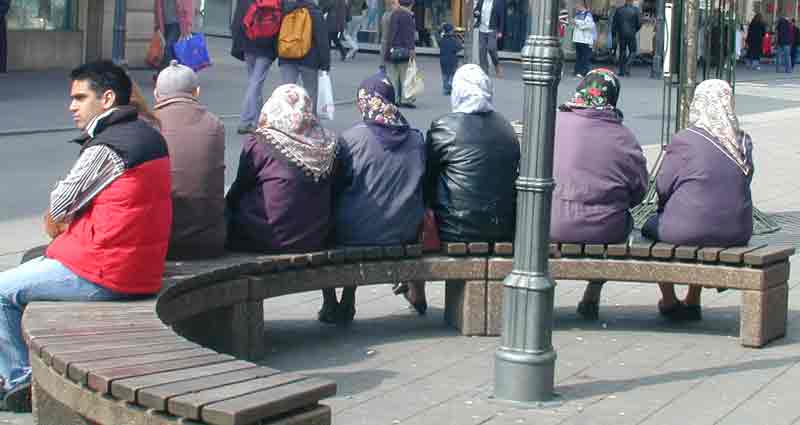
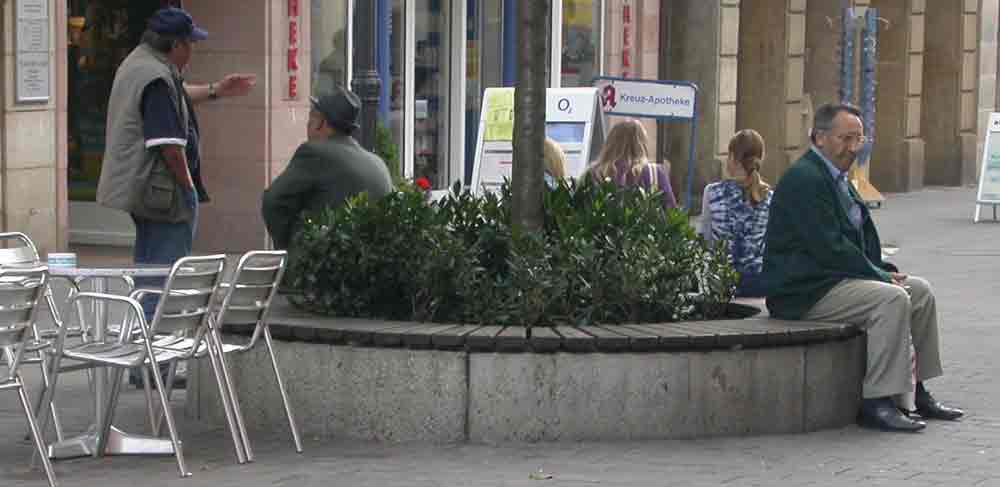
Fürth hasn’t got the prettiest pedestrian zone I know, but it used to be rather civilized with lots of benches for people to sit.

benchfw.jpg

benchroundw.jpg

Mindestens die Hälfte hat die Stadt (under der CSU) aber vor zwei Jahren entfernt. Schilder mit durchgestrichenem Fußball erschienen auch.

Two years ago, the local government under the CSU removed at least half of these benches. They also put up signs with a crossed-out football.

Es wurde abends weniger Fußball gespielt. Der Lärm wurde aber nicht reduziert.
There was less football played, but the general noise level was unchanged.

Jetzt hat der Oberbürgermeister (jetzt SPD) “ganz unbürokratisch” (Zitat SPD-Unterschriftensammlerin) noch eine Bank entfernt. (Bilder hier, Site benutzt Frames).

Now the mayor (now SPD) has removed another bench “unbureaucratically” (according to a woman from the SPD collecting signatures). (Pictures here – site uses frames – English version available).

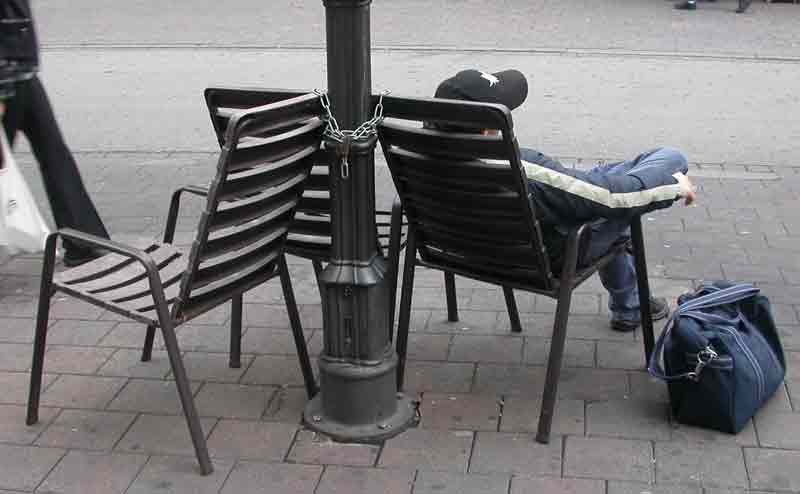
Die Grünen haben danach drei Stühle an eine Straßenlaterne gekettet.

The Green Party have now chained three chairs to a lamppost.

grbench4w.jpg

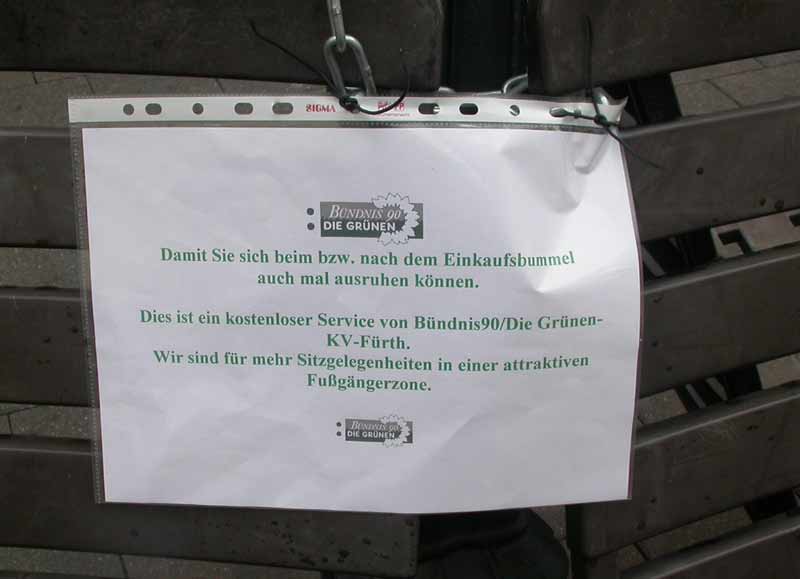
grbench5w.jpg

(Translation: So you can have a rest when you’re shopping or afterwards.
This is a free service from Bündnis90/Die Grünen, local committee, Fürth
We support more seats in an attractive pedestrian zone.)

Die Biertrinker sind ganz unbürokratisch in den Parkplatz gezogen.

The beer drinkers have unbureaucratically moved into the car park.

trinker2w.jpg

The importance of spaces between words

I have already posted (here and here) that the German courts do not like to count spaces when they pay translators, and one of their arguments is that spaces are not meaningful. As I said, some translators say they will deliver a text without spaces.

Languagehat provides proof of the significance of spaces: no matter how jumbled the letters in a word are, as long as you break them up into words of the same length as the original, it’s fairly easy to follow:

‘Aoccdrnig to a rscheearch at an Elingsh uinervtisy, …’