
‘Brain up’ revisited

Further to my recent entry, one of the comments on language hat’s site points out that the term ‘brain up’ was used in a Guardian article of August 2002, which I quote:

bq. Mr Saumarez Smith, a former academic, believes the answer is not to dumb down, “as the Department for Culture Media and Sport would sometimes seem to like us to do”, but to “brain up”.

Charles Saumarez Smith is the new director of the National Gallery. I found a brief biography (in Google’s cache) but with no suspicion indications, for example of him being German.

I am ashamed to say I believed the letter to the FAZ which had done an Internet search. In fact, a Google search brings more evidence that the term ‘brain up’ does exist. Not much support, but a ‘margaret’ (not me, however) contributes to the British Council word exchange:

bq. Word::brain up
Meaning::to bring some intelligence to a conversation, activity or presentation
Type of word::
Example::If this chat show host doesn’t brain up, I’m switching channel

‘Switching channel’ in the singular sounds a bit foreign.

Here’s another Guardian example, from the Education Guardian in January 2004:

bq. The message is that we have to brain up or fall behind, and that means two things.

Well, I shall e interest to hear how the FAZ discussion continues. It looks to me as if the word exists but is very new and may not even take hold. But some of the blame should be withdrawn. If an SPD education minister can’t trust the Guardian education section, who can she trust?
Non-native speakers/Nicht-Muttersprachler

Pf arbeitet als Lektor für eine türkische Zeitung, die auf Englisch erscheint. Die englischen Texte, die er redigieren muss, sind anscheinend kaum verständlich.

This is copy-editing rather than translating, but somehow it reminds me of some translations I’ve read.

The famous pf, of pf’s blog, is copy-editing for an English-language newspaper in Istanbul. Here’s an early example (February 19th) of copy before editing:

bq. Global variation wavy began at last quarter of previous century and gained acceleration in 90’s, shaked political and ideological positions in us extremely.

bq. Because the lived was not the influence of West norms to the world. At the same time, the modern world?s perception was opened to interrogation and a new mental formation’s prolongation entered to policy over democratism.

And here’s an example of February 21st. Here is the way pf wrote it (it’s about cloning for stem-cell research):

bq. “Science has never been in the monster-production business, however Hollywood might film it. The real monster is the unequal distribution of wealth in our society.”

He (I think) uses block quotes plus quotation marks, the belt-and-braces approach. Here is what the paper did before putting it online:

bq. “Science has never been in the business of producing monsters, assuming of course we ignore Hollywood’s portrayals! The real monster is the unfair distribution of the wealth among people.”

Here’s the paper itself, Zaman Daily News. One good thing – after a year and a half of trying to learn Turkish, I can still understand this better than Hürriyet. Ah, but this is good – I can get the same stories in Turkish. But will the English ‘translation’ bear any similarity to the original?

I have rarely encountered English as incomprehensible as the example first quoted, but the general behaviour of the client ‘improving’ the English is very familiar.

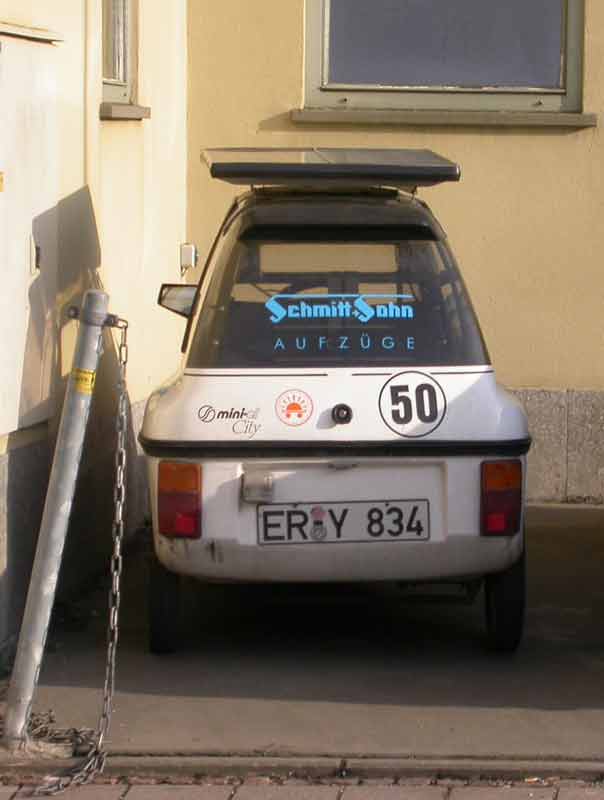
Solar-powered vehicle from Erlangen

schmitt1w.jpg

I’m not sure how this got here, nor what function it has other than to advertise lifts.

LATER NOTE: I photographed this on Friday February 20th, and I now see that the solar-power company solid had an open day on Saturday. Perhaps this vehicle had to make the long trip from Erlangen (20 kilometres or thereabouts) a day early?

Germans told to ‘brain up’/Verwirrende Anglizismen

Soeben erreicht mich folgendes (erschienen in der FAZ am 21.2.2004):

bq. Aus einem Leserbrief in der FAZ (von einem Prof. Dr. Dieter Mindt, Berlin):
“Bundesministerin Edelgard Bulmahn (studierte Anglistin) verkündet allenthalben: ‘Brain up! Deutschland sucht seine Spitzenuniversitäten.’ Eine Suche in großen Datenmengen des britischen und amerikanischen Englisch hat nur ein einziges Vorkommen der Verbindung von ‘brain’ mit ‘up’ ergeben. Die Fundstelle aus dem British National Corpus lautet: ‘He’s got no brain up here.'”

bq. From a reader’s letter to the Frankfurter Allgemeine Zeitung, from Professor Dr. Dieter Mindt, Berlin: ‘Federal Minister Edelgard Bulmahn (who studied English at university) is announcing everywhere: ‘Brain up! Deutschland sucht seine Spitzenuniversitäten.’ (‘[Incomprehensible English embellishment] German is looking for its top universities’). I searched British and U.S. English corpora and found only one example of “brain” together with “up”. It was in the British National Corpus and read: “He’s got no brain up here.”‘

Zur teilweise Entlastung der Ministerin: es gibt sehr wohl “brain up” im britischen Englisch. Collins English Dictionary gibt es im Sinne von ‘den Lehrplan geistig anspruchsvoller machen’, allerdings nur mit Objekt. Ich verstehe immer noch nicht, was Frau Bulmahn sagen will, kann es also nicht ins Englische übersetzen. Die Suche sollte aber nach ‘brain’ und ‘up’ mit ein paar Wörtern dazwischen sein.

Collins English Dictionary does give ‘brain up’: to make more intellectually demanding or sophisticated: We need to brain up the curriculum. However, it is a transitive verb and takes an object. So the minister’s use of the term is still quite mysterious.

I think I’ve come to this topic rather late: see ‘Brain up? Shut up!’

Incidentally, the reference to top universities relates to the current ideas about creating universities in Germany more like the Ivy League or Oxbridge, free to design their own programmes and funded privately.

Court decision on number of forenames/BVerfG-Entscheidung zur Zahl der Vornamen

The German Federal Court of Justice held on January 28th that there is a limit to the number of forenames (I can’t really call them first names, and Christian name is not PC) a child can have.

bq. Die Beschwerdeführerin hatte beim Standesamt erklärt, ihrem neugeborenen Sohn zwölf Vornamen geben zu wollen. Nachdem sie die Vornamen beziehungsweise deren Reihenfolge im Laufe des Verfahrens mehrmals geändert hatte, beantragte die Bf schließlich mit der Beschwerde, das Kind solle die Vornamen “Chenekwahow, Tecumseh, Migiskau, Kioma, Ernesto, Inti, Prithibi, Pathar, Chajara, Majim, Henriko und Alessandro” erhalten. Dabei sollte die von ihr gewählte Reihenfolge der Namen deren jeweilige Vorrangigkeit bei der Namensgebung zum Ausdruck bringen. Das Landgericht wies das Standesamt an, dem Kind die vier Vornamen “Chenekwahow, Tecumseh, Migiskau und Ernesto” beizuschreiben. Die Namenswahl dürfe nicht dem Kindeswohl widersprechen. Zwölf Vornamen hätten aber einen erheblich belästigenden Charakter für das Kind. Es müsste sich die richtige Reihenfolge und Schreibweise der größtenteils ungewöhnlichen Namen merken und würde durch diese immer wieder auffallen. Das weiter angerufene Oberlandesgericht (OLG) Düsseldorf änderte den Beschluss der Vorinstanz geringfügig dahingehend ab, dass dem Kind zusätzlich der Name „Kioma“ zu geben sei. Das OLG machte sich die Begründung des Landgerichts zu eigen und stellte zusätzlich darauf ab, dass die Selbstidentifikation des Kindes mit zunehmender Zahl seiner Vornamen nicht mehr gewährleistet sei. Mit ihrer dagegen gerichteten Verfassungsbeschwerde rügt die Bf die Verletzung ihrer Grundrechte unter anderem aus Art. 2 Abs. 1 und Art. 6 Abs. 2 Satz 1 GG.

bq. The complainant, at the registry office (after changing her mind about names and their order several times), wanted her son to have twelve forenames:
Chenekwahow, Tecumseh, Migiskau, Kioma, Ernesto, Inti, Prithibi, Pathar, Chajara, Majim, Henriko and Alessandro.

bq. The court admitted only four, on the grounds that the son would later be made fun of otherwise. The four names were Chenekwahow, Tecumseh, Migiskau and Ernesto, so he has a good chance of being made fun of anyway. The court of intermediate appeal added a further argument: the more names a child had, the less it could identify with them. So it allowed him one more name: Kioma.