Mongolian surnames law

The Observer reports that Mongolia is introducing last names in order to be able to use a telephone book. But too many of them named themselves after Genghis Khan (that’s what I would have chosen myself too). The 1997 surnames law was ignored till an ID card system was introduced recently.

I seem to recall a similar problem existing in Iceland.

bq. Icelanders have a given name, plus the name of (usually) their father with an attached “-son” for boys and “-dóttir” for girls. So, Jón’s son Gunnar is called Gunnar Jónsson, and his daughter Njóla is called Njóla Jónsdóttir. Because of this lack of family names, telephone directories are arranged by given names – using the above example, you’d find Gunnar Jónsson under “G”, and Njóla Jónsdóttir under “N” in the phone book. In an effort to preserve national identity, all foreigners taking Icelandic citizenship must also take an Icelandic name.

Don’t know if David stayed in Iceland long enough to look at a phone book.

DE>EN>DE church glossaries/Kirchenwörterbücher

chglossw.jpg

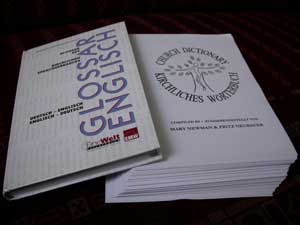
Here are two glossaries of terminology relating to the church.

The one on the left is a traditional alphabetically arranged one in book form: Maureen und Reinhold Trott, Glossar des kirchlichen Sprachgebrauchs Deutsch-Englisch, Englisch-Deutsch, Missionshilfe Verlag, Hamburg 2001, ISBN 3-921620-96-1

Maureen Trott was a translator and responsible for Engish at the office of the Evangelisches Missionswerk in Deutschland (EMW). I see there is a revised and expanded second edition, 224 pages long. It costs 5.50 euros (but even less if you buy ten!). It’s good and reliable.

On the right is Church Dictionary / Kirchliches Wörterbuch, compiled by Mary Newman and Fritz Neubauer, 1st ed. May 2003, no ISBN

Further copies can be obtained from:
The European Secretary
Council for Christian Unity
Church House
Great Smith Street
London SW1P 3NZ

You can get it in Germany for 15 euros using the form I have scanned here:

Download file

The dictionary is a loose-leaf resource which will be updated from time to time. It is not alphabetically arranged, but under themes: the broader themes are Bible
Biblical/Theological Concepts
Church Buildings
Christian Year
The Church Institution
Home and Family
Parish
Religious Movements
Rites and Services
There are many more sub-themes, though. It would be easy to scan, and probably best in electronic form; it would still be possible to select parts and print out those needed, for instance by an interpreter. It looks good too.

There must be other glossaries of this kind around, I can’t help thinking, known inside the churches that produce them but not to the wider bookbuying public.

ADÜ Nord survey on translators’ and interpreters’ earnings/ADÜ-Nord Umfrage zu Übersetzer- und Dolmetschereinkommen

Die ADÜ-Nord (Assoziierte Dolmetscher und Übersetzer in Norddeutschland e.V. – ist das ein Plural oder ein Singular) macht eine Umfrage zum Übersetzer- und Dolmetschereinkommen.

Die Umfrage ist für alle, die irgendwo auf der Welt als Fachübersetzer und Dolmetscher mit der Arbeitssprache Deutsch freiberuflich tätig sind.

Die Umfrage wird am besten online gemacht, zwischen 15. Oktober 2004 und 31. Januar 2005.

Die Fragen können auch als PDF-Datei vom ADÜ-Nord heruntergeladen werden.

Survey on the income of translators and interpreters who have German as one of their working languages.

Bayerisches Oberstes Landesgericht to be abolished

The Bavarian parliament has finally voted to abolish the Bayerisches Oberstes Landesgericht. (Süddeutsche Zeitung report)

Any German Land is permitted to have such a court, which takes some of the work from the Bundesgerichtshof (see earlier entry). But only Bavaria ever had one, and it does cost money. The Bavarian Minister of Justice, Beate Merk, said, ‘Die Köpfe bleiben, nur die Struktur ändert sich’ (The heads will remain; only the structure will change).

German Civil Code translation into English/BGB ins Englische übersetzt

LAWgical reports that the German Civil Code is being translated into English, to appear online. All 5 books are to be translated into British English by autumn 2005 and appear online as part of the German Federal Ministry of Justice‘s statutes online.

In this connection I would like to note that the Ministry of Justice did have an English part of its site, and it published translations of some statutes there, for instance the Criminal Code. It then revamped its website and at present has for some time had no English links.

What has happened to the English materials there? I did at one time get hold of their English version of the large map of the courts system. It was necessary to know the filename, and then a Google site search revealed that the stuff was still online. I have a feeling it was a different site address, though. Maybe the Wayback Machine would help.

Yes, yes – go to www.bmj.bund.de and do a Google site search for “criminal” (just add site:www.bmj.bund.de – or the Google toolbar for Mozilla has a site search icon). Not all those hits are English texts, but some are.

Anyone wanting a translation of the Civil Code now could do worse than get hold of a second-hand edition of Goren’s version (1994) and look at the German Law Archive version (click on German Law of Obligations), where the whole of the new parts of the Civil Code, Law of Obligations, have been online for quite some time now – an admirable initiative.

What’s missing, for instance, is the new material on the electronic Register of Associations in § 79.

LATER NOTE: Damian Brandt, in the comments, points out that the 1994 Goren is still available from the original publisher. I have heard three people say they can’t get it, so I assume it isn’t in other catalogues. Of course, you need to know that there have been huge amendments, especially to Book 2, since 1992 (the date of theGerman Civil Code version published in translation in 1994).
At all events, it does appear to be available from the publisher for §130:
http://www.wshein.com/Catalog/Gut.asp?TitleNo=314070