wood s lot (November 24th) shows three textbook disclaimer stickers:
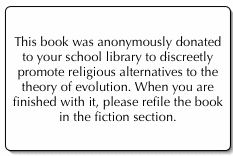
They are originally from Bifurcated Rivets, which has more.
wood s lot also gives links to some anti-evolution sites.

wood s lot (November 24th) shows three textbook disclaimer stickers:
They are originally from Bifurcated Rivets, which has more.
wood s lot also gives links to some anti-evolution sites.
Schott’s Original Miscellany appeared in the UK in 2002 and became a bestseller. Ben Schott created a bizarre collection of useless facts, but the collection didn’t seem forced or twee or self-conscious. What sounds like a more self-conscious German equivalent appeared in August 2004, Ankowitschs Kleines Konversationslexikon. Meanwhile, Schott has been translated into German, and the translator adapted some of the lists to German, but if one is to believe ‘Welt am Sonntag’, not very convincingly (the number one German Christmas pop song being an unmeaningful category). It is in this German adaptation that Ankowitsch excels. Links all to amazon.de – might be worth looking at as a Christmas present – and the original might be useful for translators – it does have an index):
I realized the translation had been adapted when I watched that strange TV programme, Elke Heidenreichs ‘Lesen!’.
I had to go to the Berlin Verlag website to find who was responsible for translating / adapting Schott into German:
bq. Aus dem Englischen unter Mitarbeit von Matthias Strobel u. a.
The following picture has nothing to do with the remembrance days in November, but shows the Germans getting ready for Advent. Each of these wreaths should get four tasteful candles implanted into it before next Sunday.

Eric Bakovic at Language Log has a post on legalese. He refers to a short radio piece on npr reporting that many jurors are confused by the language of jury instructions.
bq. Numerous studies show that jurors are confused by the legal instructions given to them on how to decide a person’s guilt or innocence. So, California is simplifying them, but not everyone likes the changes.
The question is how simple the instructions are to become, and whether those simplifying them are doing more harm than good.
California’s instructions won’t be ready till spring 2005, but some other states have already simplified theirs. A legal problem is that many instructions (they vary from crime to crime) have been fought out and defined in case law, and if the rephrased instructions are erroneous, a case may have to be retried.
The rewriting task force is headed by an appeals judge, Carol Corrigan. who speaks briefly. She says Latin and law French need to be simplified, hence ‘mitigating circumstances’ becomes ‘factors that make the crime less worthy of punishment’ – but that is neither brief (people’s attention spans are said to be short) nor accurate, is it? Does it not mean ‘reasons to reduce the punishment’?
The programme also quoted an English professor, Laurie Rozakis, author of ‘English Grammar for the Utterly Confused’:
bq. I’m a very big proponent of clear, direct, simple prose. […] Make it communicative; make it communicate quickly and easily — especially when someone’s life is at stake.
Bakovic concludes:
bq. Movements to “simplify” legalese are popping up all over the place, and have already made inroads in some states (according to this NPR piece). Is there a linguist involved in any of these movements? I sure hope so.
The previous Language Log post, by Mark Liberman, also deals with legal language and is worth reading, but I can’t understand it myself and am going to drink some coffee.
I mentioned online dictionaries earlier, including LEO. I don’t use it myself, but I see Chris of Crooked Timber is learning German and says how useful it is for him.
bq. Not only is Leo invaluable as youre trying to decipher that article in Der Spiegel or FAZ, it also enables registered users to enter the words they dont know into a little personal list and then to test themselves repeatedly on their chosen vocabulary. Leo is also very easy to integrate with Mozilla Firefox both by adding to the search engines box and this is really great by installing the ConQuery plugin so you can highlight the German text and then have the dictionary open with a translation in a new tab.
According to a commenter (Tobias of Fistful of Euros), LEO is also ‘Google-enabled, though only for google.de queries’, if you enter ‘de-en’ or ‘en-de’ as part of the search. I haven’t quite got that to work, but I see in the latest Firefox, although I have English in the language settings, the original Google toolbar takes me to Google.de, and on top of that the start page has a Google search bang in the middle, but where that takes me I don’t know. Ah yes, the first real hit for Bisamratte is for me, but before that is a link to take you straight to Leo.
(Thanks to Abnu for the link)
Für den deutschen Bericht siehe journalismus.compact:
bq. Glaubt man der Grüchteküche im Netz, dann steht die Künstlersozialkasse unmittelbar vor dem aus. In zahlreichen Mailinglisten wird derzeit eine “E-Mail-Lichterkette durch die Republik” organisiert:
bq. Tatsächlich tagt am Montag (22.11.) die Enquete-Kommission Kultur in Deutschland im Berliner Paul-Löbe-Haus über zur Zukunft der Künstlersozialkasse. Eigentlich sollte es sich um eine Anhörung zur “Wirtschaftlichen und sozialen Absicherung für Künstlerinnen und Künstler” handeln. Doch davon ist in der Pressemitteilung der Enquete-Kommissions Vorsitzenden Gitta Connemann, CDU-MdB, nur nebenbei zu lesen. Ganz offen wird dort die Frage gestellt wird, ob die KSK überhaupt erhalten bleiben soll.
Some freelance translators who work mainly for publishers and therefore at a pittance, and also journalists, singers, artists and others, pay their social and health insurance to an institution called the Künstlersozialkasse (Artists’ Social Insurance). It sounds as if this arrangement may be ended tomorrow. I’m posting because I’m sure some people reading this site are affected.
Expatica gives a report by Nick Woods, a freelance journalist who moved to Germany, dated November 2004:
bq. For social security you must join the ‘Künstlersozialkasse’ (KSK) – www.kuenstlersozialkasse.de.A form can be accessed on the net.
bq. A special perk for freelancers working in media and the arts is that half these costs are paid by organisations who use my work (30 percent) and the State (20 percent).
The remaining half is my responsibility. I declare my anticipated earnings to the KSK when I register and for each forthcoming year.
A bill is sent out in due course while the KSK should be notified of any differences in target in actual earnings.
The agency collects money from the media organisations separately by levying a percentage charge – 5.8 percent in 2005 – based on each outlet’s annual payment to freelancers. Other self-employed people and entrepreneurs are liable for the total cost of their social security bill.
(Thanks to Christiane on the pt list at Yahoogroups)