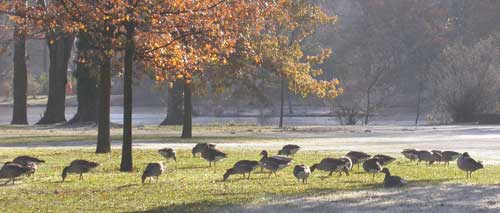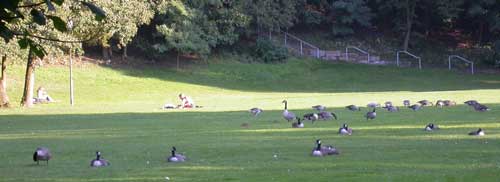
Huntsmen attack geese in Fürth Stadtpark

September 2004:

geese3w.jpg

November 2004:

geesenvw.jpg

Last Saturday, at about 8 a.m., people in the Fürth Stadtpark were surprised to see men with guns taking pot shots at some of the grey geese. Apparently some think there are too many of them. The Fürther Nachrichten reports in today’s edition, which is unlikely to be online for long. One of the men was Georg Höfler, the Jagdpächter (Collins says game tenant) responsible. There seem to be doubts as to whether anyone is allowed to shoot anything in the park, whether he should not have had a permit from some authority other than the parks office, and whether grey geese may be killed at all. However, he did take care not to kill any humans, by shooting from the park into the river (actually, he is allowed to do more on the other side from the park, and he is allowed to kill rabbits, hares, pheasants and wild duck – wild duck is rather too broad a term, because some of the ducks are rare ones).

bq. „In den vergangenen zehn Jahren haben sich immer mehr Gänse im Stadtpark niedergelassen“, klagt Sylvia Jahn vom Grünflächenamt. Für die Jagd auf die Vögel gebe es zwei gravierende Gründe: Immer mehr Graugänse würden die Liegewiesen verschmutzen. „Da kann man sich oft kaum hinlegen, weil überall Kot herumliegt“, sagt Jahn. Zudem würden die Tiere beide Stadtweiher „überdüngen“. Die Bakterien, die die Gänse ausscheiden, entziehen den stehenden Gewässern zu viel Sauerstoff. „Die Weiher kippen irgendwann um und die Fische sterben“, sagt sie.

(Some people don’t like sunbathing on grass if forty geese have been defecating on it. But they are more ornamental than the sunbathers IMO).

Mayhew’s ‘London Labour and the London Poor’ online

Henry Mayhew’s ‘London Labour and the London Poor’ has been digitized and put online by the University of Virginia Library. We always had a Mayhew at home, but maybe it isn’t so well-known outside Britain. He was a journalist who interviewed and collected information on the poor (the ‘labouring poor’), street sellers for example, in the 1850s. Apparently he also wrote books on the boyhood of Martin Luther and on German life and manners in Saxony (see this site, which doesn’t want to be copied).

bq. The costermonger’s love of a good strong boot is a singular prejudice that runs throughout the whole class. From the father to the youngest child, all will be found well shod. So strong is their predilection in this respect, that a costermonger may be immediately known by a glance at his feet. He will part with everything rather than his boots, and to wear a pair of secondhand ones, or “translators” (as they are called), is felt as a bitter degradation by them all.

I meant to quote some of the text and dialogue, but I was diverted by the reference to second-hand boots as ‘translators’. There’s some truth in that.

(Via Boing Boing)

Searching this site

Someone came here searching for ‘Mauritius’. I know my occasional commenter AMM did bring Mauritius into the discussion, but my site search won’t find that. But if you use Google’s site search, you will find it. Enter the following:

site:www.margaret-marks.com mauritius

or use a Google toolbar – the Firefox one has a little icon for site search.

Here are some of the search terms used to search Transblawg (according to awstats):

german twix
alfa bravo charlie
collocation dictionary
twix german
dear sir
dear sir or madam
twix germany
ikea
anonymous lawyer
the curious incident of the dog in the nighttime

My visitors, apart from those unknown or from domains ending in com or net, come in this order from: Germany, Italy, Norway, UK, Austria, U.S. Educational, and Belgium! 78.3% of my visitors like to stay for less than 30 seconds.

LII sites for world law

‘Over the past five years, an international “free access to law movement” has emerged, based around independent, often University-based, Legal Information Institutes (LIIs). They give links to primary legal materials – legislation, case-law, treaties etc., and some secondary materials.

Here’s a list of the LIIs with the dates when they were founded :

LII (Cornell) (I didn’t realize that was one of them, least of all the earliest)
AustLII 1995
BAILII 2000
CanLII 2000
PacLII 2001
HKLII 2002
IRLII 2001
SAFLII 2003
NZLII 2004
Jurburkina 2004
Droit ‘Francophone (2003 – ‘may include any francophone countries, but initially concetrates on West and Central Africa.

Via an article by Graham Greenleaf, ‘Global Law Research: WorldLII and the Future’, in Delia Venables’ latest Internet newsletter (subscription £40)

To console anyone who wanted French rather than African sites, here is something completely different: a French language portal with links to all sort of things. Lexilogos has links on first names, last names, quotes, etymology, slang, keyboards, flags and anthems, French tourism, song texts and much more. Here’s My Way in the original – well, they changed that, as can be seen from the English, German and Spanish versions:

El fin
Muy cerca esta
Lo afrontaré
Serenamente

Ya ves
Yo he sido asi
Te lo diré
Sinceramente

Vivi
La intensidad
Y no encontré
Jamas fronteras

Jugué
Sin descanzar
Y a mi manera

(Thanks to Rainer Langenhan in email – and Languagehat has already blogged this).

Reznikoff: Testimony – found poem based on law reports

Gail Armstrong at Open Brackets, writing on plagiarism, mentions a work unknown to me: Charles Reznikoff’s ‘Testimony: The United States (1885-1915): Recitative’, which ‘consists of hundreds of stories taken from law reports’ (to quote Mark Ford) and rendered as free verse.

Languagehat takes this up too. Steve obviously knows Reznikoff, and he gives a longer quote from Ford and more links. From Wikipedia I gather that Testimonies was a kind of found poem. From an interview with Reznikoff:

bq. INT: When you were working in the law book company, did you come across the records that enabled you to write Testimony?

bq. CR: No, but working in the law book company I learned many interesting facts about the law. As a matter of fact, Dreiser’s novel, An American Tragedy, was based completely on a case, but he went into great detail there. It occurred to me that I should go through all the case books. I might go through a volume of a thousand pages and find just one case from which to take the facts and rearrange them so as to be interesting. Now Testimony: 1885-1890 covers every state in the union. I don’t know how many thousands of volumes I went through, and all I could manage to get out of it were these poems. And in looking through the book I might throw out some of them.