
Ringtone selling / Klingeltonverkauf

End 2004 tauchte das Problem der Klingeltonabonnements in Großbritannien auf, jetzt scheint es gelöst – BBC-News-Artikel.

Mr Flynn said that the move to using subscriptions happened over the space of a few weeks at the end of 2004.

Websites such as grumbletext.co.uk started getting reports from customers who were racking up large bills for phone content they did not know they had signed up for.

“What made us uncomfortable was that these services were not being marketed transparently,” said Mr Flynn. “People did not know they were being offered a subscription service.”

Ein Verhaltenskodex wurde Mitte Januar eingeführt und konnte durchgesetzt werden.

The drafting of the new rules was led by the Mobile Entertainment Forum and the UK’s phone firms.

“Everyone is required to conform to this code of conduct,” said Andrew Bud, regulatory head of the MEF and executive chairman of messaging firm MBlox.

Interessant für Leser von Spreeblick und Kunden von Jamba.

Und jetzt eine Frage für eine Freundin, die ein neues Handy hat und gerne ein “normales” Klingeln hätte, und lieber was monophones. Ich habe zwar durch langwieriges Suchen ein “Klingeln – altes Telefon – brrrng brrrng” oder so ähnlich gefunden, aber wo findet man so einen Ton? Der Hersteller (Samsung) konnte nicht weiterhelfen.
Webster’s online dictionary – Rosetta edition

What on earth is this ‘dictionary’?

Here it is on translator. There are seven pictures of translators, none of which are me.

Very bizarre. If you click on ‘references’, you are taken to amazon.com. We know ‘Webster’s’ has no particular meaning. But apparently part of this is Merriam Webster’s. The credits page is under construction. The ‘About Us’ page is more expansive:

Our mission is to create the largest dictionary of modern language usage (the equivalent of 500 encyclopedias). The dictionary will soon consist of over 400 modern languages, and 10 ancestral languages, with some 30 million individual entries across languages (including expressions, technical terminologies, and words). The languages included are read or spoken by over 95 percent of the world’s population. The world’s largest dictionary should be free to consult by all persons of the world, via the Internet.

Eurodicautom

The Frankfurt Rechtsanwaltskammer (chamber of lawyers) has recently given a link to Eurodicautom, describing it as follows:

Ein sehr nützliches Rechercheinstrument im Internet ist das interaktive Wörterbuch der EU zu allen EU-Begriffen. Es übersetzt aus jeder beliebig gewählten europäischen Ausgangssprache in jede beliebig gewählte Zielsprache.

A very useful research instrument in the Internet is the interactive EU dictionary on all EU terms. It translates from any chosen European source language into any chosen target language.

I find this a bit odd. When I first encountered Eurodicautom in the early nineties, I was warned it was a huge conglomeration of varying quality, not giving all languages. It was said it was put online free of charge because the vocabulary had begun to be collected (in the 1980s?) but no note of the source had been taken, so the EU couldn’t copyright it. I hardly ever use it – on the few occasions I might, I tend to forget it’s there – but some translators use it a lot, and its movings from place to place are keenly followed on mailing lists. I would not think of it as a database purely of EU terminology (if I understand that correctly), but of technological vocabulary too. It most certainly has its uses.

Of course it doesn’t have the latest EU languages, by the way.

I wondered how to describe Eurodicautom for someone who’d never seen it, and my search took me to Wikipedia, which has an entry. But what do I find? Just as thin a treatment as above. Of course it’s wrong to criticize Wikipedia without improving it, but I really am not the expert on this subject.

Eurodicautom is the terminology database of the European Union. There are web interfaces as gateways to this free service, allowing the translation of the EU-vocabulary between the official languages of the EU.

Incywincy has a better definition:

The European Commission’s multilingual term bank. Particularly rich in technical and specialized terminology related to European Union policy.

That’s right. It was the Commission that started it. And the specialized terminology is not so much just political, but about anything that EU policy may be about.

There are other terminology databases in the EU, and here is a useful article about them by Alistair Macphail. This article calls for a central EU terminology database to be set up. Eurodicautom is not it.

(Via Handakte WebLAWg)

Purity of German beer/Reinheitsgebot in Deutschland

s_a.gif

Bundesverwaltungsgerichtentscheidung zu Schwarzbier (Az. BVerwG 3 C 5.04).

The German Federal Administrative Court today decided that a German beer to which sugar was added can be called beer nonetheless. It overruled a decision of the Frankfurt an der Oder Administrative Court.

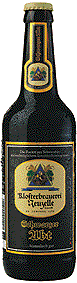
A brewery in Neuzelle applied ten years ago to market its ‘Schwarzer Abt’ (Black Abbot) as a beer. Traditionally, beer may contain only hops, malt, yeast and water. The brewery argued that special beers are permitted, and that there was discrimination against domestic firms, since under EU law beer brewed outside Germany can be sold as beer in Germany even if it doesn’t comply with the Reinheitsgebot (purity law). Apparently, however, the provision for special beers applies to herbs rather than sugar.

Schwarzer Abt is based on a traditional recipe and sweetened with sugar syrup.

LATER NOTE: Streitsache quotes Beck Aktuell, which gives a more detailed report.

The court said that the Reinheitsgebot does not protect health, but tradition and quality. It was necessary to be generous with exceptions. The Schwarzer Abt beer is brewed using malt. The sugar is added only after the brewing is complete. 2 – 3% sugar syrup is added. The beer is permitted as a special beer. And if the brewery is allowed to brew it, it must also be allowed to market it.