Annoying American date format

Jemima Kiss is apparently the Julie Burchill of punctuation:

bq. Kicking around in a mailbox: OPA Intelligence Report 2/7/05. That’s the second of July in my world. I can accept that you put your dates in a different order – but it’s just the wrong order! What possible reason is there for putting the month first? It’s completely illogical and worse, could (and almost certainly has) caused some transatlantic communication nightmares.

The comments are fun. I hope this one by an American was tongue-in cheek:

bq. But hey, it’s not world peace, so there’s no use fighting over it.

And there’s a follow-up.

Thanks to Trevor (the Mycroft of the Internet).

Texts /Texte

shannonw.jpg

I suppose this was done by Sebastian, unless Shannon doesn’t know her prepositions.

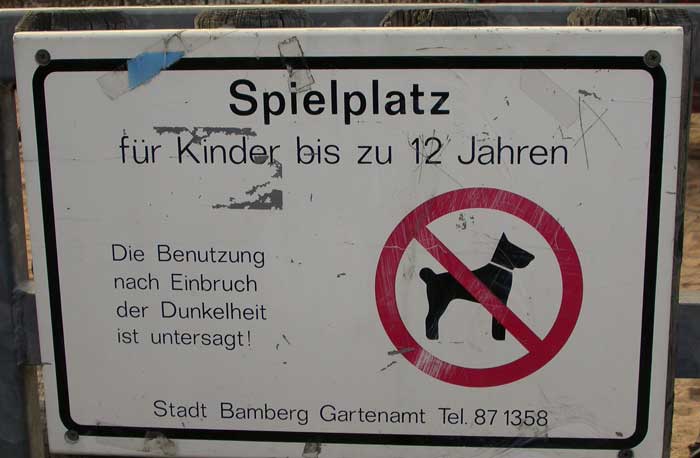
spielpw.jpg

Hope this is well lit at night.

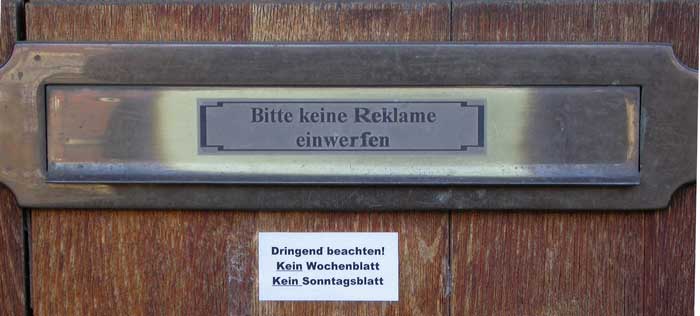
keinerw.jpg

This is just so tempting, but I didn’t have anything with me.

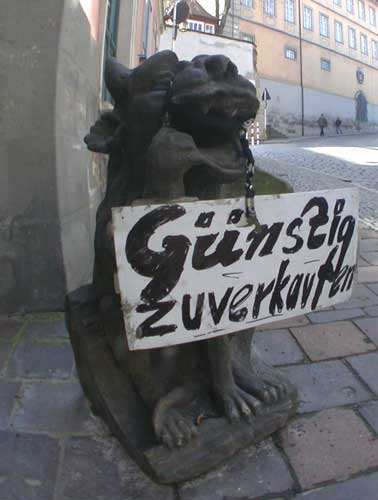
guenstigw.jpg

Of course, ‘good value’ is one of those flexible concepts.

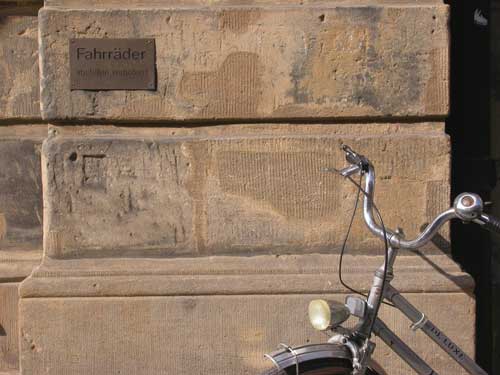
fahr2w.jpg

Fahrräder abstellen verboten

kehr1w.jpg

This house belongs to a family called Marx. Perhaps the text is trying to tell me something.

Translation job

Today a client called. Could I translate an eight-page employment contract into English by the end of March? Answer: most probably, although I need to see the document before I confirm that.

I’m now asking myself when a client last phoned up and wanted something in a civilized period of time? Almost everything recently has been for the next day. I’ve forgotten how to time things like this.

Nacherbe is *not* reversionary heir

Excuse me tearing my hair out, but I’ve just seen this recommended yet again, and it’s in several dictionaries, and it is wrong!

Under German law, a testator may leave stuff to a Vorerbe (prior heir) and a Nacherbe (subsequent heir). In the usual case, maybe a house to A for life, and when A dies, then to B.

That’s a bit like a life interest and a remainderman (remainderperson in some U.S. usage). A trust arises in English law, but the situation is similar. The remainderman gets what’s left.

These trusts can be quite complex. The testator may leave the estate to A for life, with remainder to B for life, and in that case, since clearly B’s heirs are not included, on B’s death the estate will revert to the testator – or rather, since the testator will be dead, it will revert to the testator’s heirs on intestacy (gesetzliche Erben). They are the reversioners.

It’s not a secret that revert means come back, is it?

But a Nacherbe is not a reversioner, not the heir(s) on intestacy of the testator. It might happen by coincidence, but that is not the definition. If any of those words fit, it will be remainderman, but since that’s a rather old-fashioned word unknown to the general public, people may want to write subsequent heir or final heir or something like that.

I haven’t got one law dictionary here that does not contain reversionary heir, sometimes alone (Dietl), sometimes as one alternative (Romain, von Beseler/Jacobs-Wüstefeld, Lister/Veth).

Bamberg

barockw.jpg

Die barocke Kreuzigungsgruppe wird zur Zeit saniert. Stiftung Weltkulturerbe Bamberg. Mit Unterstützung von brose – Technik für Automobile.

The small shadow at the bottom right edge, the shadow of a person with a cross, is not me, btw.