Penal Code song / Strafgesetzbuch-Lied

Strafgesetzbuch, von Vladimir Vysotsky, übersetzt von Martin Remane

Ich pfeif auf Advokatenwinkelzüge;
ich weiß recht gut, was die Justiz uns gibt.
Das Strafgesetzbuch sagt mir’s zur Genüge.
Als bestes Buch ist’s sehr bei uns beliebt.

Wenn ich ‘nen Kater hab und kann nicht schlafen,
nehm ich mir irgendeine Seite vor
und freß mich fest in all den Paragraphen.
Im Morgengrauen erst hau ich mich auf’s Ohr.

Glaubt nicht, ich möcht Ganoven Rat erteilen.
Raub ist – ich weiß – bei denen so beliebt,
weil’s dafür nach gewohnten Strafurteilen
‘nen Dreier nur, höchstens ‘nen Zehner gibt.

Doch lest einmal die reichlich langen Listen
verbotner Bücher, und ihr wißt genug!
Ein Nichts dagegen sind die kurzen Fristen
für Falschspiel, Rauferei und Scheckbetrug.

Soll das noch hundert Jahr so weitergehen?
Sieht man denn nicht ein menschliches Geschick
bei jeder Frist? – Ist kurz sie aus Versehen,
dann freu ich mich, dann hatte einer Glück.

Riskiere ich’s jedoch auch zu befragen
die Paragraphen, die mich selbst bedrohn,
beginnt mein Herz vor Schreck so wild zu schlagen,
als schlügen an die Tür die Bullen schon.

Translation © by Martin Remane

For English version and more information, read on. Continue reading

Languages Forum (originally ####)

I have already reported that the Compuserve Foreign Languages Educational Forum, FLEFO, has become The Languages Forum.

It appears that if you type FLEFO into a message there, the word is replaced by the Compuserve computer with #### (see thread on Translation Journal in the Transl/Interp MISC section). F-L-E-F-O gets through, though.

(Found via flefo.org, the sanctuary for those who want to talk about languages and don’t like having their messages deleted).

The Supremes do it again/Supremes wieder

In den USA heißen die Richter des Supreme Court The Supremes (auch die erfolgreiche Motown-Gruppe der sechziger Jahre), oder vor allem in Zeitschriften heißt das Gericht the High Court (auch ein erstinstanzliches Zivilgericht in England und Wales).

Headings like Another Witless Linguistic Error by the Supremes always make me think ‘Who’s getting at Diana Ross now?’

I suppose it’s just because I’m British (I have the same difficulty with lines in US papers like ‘High Court upholds death penalty’, although I know they aren’t really talking about the English High Court).

Of course, others have been here before.

Legal Protection of Cultural Property: English-language resources

The latest ‘issue’ of LLRX includes a guide by Louise Tsang on English-language resources on the legal protection of cultural property:

bq. The purpose of this guide is to direct the reader to important sources of information, both print and electronic, concerning the protection of cultural property in wartime, international trade in cultural property, and the laws applicable to the illicit traffic of art and antiquities. Section V of this guide highlights resources that are specific to the topic of restitution of Nazi-looted art. Section VI highlights resources on stolen cultural property in Iraq. This guide focuses on materials in English.

There are links and a bibliography, and international and EU law as well as the situation in individual countries are considered.

Hamburgers, Frankfurters/Wiener und Pariser

Following the discussion on Berliner, some discussion in the languagehat comments. John Emerson writes:

bq. Well then, why DID the effete Europeans name all their great cities after pastries and sausages?

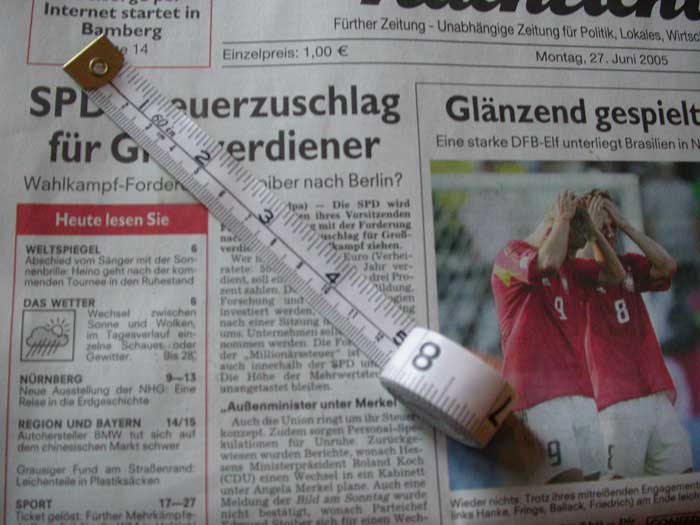
And Chris Waigl comments on the Amerikaner. Now I thought Amerikaner here were always black and white, but my search today (in the middle of a heatwave) only produced a white one. Here it is nearing the end of its life:

amer2_050627w.jpg

And here (added later) a vague indication of size:

ins_050629w.jpg

Of course there are Debrecziner and Krakauer, and even Regensburger. And on some translators’ list (pt?) there is currently a discussion about Engländer, Franzosen and Schweden – all of them types of wrench, if I understood it correctly. It can’t have been the Werkzeugforum, because I don’t read that.

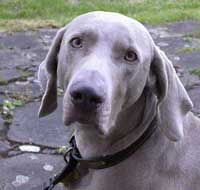
LATER NOTE: How could I forget the Weimaraner?

dog2_050608w2.jpg

Somebody’s granny working above some shop in Nuremberg/SDL und die Welt der Übersetzung

2003 hat der Marketing Director von SDL (die jetzt Trados gekauft hat) freiberufliche Übersetzer so beschrieben: “Irgend jemandes Oma, die über einem Laden in Nürnberg arbeitet”.

I’m a bit behind the times with this 2003 quote from Hedley Rees-Evans, SDL’s marketing director:

bq. The companies also face price competition from small outfits that may focus on translating into one language, or from people with personal ties to corporations. Companies continue to farm out work to such individuals, but are learning that a more sophisticated provider may be a wiser choice, said Rees-Evans.

bq. “It’s somebody’s granny working above some shop in Nuremberg,” he said. “Then they realize that there are actually economies of scale to be realized and questions of quality.”

Thank goodness I have left it too late to be a granny. I do work above a shop, and not far from Nuremberg. And I agree that economies of scale can be made, and that questions of quality need to be considered.

(Thanks to Marc Prior)