This weblog will soon be closing down for about two weeks, at which time comments will be closed to avoid spam.
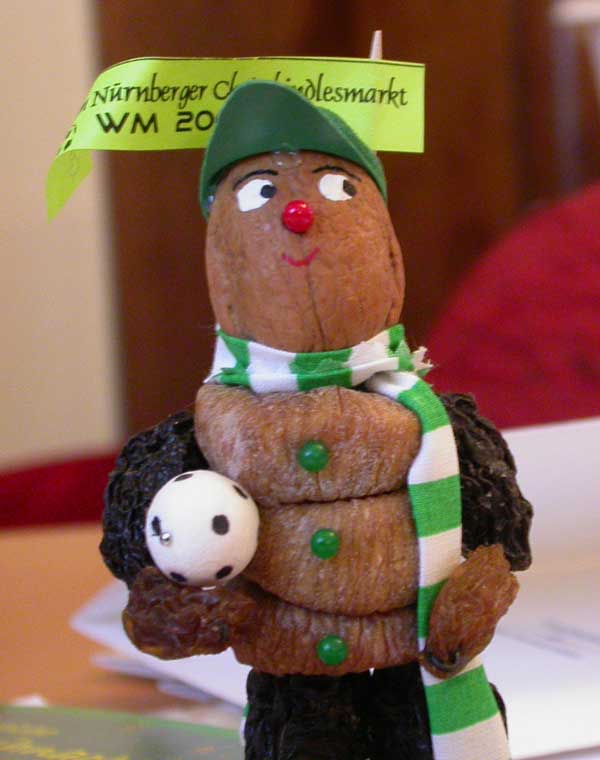

This weblog will soon be closing down for about two weeks, at which time comments will be closed to avoid spam.
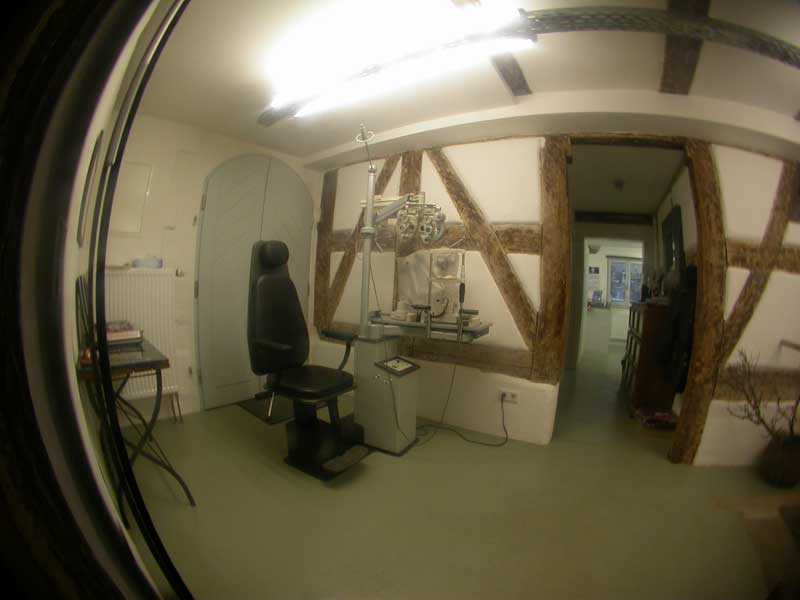
This optician’s on the Grüner Markt in Fürth reminds me of the Optician’s sketch by the Two Ronnies – they would have found an A or a K immediately.
The Nürnberger Nachrichten recently tested Lebkuchen to find the best (I’m surprised the link still works – it probably won’t for long). The result was obvious, but I suppose one must allow them to indulge themselves.
Nach dieser Absolution liegt schon im ersten Durchgang die Bäckerei Düll aus der Mathildenstraße 28 vorne. Ihr weißer Elisenlebkuchen holt Note 1, weil er üppig und perfekt aussieht, gut duftet und seine mit Feingefühl dosierten Gewürze lange nachschmecken. ‘Saftig und dick’ entfaltet auch das Schokoladenexemplar (1 minus). Mit Piment, Kardamom, Muskat und mehr, dezent, aber anhaltend im Abgang, entlocken die Düllschen Produkte Tester Reitzner den Seufzer: ‘Wirklich eine ganze Mahlzeit.’ Und eine gute dazu. Qualität hat ihren Preis: Fünf Stück kosten 8,95 Euro.
(Following the absolution (of Pope Benedict with regard to Lebkuchen in general – he likes it), Bäckerei Düll of Mathildenstraße 28 leads the field in the very first round. Their white Elisenlebkuchen gets top marks (1): it looks luxurious and perfect, it smells good, and its judiciously measured spices linger on the palate. The chocolate-covered version is also ‘succulent and thick’ (1-). With allspice, cardamom, nutmeg and more, subtle, but with a long finish, the Düll Lebkuchen leads the tester Reitzner to sigh, ‘Really, a whole meal in itself’. And a good one. Quality has its price: five cost 8.95 euros.)
Man kann Düll Lebkuchen auch übers Internet bestellen, sowie per Telefon und Fax. Die Bilder auf der Website sind irreführend schlecht.
Elisen Lebkuchen is the name of the most expensive quality, only a maximum of 7% of which is flour – the rest is fruit and nuts. The local bakeries make Lebkuchen that is slightly soft and chewy, not dried out.
Düll (English and German)
Eur-Lex ändert sich (nicht ganz fertig).
Eur-Lex is about to change to this interface.
(via LAWgical)
The Times Online also has David Pannick’s review of 2005:
Cartoon of the year was by Pat Byrnes in The New Yorker. One lawyer says to another, Remember, we can only afford to do all this pro bono because of how much anti bono pays.
David Luke, who has died at the age of 84, is described by the Times as:
bq. Translator of the German classics whose versions were regarded in some quarters as being better than their originals.
Some of my translations are better than the original, but they aren’t by Goethe. The comparison was made by Stephen Spender.
bq. According to his own account, it was the realisation that most of his pupils simply lacked the linguistic knowledge to understand and enjoy the great riches of German literature that led him to embark on the sustained work of translation that began with his translation for Penguin of the poetry of Goethe in 1964 and continued almost until his death. His published translations, which included much or most of Kleist, Mörike, Stifter, the Brothers Grimm and Thomas Mann as well as almost all the poetry and much of the prose of Goethe, are likely to be his most enduring literary legacy. …
bq. (He once complained to the chaplain at Christ Church that his pupils took no interest in German grammar; all they were interested in was fornicating. To this the chaplain replied: But you must admit, David, fornicating is much more interesting than German grammar. He did admit it.) …
bq. Eventually he was received into the Russian Orthodox communion. For some years he was an active member of the North Oxford congregation where he sang the Church Slavonic liturgy with great gusto and delight. Finally, however, he found it impossible to reconcile the facts of evil with the hypothesis of a benevolent creator.
I would like to know more about how most of Luke’s doctoral thesis was typed on lavatory paper (I write that as someone whose thesis should have been typed on lavatory paper).
There’s an obituary in the Independent too, but it costs money to see it.