Video via pt at Yahoogroups.
In all fairness, some West Germans should be asked to draw West Germany too.

Video via pt at Yahoogroups.
In all fairness, some West Germans should be asked to draw West Germany too.
A more coherent European wide [sic] legal language, by Viola Heutger, of the University of Utrecht, is an online paper (PDF or html) I found through DORES, whose latest set of new publications relating to language and law has just appeared. It doesn’t concentrate, as one might have expected, on the common law – civil law divide.
bq. The German formalistic Civil Law Codification is largely unreadable as far as a non-German lawyer is concerned. Without any special indication as to the use of terminology this codification can rarely be understood. If we remain with the German language we must realize that with a knowledge of German legal language the other German-speaking legal systems of Switzerland and Austria or not automatically accessible (Grossfeld, 180). Very simple terms have different meanings. When a German speaks of Besitz, he means factual possession. However, an Austrian lawyer understands Besitz as the factual possession including the animus domini. What a German understands under Besitz, is for an Austrian Innehabung. So even German speaking lawyers from Austria, Germany, Liechtenstein and Switzerland will not understand automatically each others concept-based legal terminology. It cannot be expected e.g. that the German knows what is meant by the Austrian terms of a Präsenzdiener or a Landeshauptmann, a Aufsandungsurkunde or a Superädifikat.
I imagine the varying meaning of Besitz is more of a problem than the last four terms.
The article and bibliography contain some useful links.
We know that all translators earn at different rates. Literary translators translate stuff like Finnigans Wake and supplement their income by selling matches on street corners. Technical translators are locked into CAT systems and forced into dwindling returns for repeats as a result. Financial translators charge £500 per page for glossy brochures on stock-exchange startups but take several weeks to research them. And then there are those freelances who charge £15 per 1,000 words and make £300 per hour because they employ harems of audiotypists.
On a German translators mailing list, u-forum, there is a heated discussion on this topic (a euphemism for a bit of a free-for-all, with all sides accusing each other of ruining the market). Should I be amazed at the vitriol?
Its focused on an article by Luis Cerna, based on rates in Germany, in which he says you should not work for more than 2000 hours per year for the sake of your health (what health?), and only 1000 of those hours will be translation, as opposed to acquisition, bookkeeping, organization etc.
Bei u-forum gibt es eine Diskussion auf Deutsch über Übersetzereinkommen für Freiberufler in Deutschland. u-forum findet man in dieser Liste bei Alexander von Obert.
Es geht zum Teil um diesen Artikel von Luis Cerna (deutsche Version).
LATER NOTE: The ADÜ-Nord’s survey on translators’ rates has now been published in book form. There’s a summary (in German) on the ADÜ-Nord website.
New words in Denver
On December 29, the Denver Post reported on new words entering the common lexicon (thanks to Karen – I’ll send you your Christmas card next year). At the top of the printed edition was prairie-dogging: when the heads of office workers pop up over dubicle walls in response to a loud voice or noise. I wasn’t too impressed with blogosphere, podcast or vlogs, and chattering classes is presumable new only in the USA. But there’s a longer list there.
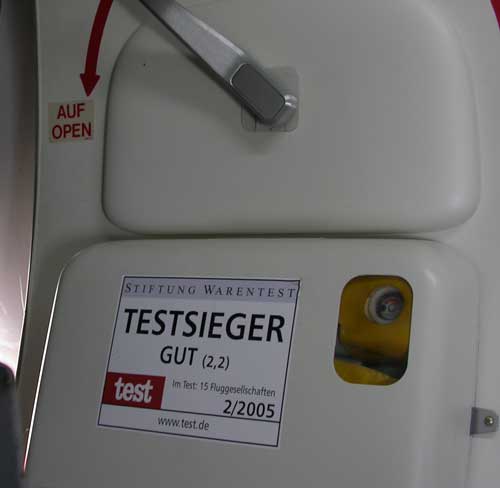
Air Berlin
Free trip to Portugal
The translation company Lingo24 (of Aberdeen, Romania and points east) has a competition for a company slogan – the prize for those in the UK is a trip to Portugal and accommodation for three nights. The slogan has to be snappy and translated into another language. Deadline is February 14.
Busted without help

Lidl, Romford, December 2005.