



I know I ought to correct this translation, but I haven’t got time at the moment. Here’s the German original and English translation in Wikipedia (which is often very useful):
bq. Er schrieb darin nach herkömmlicher Ansicht das bis dahin mündlich überlieferte Recht nieder, das im sächsischen Gebiet gültig war. … 2005 verglich der Kanonist Peter Landau den Buchbestand des Zisterzienserklosters Altzelle mit den Quellen Eikes und kam zu dem Schluss, dass eine Entstehung in der Nähe von Altzelle wahrscheinlich sei.
Der Sachsenspiegel, eines der ersten Prosawerke in deutscher Sprache, gilt als bedeutendes Zeugnis für die beginnende Vereinheitlichung der deutschen (mittelniederdeutschen) Schriftsprache. Die große Wirklichkeitsnähe (erprobtes und bewährtes Recht) verhalf der Rechtssammlung zu hoher Akzeptanz.
bq. Von Repgow wrote in his conventional view the traditional law that was widely used in the Saxon territory. By modern views of the gunner Peter Landau in 2005, he compared the bookstock of the Zisterzienser Monastry of Altzelle with the sources of Eikes and came to conclusion that a creation near Altzelle would be possible.
The Sachsenspiegel, one of the first prose works in German language, is an important testimony for the beginning unification of the German (middle lower German) literary language. The great reality proximity (field-tested and test-stooded law) helped the Sachsenspiegel to get greater acceptance.
I don’t read everything that critically, but it was the combination of failing to understand some sentences and the sudden appearance of a gunner instead of an expert on canon law (German doesn’t have our distinction of NN and N between cannon and canon) that made me wonder if this wasn’t MT.
Giant insect invades Germany, reports Slashdot.
Here’s the Google Earth image. I was actually driving quite near here at the weekend, but I didn’t notice anything.
And here’s the solution.
bq. Interesting find – a first. It looks like a thrips, a very small (1mm or so) insect. The size might explain how it got involved in the printing process. The brown glob at the posterior end is bug poop, forced out of the poor critter as it got squished between a glass plate and the film during the scanning process.
Thanks, of course, to Trevor.
Link zur Jurameer-Ausstellung in Eislingen
Der letzte Ichthyosaurus, von Joseph Viktor von Scheffel (der natürlich auch das Frankenlied geschrieben hat, wie ich leider seit meinem 21. Jahr weiß)
This collection of 3D ichthyosaurus and friends was happened upon when a road was being built in 2002. I went to the exhibition in Eislingen last Sunday.
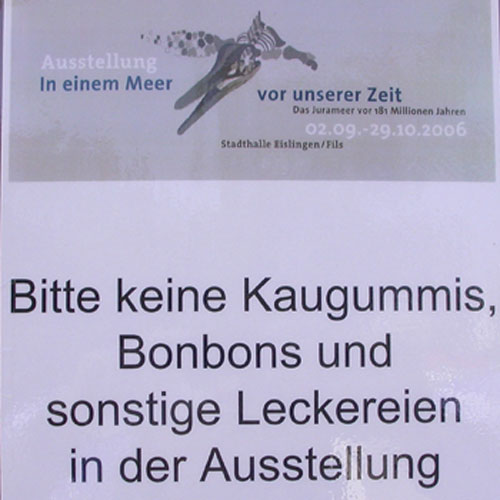

What is particularly exciting is that I have discovered a new ichthyosaurus myself – the one on the logo! The blue picture is part of a postcard showing the exhibit hanging inside (no photos allowed). The whole thing is plaster. The dark bits are casts of what was found, the pale bits of what was reconstructed – hence the exciting eyeball socket. The creature almost certainly travelled up and down with its mouth open, rather like me on my office chair reading exciting news on the Web. Its upper jaw is longer, presumably for bashing its food on the head. But the one in the logo has a longer lower jaw, like a bottom-feeder. I wonder if anyone else has noticed this discrepancy.
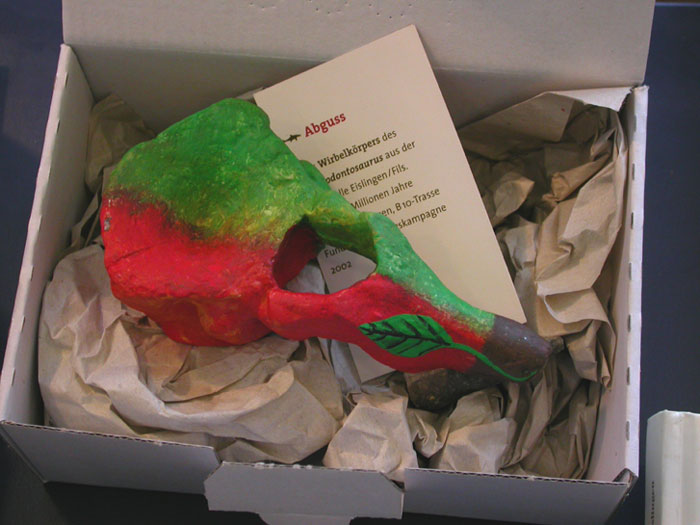
The first bit discovered was a vertebra. You can request your own colour cast (I didn’t get one).
Riccardo announces that he is teaching a course at the University of Denver on the Foundations of Translation. He will be posting his lecture notes in his blog.
bq. It will concentrate on the fundamentals that all translators should know: A deep knowledge of ones own native language and of at least one foreign language is a necessary prerequisite, but, alone, it is not sufficient. To become a translator one should also fully understand the subject-matter of the text to be translated, and have knowledge of things such as translation tools, reference materials, translation processes, and, above all, self-knowledge – knowing what one knows as well as an awareness of what one does not know.
Here is Lesson One.
The Daytona Beach newsjournal.online.com reports on a Spanish-speaking subject who is claimed to have waived his right to silence but says he didn’t understand everything that was said.
bq. Olmos was questioned at times by a Spanish-speaking police officer called out to be a translator, but investigators also asked him questions in English. Investigators say during those conversations Olmos waived his right to remain silent.
Olmos’ attorney and some experts say instead it’s likely the suspect didn’t understand what police were telling him and everything said to them that night should be thrown out of his murder trial.
Obviously, lawyers often claim that their clients did not understand what was happening, but in this case the argument is stronger than usual.
bq. Dr. Robert Sitler, a language professor at Stetson University, said that even in the rare case that a person is truly bilingual, unexpected switching of languages by interrogators would produce confusion.
“If the person’s brain expects to hear a particular language, words in another language, especially the first ones uttered, will often go unrecognized, even if the person is familiar with the words,” Sitler said.
Of course, the confession (which is quoted in detail) may be true. But the problem might have been avoided if an independent professional interpreter had been called in.
This follows an earlier case which I think I reported:
bq. Juan Ramon Alfonzo was sentenced to 15 years in prison in December 2004 after pleading no contest to what he understood through court-appointed translation to be for stealing a toolbox. It turned out the translation was botched and his plea was actually for stealing a dump truck.
A year later, Circuit Judge William Parsons reversed his sentence and after a retrial Alfonzo got a five-year sentence instead of the 15. The court-appointed interpreter was fired.
The case caught the eyes of Florida legislators, who passed a bill in May requiring court interpreters to be certified.