Still braining up / Es ist nicht immer Denglisch

Some time ago I was irritated, like many people, by the then minister of cultural affairs’ use of the word brain up. Scarcely twenty-four hours after I had posted about this, I had to eat my words (in German, one eats Hirn rather than Gehirn): sure enough, the term could be justified – although I still don’t like it.

Now Bremer Sprachblog reports that German papers are still complaining about it. My past record means I can’t be very smug about this.

Mir ist schon klar, dass die Fähigkeit zur eigenständigen Recherche auch in den Printmedien nicht mehr so ernst genommen wird wie früher. Vielleicht steht in den Redaktionsräumen der ZEIT auch kein aktuelles englisches Wörterbuch. Aber ich bin mir ziemlich sicher, dass man dort Internetzugang hat und dass man weiß, wie Google zu bedienen ist. Also hätte man doch einfach einmal die Wörter to brain up eingeben können. Die Suche hätte man auf Webseiten aus Großbritannien, dem Mutterland der englischen Sprache, einschränken können, um wirklich nur englischstes Englisch zu erhalten. Und dann hätte man unter den ersten Treffern gleich mehrere Seiten bedeutender britischer Presseorgane gefunden, die zweifelsfrei belegen, dass das phrasale Verb to brain up sehr wohl existiert.

Of course, these are the people who think we stole wishy-washy from them.

Register office / Standesamt

Register office is the official term, as I opined in a comment in an earlier entry. I don’t really have a problem with registry office, but some people clearly do – so watch out, translators into English!

John Bolch’s rant in Family Lore.
His smug post today on a petition that was rejected by the court, in part because it contained the term registry office.

Surely something like this must have happened in Germany too?

LATER NOTE: comments closed for the second time on August 3, after I deleted ten spam comments, each containing a different set of a few dozen URLs in China.

Comments can always be sent by email, or put on a newer entry with a request to me to move them.

Journal of Specialised Translation

The online Journal of Specialised Translation has appeared again, this time with an issue on revising.

Brian Mossop wrote a wonderful book on revising, which has just come out in its second edition. His article describes a number of empirical studies of revising techniques. Questions arise, such as how often revision simply makes a translation worse.

The introduction is in French and so are some of the articles, but they do have English abstracts. I’m looking forward to reading more.

The liquorice fields of Pontefract / Lakritz

20070723fue003w.jpg

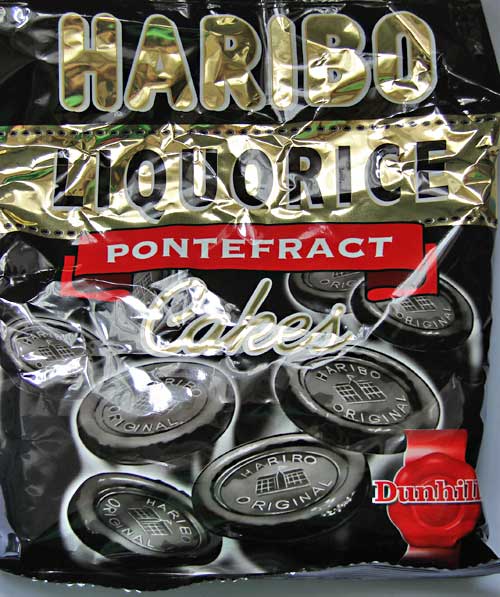
They look like Pontefract cakes … but what’s this I read:

20070723fue001w.jpg

Haribo! Someone tell me it’s a nightmare and I’m going to wake up. It’s not that I have anything against Haribo, if they stick to their Goldbären and Weingummi and Colorado and even liquorice snails. But these ‘Pontefract cakes’ (from the UK) have an inauthentic uniform gelatinous quality and don’t hit quite the right flavour. True, the real thing can easily get too hard, but can they deprive us of the pleasure of hitting upon a fresh box, with that quality of being almost leathery and yet friable at the same time.

Haribo says on its website that it acquired a majority share in Dunhills in 1972 and the rest in 1994 and then:

New recipes and manufacturing methods helped to improve product quality. HARIBO brought new recipes, as well as gelatine manufacturing technology from Germany, which greatly improved the product quality.

Well, let’s just say it made it more gelatinous. Improved, indeed!

Note the rather poor stamp on the sweets: ‘Haribo original’, and a picture of Pontefract Castle. ‘Original’, my foot!

But thank heavens, Wilkinson’s are still around. See The Sugar Boy:

These are made by Wilkinsons who along with Dunhill (now owned by Haribo) are the only remaining manufacturers from the many there used to be in Pontefract. This is a drier, thicker cake than the Dunhill version, each has its loyal fans so try both varieties and decide for yourself.

Here’s more information from Wakefield Council. I read that John Betjeman wrote a poem called ‘The liquorice fields of Pontefract’, and Harold Shipman started his career there. I actually learned it was pronounced Pumfret, but I now gather that is the way it is pronounced if it is spelt differently.

She cast her blazing eyes on me
And plucked a licorice leaf;
I was her captive slave and she
My red-haired robber chief.

But I don’t want to be too narrow-minded, so I may take up Andrew’s suggestion in German Joys of buying a mixed packet of Dutch liquorice (or licorice, as he spells it). Here’s the online shop he recommends.