Schlimmbesserung/Verschlimmbesserung

I am perhaps rather late to discover the new English word Schlimmbesserung (should be Verschlimmbesserung).

I saw it on Susan Hill’s blog today, but to comment there I would have to register. It’s used by the guest blogger, Robert Matthews.

But Google reveals more instances. I wonder if it started in Howard Rheingold’s Book They Have a Word for It, which I happen to have here because someone gave me it – I am a bit allergic to these collections of spurious terms from all world languages:

The time is ripe for that good old German word for improvements that make things worse: Schlimmbesserung (sh-lim-BESS-air-oong). While perfect for many egregiously inappropriate applications of technology, Schlimmbesserung is by no means limited to technological “improvements.”

But no, I find 2005 instances online.

The thing is, Verschlimmbesserung makes more sense in German, with the ver– prefix indicating a change.

Still, I suppose if Germans can amend the English language (body bag), English speakers should be able to amend German too.

It’s amazing what you can learn on the internet. A favourite word of Einstein’s! From Dyneslines:

Schlimmbesserung is a rare, but useful German term to designate an effort to make something better that actually makes things worse. According to Sebastiano Timpanaro, the brilliant Italian philologist, the term originally derived from the exacting discipline of textual criticism.

MT general terms/AGB nach MÜ

From a website – machine translation is not the solution for every text:

§2 Zustandekommen. Ihre Bestellung wird angenommen, solange der Vorrat reicht. Der Vertrag zwischen Ihnen und uns kommt durch die Annahme unsererseits zustande. Dies kann auch durch die Zusendung der Ware geschehen.

§ 2 Consummation. Your order will be accepted as long as supplies last. The contract between you and us by the adoption of our agreement. This can also be improved by sending the goods.

§5 Fehllieferung. Sollte die gelieferte Ware nicht der bestellten Ware entsprechen, so teilen Sie uns bitte mit, auf welche Weise Sie eine Regulierung wünschen. Wir bitten Sie im Falle einer Rücksendung, das Rückporto (ein frankierter Paketaufkleber) bei uns anzufordern oder das Porto für uns auszulegen und die Rücksendung ausreichend zu frankieren, um die hohen Kosten einer unfreien Sendung bzw. Strafporto zu vermeiden. Das Rückporto werden wir Ihnen dann umgehend erstatten. Wir werden Ihnen in angemessener Zeit Ersatz liefern oder für die Beseitigung des Fehlers sorgen. Bei fehlgeschlagener Fehlerbeseitigung bzw. Ersatzlieferung können Sie Ihr bezahltes Geld zurückverlangen oder den Preis mindern. Im übrigen gelten die gesetzlichen Bestimmungen.

§ 5. If the goods are not delivered the goods ordered, so let us know in which way you want to regulate. We ask you in the event of a return, the return postage (one frankierter package sticker) with us, or the postage for us to be and the return to frank enough to justify the high cost of a postage charges for shipment or to be avoided. The cost of the return postage will be refunded immediately. We will give you adequate time to spare or provide for the elimination of the error. During an unsuccessful troubleshooting replacement or your money back or paid the price. Moreover, the statutory provisions.

Another one. Names removed to protect the ignorant:

§ 1 Allgemeines

I. XXX (Deutschland) GmbH führt die Versendung von Waren, die der Kunde im Wege des Fernabsatzes bestellt, auf der Grundlage der nachfolgenden Allgemeinen Geschäftsbedingungen (AGB) durch. Der Kunde erkennt die AGB mit jeder Bestellung an.

II. Unsere AGB gelten ausschließlich. Abweichende Regelungen werden nicht anerkannt. Sie haben ausnahmsweise Geltung, wenn sie zwischen der XXX (Deutschland) GmbH und dem Kunden schriftlich vereinbart worden sind. Die Aufhebung dieses Schriftformerfordernisses bedarf ebenfalls der Schriftform.

III. „Verbraucher“ im Sinne unserer AGB sind natürliche Personen, mit denen in Geschäftsbeziehungen getreten wird, ohne dass diesen hierbei eine gewerbliche oder selbständige berufliche Tätigkeit zugerechnet werden kann.

IV. „Unternehmer“ im Sinne unserer AGB sind natürliche Personen, juristische Personen sowie rechtsfähige Personengesellschaften, mit denen in Geschäftsbeziehung getreten wird und die hierbei in Ausübung einer gewerblichen oder selbständigen beruflichen Tätigkeit handeln.

V. „Kunde“ im Sinne unserer AGB sind sowohl Verbraucher als auch Unternehmer.

§ 1 General

XXX (Deutschland) GmbH does the dispatch of goods by the customer in accordance with the distance ordered on the basis of the following terms of use. The customer recognizes the terms and with each order.
Conditions apply exclusively. Different arrangements will not be recognized. They have exceptional coverage if they have been agreed upon between XXX (Deutschland) GmbH and the customer, in writing. The repeal of this writing requirement must also be in writing. Formularmäßigen reference to the terms and the customer is contradicted.
“Consumer” within the meaning of our terms and are natural persons with whom business relations underfoot, without these have an independent professional or commercial activities.
“Entrepreneur” in the sense of our terms and are natural or legal persons and legal persons companies with which business relationship underfoot and assisted in the performance of a commercial or self-employed professional activity.
“Customer” in the sense of our terms and are both consumers and entrepreneurs.

German-Language Culture and Its Reception/Konferenz in Liverpool

WIGS, not to be confused with WAGs, stands for Women in German Studies, co-organizers of a conference in Liverpool next week.

IMPACT: German-Language Culture and its Reception

Venue: Foresight Centre, University of Liverpool, 23 to 25 July 2008

The programme can be seen at the link. Via an ITI list, I also received details of the Thursday evening round table discussion. No guarantee as to their correctness:

At
The Auditorium, Tate Liverpool, 17:30, Thurs 24 July 2008.

Featuring
Chair: Michael Schmidt, Professor of Poetry (Glasgow), editor Carcanet Press
Christoph Grunenberg, director of Tate Liverpool
Karen Leeder, Reader in German (Oxford), freelance translation and radio
work
Walter Meierjohann, Associate Director at Young Vic Theatre, London
Rebecca Morrisson, Editor of New Books in German (London)

A round table discussion followed by questions invited from the floor

How receptive is the British public to the history and culture of its close
neighbours in German-speaking Europe? Come and listen to 6 industry
specialists from publishing, theatre and the art world discussing the
practical challenges and cultural considerations in packaging
German-language culture for a British audience. Have the fall of the wall,
the increased profile of contemporary German-language film and literature in
translation, and the successful hosting of the 2006 World Cup altered
British attitudes to the German-speaking countries, or do representatives of
all things German still find themselves battling against ingrained
stereotypes? Is the dramatic decline in European language learning at
British schools cementing intolerance and cultural indifference for
generations to come, or might it actually increase the market for
translation and specialist cultural mediation?

Neue Mitte/Pictures

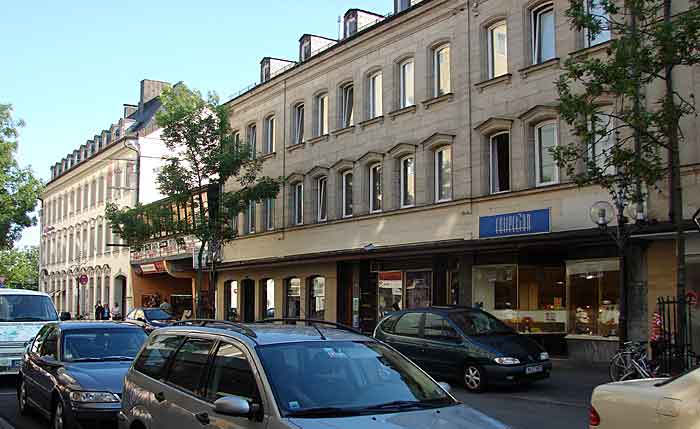
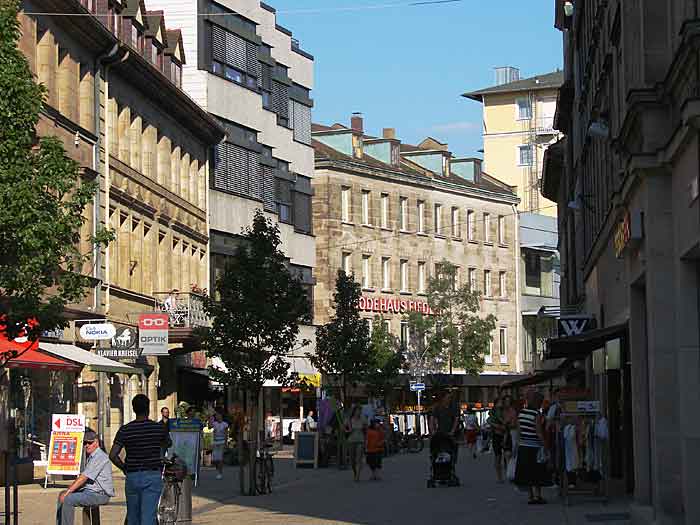
Here is Rudolf-Breitscheidt-Straße from the western end, looking towards the prospective shopping centre site. A sort of glass wall will cut across this street. In the distance, the tall building is the Park Hotel, which is not listed and is available for demolition. This side of it is the former Fiedler department store (clothes and household furnishings), marked with its name, now largely disused, and nearer, spot the Commerzbank building, rather an eyesore.

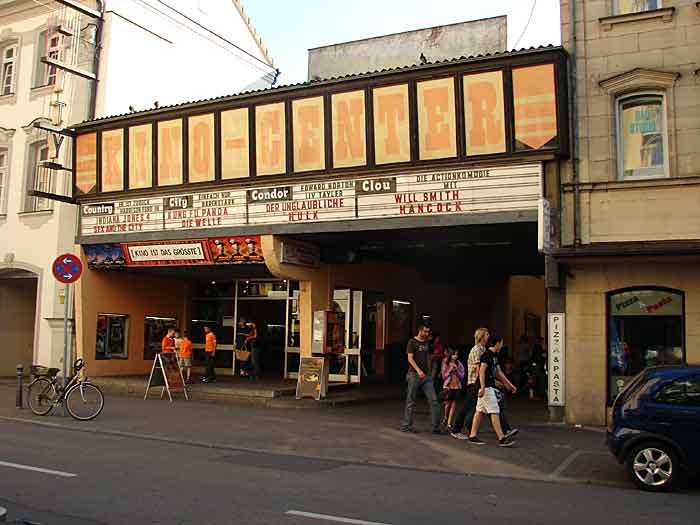
We have now moved along the street and are looking at the right-hand side at the other end of the development. The Park Hotel is out of view, to the left. On the right, distant, is the former HypoVereinsbank building, which is to remain. This side of it the cinema, and nearer the camera some low buildings, listed, which are to be pulled down.

Closeup of cinema (I rather like it myself):

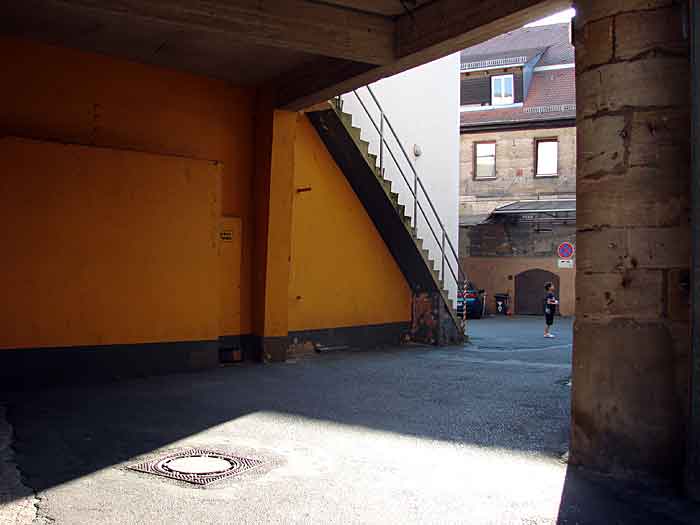
Here is part of the area behind the cinema known as the Wölfel-Areal. This rather Chandleresque area will probably be missed by no-one except me. It belongs to my landlord.

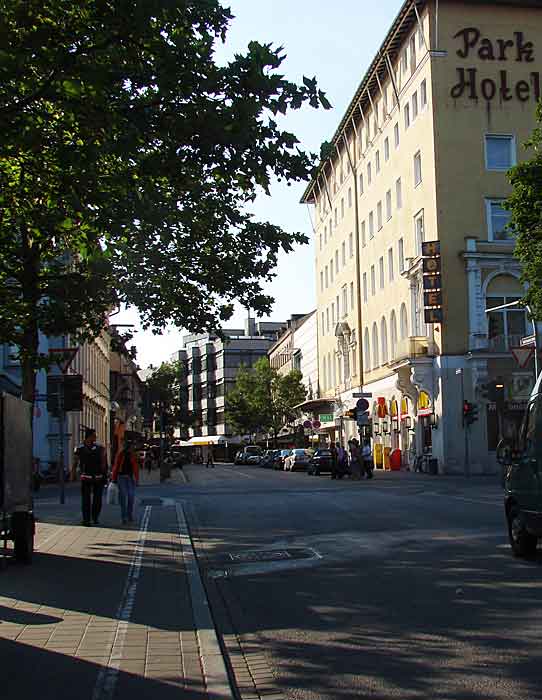
Finally, now looking from the east and Fürther Freiheit back to the Park Hotel. It’s not listed – it was originally completely different. Only the ground floor is now partly inhabited by McDonalds. I think the shell may be 1950s. It will be a loss. Yet another view of the charming Commerzbank.

There are some design drawings in the Fürther Nachrichten.

I’m writing as though the plan were decided, which it is not. Only 80% of the land has been acquired. There are tenants who need to be moved to cheap housing elsewhere and might refuse. I remember hearing stories from an estate agent on rehousing a large number of Turkish tenants who lived at cheap rents in the area where the City Center was built.

Neue Mitte Fürth/Destruction of Fürth to proceed

I have been remiss in not publishing last Thursday’s shocker: a Portuguese concern looks likely to replace part of the centre of Fürth with a huge glassed-in shopping centre.

Photos in next entry.

Links to the local rag and a heated discussion in German at zonebattler’s blog.

It looks as if the town council will consent to the project on July 30th. It has been hushed up until now.

The prospective investor, Sonae Sierra, is also responsible for the rather unattractive Alexa Center in Berlin.

One negative aspect might be the intention to use the first railway as a theme. This could be quite trivial. Some of the underground stations already have tiled versions of the train, which seems enough to me.

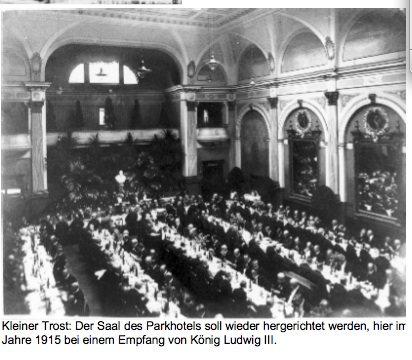
A positive aspect would be the resurrection of the first-floor banqueting hall in the Park Hotel – the hotel itself would go – which no-one ever sees. The hotel has been altered several times and is not listed, but I imagine the hall should be. It would be used for restaurants and cafés, well, better than not seeing it at all.

In the Stadtheimatpfleger’s latest PDF newsletter there is a photo of the hall in 1913 which I can’t find anywhere else (click on Rundbriefe). I have pinched it:

I think that this would be more than a small comfort (kleiner Trost). I am very keen to see it.

What disturbs me most about the whole thing is the virtual loss of Rudolf-Breitscheidt-Straße as a public street. At the moment the City Center – a previous and now failed similar project – is closed after 18:00 and, of course, on Sundays. The new place would presumably stay open till 20:00. Obviously the fact that this street is the natural pathway from Schwabacher Straße to Fürther Freiheit is part of the attraction – people, potential shoppers, will walk through there. But when it’s closed, the centre is going to be deader than ever (especially since so many comfortable seats have been removed so no-one can sit down comfortably on warm evenings).

This certainly explains why they’ve been slow to pave Rudolf-Breitscheidt-Straße as a pedestrian street.