I watched a programme on John Le Carré on arte on Sunday and was surprised to hear that George Smiley lived near Baywater Street and that there was a row of gregorianische Cottages there.
I can’t explain the former, but I quickly realized that gregorianisch refers to the architecture that started in the reign of King Gregory I and continued through his other namesakes to that of King Gregory IV.
The text was a reading from the translation into German of Smiley’s People (Agent in eigener Sache), so I don’t know if this was the work of the translators or the reader. However, Google finds a lot of this architecture, seemingly always in Britain or Ireland, so my guess must be right.
Here’s one example:
Auf der Fahrt zu den Sehenswürdigkeiten auf dem Lande kommen Nordwales-Besucher immer wieder durch Städtchen, die zu einer Pause einladen. In St. Asaph ist ein Blick in die Kathedrale lohnenswert, Ruthin besticht mit einem Architektur-Mix aus Mittelalter, Tudor und gregorianischer Zeit.
Here’s the story of the unfortunate demolition of one of these obscure cottages:
Ein wirklicher dummer Zufall: Nachdem er für 400.000 Pfund die Angel Cottage in Windmill Lane, im Osten Londons, ersteigert hatte, fuhr der neue Besitzer Mubarak Patel für einige Zeit ins Ausland. Während seiner Abwesenheit rissen Bauarbeiter, die er eigentlich für ein anderes Gebäude bestellt haben wollte, das 1826 erbaute Anwesen ein – das einzige gregorianische Haus in dieser Gegend. Ein Versehen, so hieß es zunächst. Später wollte Patel sich zu dem Vorfall nicht mehr äußern.
And here is a pre-demolition picture and a British report:
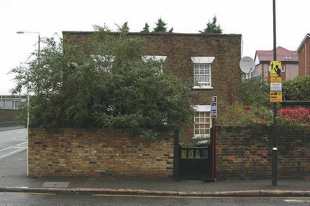
A LISTED building in Stratford has been illegally demolished over the weekend.
Angel Cottage was one of the last remaining buildings dating back to late Georgian times.
Newham council and English Heritage are still trying to determine how it was destroyed.