Shopping centre plans in Fürth/Bürgerinitiative Eine Bessere Mitte für Fürth

I’ve already mentioned the mayor’s secret plans to replace part of the centre of Fürth by a huge new shopping centre. Now a protest group has formed, in favour of a better plan: Bürgerinitiative.

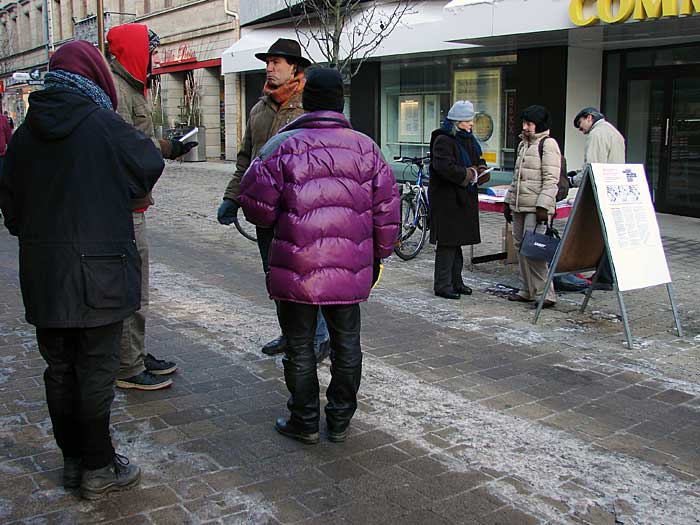
Here are some of them disseminating information in Rudolf-Breitscheid-Straße last Saturday:

On Thursday January 15, i.e. tomorrow, there is to be a talk by an architect, co-editor of a book on the effect of shopping centres on city centres, Dr. Holger Pump-Uhlmann, preceded by something about the history of the Rudolf-Breitscheid-Straße, formerly Weinstraße, with pictures, by Lothar Berthold, who publishes books on the history of Fürth.

The latest newsletter from the Stadtheimatpfleger, Dr. Alexander Mayer, summarizes the plans and contains a lot of photos with clear indications of which buildings would be demolished if the project Neue Mitte went ahead as planned (and the potential investor is apparently not prepared to give way on the main points). It’s Rundbrief no. 47.

John DeFrancis and Derek Bryan

I see that John DeFrancis died on January 2, 2009, and that he had an exciting life (via languagehat).

Biography:

John DeFrancis, emeritus professor of Chinese at the University of Hawaii, began his career in Chinese immediately after graduating from Yale in 1933 by spending three years studying and traveling in China. Apart from academic study, his learning experience included grassroots contact with the language and people in the course of a 4,000-mile trip in Northwest China and Mongolia that involved trekking 1,000 miles across the Gobi Desert by camel and floating 1,200 miles down the Yellow River on an inflated sheepskin raft.

It was his books that were used in class when I learnt Chinese. I started in 1969, when they were fairly new, and went through the three sets of three volumes (basic text plus character text and reader) in evening classes, first at Holborn College in Red Lion Square. We eventually did the Cambridge O Level and A Level exams, which unlike the London exams were intended for non-native speakers, so instead of four novels at A Level we did something like four short stories or extracts from longer books. I think I still have the books somewhere in Upminster. We did a story by Lu Xun, can’t remember which, and something by Ba Jin.

Later I attended courses in my spare time at Cologne University (classical poetry) and Bonn University (where the diplomats studied). But I never made the leap to fast reading or real fluency, although I reached the point where it would not have been hard.

The DeFrancis books fascinated me with their setting in a world quite unlike Chairman Mao’s China, a world where a young American student could strike up a friendship with a young Chinese student in Beijing.

Our teacher was Derek Bryan, who had left the diplomatic service after his sympathetic view of Communism became known – I see he has made Wikipedia and didn’t realize he was a friend of Donald Maclean’s, nor that he helped resolve the Yangtze Incident (he was in China from 1933 to 1943). Derek wasn’t a Communist – he was a Quaker – and he was an ideal person to introduce China. One problem, however, was that he too often corrected DeFrancis, saying ‘you wouldn’t say it that way’ – I had the feeling that we should rely on the book slightly more and find out for ourselves later what was more natural. Another problem of learning Chinese was the big gap between the vocabulary of Mao and the People’s Daily, and everything published in China, and literature, because every unfamiliar character took such a long time to look up.

I see that Derek and DeFrancis were born in 1910 and 1911, but Derek died in 2003, so he only reached the age of 92 (perhaps I should brush up my Chinese again).

DeFrancis’s books were more approachable than the ones from China, which at that time were also heavily politicized. I see most of them have been revised – here is a list of his books.

Derek Bryan: obituary in the Guardian; remarks on a visit to China in 1999.

Judgment/Beschluss und Urteil

This is about translating the German words Urteil and Beschluss.

Here’s the German Federal Labour Court (Bundesarbeitsgericht) on its English pages:

There are two different kinds of Labour Court procedures, “Urteil” procedures and “Beschluss” procedures. They differ in terms of the kind of decision they lead to (“Urteil” or “Beschluss”). The main difference is, however, that in “Urteil” procedures, it is the responsibility of the parties to provide the court with the necessary information and evidence needed to make a decision, while in “Beschluss” procedures, it is largely the responsibility of the court to establish the facts of the case.

Here’s Donald Kommers, in The Constitutional Jurisprudence of the Federal Republic of Germany:

A decision handed down on the basis of an oral proceeding is known as a judgment (Urteil); a decision handed down in the absence of oral argument is labeled an order, or ruling (Beschluss). The distinction is formal, however; whether an Urteil or a Beschluss, the judgment binds all state authorities, and decisions having the force of general law … must be published in the Federal Law Gazette…

Yet again I have encountered a translator who insists on translating Urteil as judgment and Beschluss as order.

But we don’t have this distinction in English. They are both judgments. If it’s necessary to distinguish, I would add a brief definition. Many Beschlüsse are just as long as Urteile, so order won’t do. In any case, Verfügung would often be translated as order – something much narrower.

But what about the word ruling, a synonym of decision? Potentially better, but still, by translating Urteil as judgment and Beschluss as ruling, you will confuse the English reader, who will wonder what the difference is supposed to be.

Cold/Kälte

I would write more, but my brain is frozen.

Here is some ice:

These swans have probably had to leave frozen ponds and lakes for the Pegnitz.

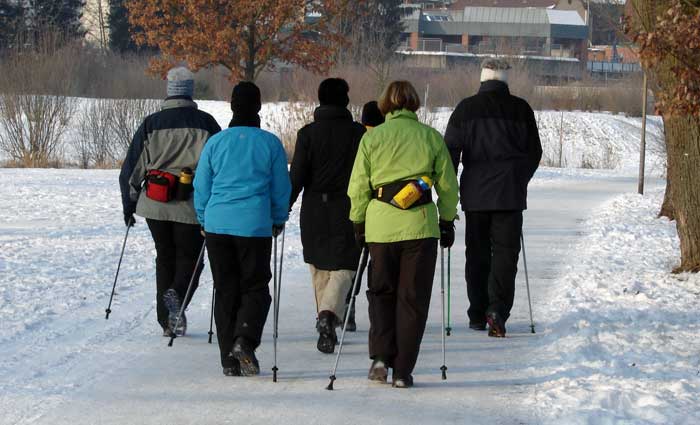
A pod of Nordic walkers:

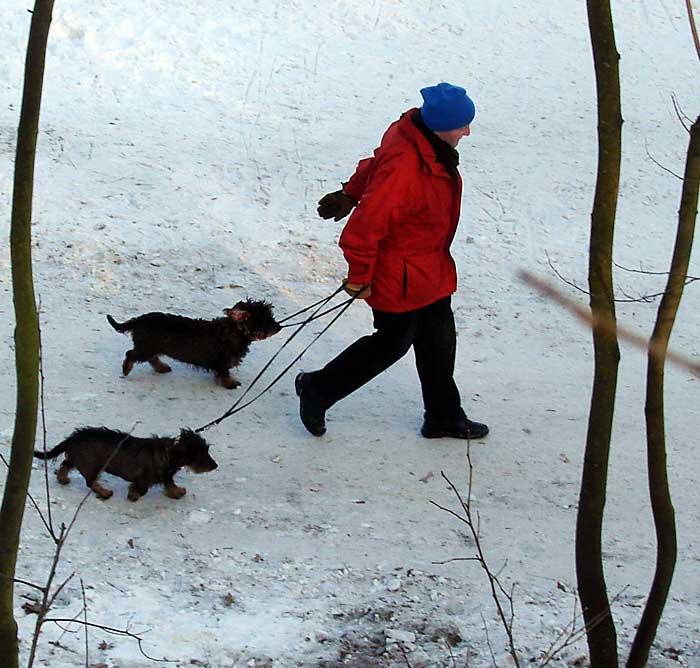
Two standard-issue German dogs:

Under oath/Beeidigt aber nicht enteidigt

Criggo quotes a witness who is worried because he was put under oath but never de-oathed. ‘My girlfriend told me they have to remove the oath before I am safe again’.

I suppose I am in much the same situation as a sworn translator, but I believe that only applies when I am actually preparing sworn translations. I can lie in my other translations.