I see that even the Bundesverband deutscher Apothekerverbände uses English in its viral video advertising (the punchline is in German). (Via Die Zeit)
Bundesverband deutscher Apothekerverbände
Reply

I see that even the Bundesverband deutscher Apothekerverbände uses English in its viral video advertising (the punchline is in German). (Via Die Zeit)
I have at last succeeded in photographing Quaks. I phoned the Bavarian Bird Association pelican ‘hotline’ and they suggested I parked in the centre of Frauenaurach and walked down the Brauhofgasse, since the pelican has been spending the night on the Schwarzer Adler:
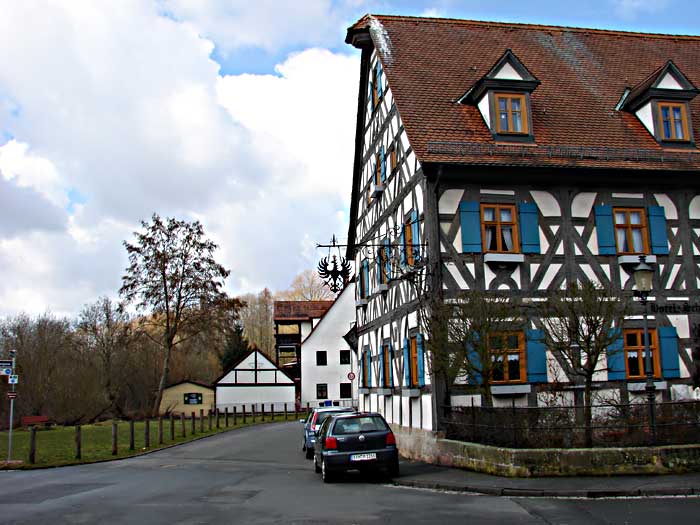
I saw two pairs of storks on chimneys. They were quite noisy:

I didn’t think I was going to see the pelican, but he was standing there next to a pond, beside a small pollarded (and dead) willow, unfortunately behind barbed wire and small branches:



Google Maps shows Frauenaurach. The pond can be seen near Brauhofgasse and the River Aurach.
After that he flew away. Later, I saw him flying over the bridge over the Regnitz.
Brewery cat:

Now my pelican pictures have joined the rest on the website of the Landesverband für Vogelschutz in Bayern.
Google introduces interest-based advertising. I received an email: by 8th April Google requires me to review the wording of my site’s privacy policy.
Details
Google Blog discussion
I will either opt out of this or stop using Adsense, I think. I don’t particularly want Google to display ads to me based on the sites I have been visiting. OK, I buy books, but that doesn’t mean I want to see more advertising for them. And I visit a lot of sites based on what I happen to be translating. As for the effect on visitors to my site, it could be just as irrelevant to them, to say nothing of the invasion of privacy.
Of all freelances with higher education, translators earn the least:
Vertalers halen gemiddeld een omzet van 36.000, dat is het laagste van alle hoogopgeleide zelfstandigen.
So says research done at the University of Utrecht. But how do they identify a translator – just people who call themselves translators?
Also blogged by Percy Balemans, with a link to the research student’s sit.
(Thanks to Trevor)
Quaks is the name given to the pelican that has been following storks for a couple of years and has now been spotted in Fürth and Erlangen, but alas not by me.
The Bavarian bird organization is providing updates so I have a rough idea of where to drive.
Typical German contracts that I get to translate will start off by naming the parties and in brackets defining a short name, e.g. im folgenden: “Käufer” (hereinafter referred to as the Seller).
That’s similar to the English-language approach. I usually remove the inverted commas. It is not necessary to capitalize seller, at least in England, but my clients appear to expect it.
After this, the contracts usually never use the term Käufer or Verkäufer again! They will write Vertragspartei, or name the company, but having defined the terms they drop them. I have sometimes seen a party referred to in four different ways in one short contract. Or having defined die Produkte (the Products), the writer thereafter refers to die Vertragsprodukte (the contract products – presumably this can’t be capitalized if it hasn’t been defined).
As a result, a translator’s note usually needs to be made. One doesn’t want to use several different terms in English, even if it is easy to do so (which it sometimes isn’t), but nor does one want to misinterpret.
Incidentally, I would love to use the company name instead of Seller, especially where the defined term is hard to translate, but this is usually rejected, possibly because the customer wants a text that can be used in future with a variety of parties (in which case, I need to know that, so I can ensure the translation is not gender-biased, for example), possibly just out of a feeling that this is too great a departure from the German.
Anyway, it’s clear why the defined terms are not used consistently – it’s because the drafter grabbed bits from a variety of sources and did not adapt them. That happens with English contracts too. And the drafter is sometimes not even a lawyer. But still, the prevalence of this in German contracts always surprises me.
Why is it so? I think it must partly be because the German drafter doesn’t feel the definition of terms is needed for clarity. This refers to shortish contracts, of course, not the huge ones preceded by dozens of definitions.
Incidentally, contracts online are often standard contracts intended to be adapted by the user, so they do not vary the names of the parties, since der Käufer/die Käuferin (the latter often refers to a company rather than a woman) are the only terms they have.