2000th anniversary coming up: here’s a travel agency sign:

I actually translated a booklet on Kalkriese many years ago. Kalkriese as the location of this particular battle is now a subject of scholarly dispute.

2000th anniversary coming up: here’s a travel agency sign:
I actually translated a booklet on Kalkriese many years ago. Kalkriese as the location of this particular battle is now a subject of scholarly dispute.
I rather enjoy Goethe’s Die Wahlverwandtschaften, but I don’t know how it would come over to an English reader new to German literature of the eighteenth century.
To quote the Oxford World Classics site on David Constantine’s translation:
In Elective Affinities Goethe conducts an experiment with the lives of people who are living badly. Charlotte and Eduard, aristocracts with little to occupy them, invite Ottilie and the Captain into their lives; against morality, good sense, and conscious volition all four are drawn into relationships as inexorably as if they were substances in a chemical equation.
There have also been translations by R.J. Hollingdale and H.M. Waidson, and others. It’s the Waidson translation that is reviewed in the Observer today:
The translation is good but suffers a bit from the awkwardness of German syntax and Goethe’s very formal style, which can make this new edition seem a struggle at times.
One likes to see the translator acknowledged, but this is odd. And note that ‘new edition’ means ‘1986 translation’.
I used to have a picture of a catladder at a prison in Bavaria – it led into a first-floor cell. I can’t find it to blog, though. So make do with this blog of pictures of catladders.
The second MDÜ article on legal terminology is by Monika von Kurzynski and Anne-Kristin Langner and comes from a BA dissertation done at Hildesheim University. It’s about the differences in legal language between Swedish, German and English judgments. Unfortunately, it’s not really about terminology. It discusses the macrostructure and microstructure of judgments, puts the judgments of the three countries on a spectrum from abstract to personal, and considers the influence of the EU and the internet on judgments (the last two seem difficult to make generalizations about). Apparently the dissertation was based on three judgments of appeal courts, one in each language, but those judgments aren’t named, nor is there a bibliography. On top of all that, I wonder if this started out as a Swedish-German comparison and England was added to spice it up – but perhaps I’m doing an injustice to the university. At all events, it is not terribly well-informed about English judgments and English law. For example:
Ohne eine schriftliche Gesetzesbasis entscheiden Richter von Fall zu Fall auf Grundlage von Präjudizen.
There’s a bit of a contradiction betwee von Fall zu Fall and auf Grundlage von Präjudiz(i)en. It isn’t mentioned that England has statute law; its law is referred to as ‘gesprochenes Recht’.
It’s not easy to deal with three legal systems in a short treatise, because it’s so hard to generalize when one’s knowledge is limited.
On German judgments:
Die Normierung bzw. die klaren Vorgaben zur Urteilsgestaltung beeinflussen den Sprachstil deuscher Urteile erheblich, denn der Stil ist unpersönlich und abstrakt. … Der Text ist objektiv und ohne wertende Elemente.
The third article is about terminology, law and justice in South Africa and is by Anja Drame. This does have English and French summaries and a bibliography. South Africa, it says, has eleven languages recognized as equal, but only two of them have in the past been used for writing about law. As for the others, the African languages, they do have legal terminology, but it may differ or overlap, and documentation is in a problematic state. This is all interesting, but it leaves me feeling grateful I only have to worry about the difference between common law and civil law.
Here are some notes on the structure and style of English (and German) judgments. It is painted with a somewhat broad brush, and there is already a comment to the effect of ‘incorrect’. Suffice it to say that I agree the following is over-simplified – so it was intended to be – and it relates to a larger context which has not yet been revealed.
German judgments tend to be authoritative and impersonal. They also fail to name the parties (note: this means ‘name the parties’, not say ‘defendant’ and ‘claimant’), and sometimes even the judges (I speak from experience of translating many judgments). You don’t get much information on the history of the case or even the facts. (This means: ‘you don’t get much information’, not ‘you get no information at all’. The story of the case tends to be cryptic).
Quoting Intellectual property in the new millennium: essays in honour of William R. Cornish (quoted from Google Books):
On the other hand, the English judgment is exemplary in style. The judge writes personally, he sets out the matter in a concrete and detailed manner, he explains what he thinks, opines, has reservations and doubts, is irritated or may retrospectively correct a witness without correcting him. The English judgment is discursive, in some ways narrative, but nonetheless human. It is to a significant extent the expression of a human interaction with the parties and also the case. It allows much more to be understood by the third party reader (and also the parties), and it should be valued for this.
Just because the German judgment is impersonal, it doesn’t mean it isn’t the judge’s personal opinion. Just because the English judgment is personal, it doesn’t mean the English judge is not bound by statutes and precedents.
Where is it laid down what form a judgment has to take?
Supposing it’s a German civil judgment, the Zivilprozessordnung (Code of Civil Procedure) contains provisions. Take section 313:
§ 313 Form und Inhalt des Urteils
(1) Das Urteil enthält:1. die Bezeichnung der Parteien, ihrer gesetzlichen Vertreter und der Prozessbevollmächtigten;
2. die Bezeichnung des Gerichts und die Namen der Richter, die bei der Entscheidung mitgewirkt haben;
3. den Tag, an dem die mündliche Verhandlung geschlossen worden ist;
4. die Urteilsformel;
5. den Tatbestand;
6. die Entscheidungsgründe.(2) Im Tatbestand sollen die erhobenen Ansprüche und die dazu vorgebrachten Angriffs- und Verteidigungsmittel unter Hervorhebung der gestellten Anträge nur ihrem wesentlichen Inhalt nach knapp dargestellt werden. Wegen der Einzelheiten des Sach- und Streitstandes soll auf Schriftsätze, Protokolle und andere Unterlagen verwiesen werden.
(3) Die Entscheidungsgründe enthalten eine kurze Zusammenfassung der Erwägungen, auf denen die Entscheidung in tatsächlicher und rechtlicher Hinsicht beruht.
What about the English judgment? The Civil Procedure Rules don’t go this far. Are English judges free to write as they like?
It’s true that there are no practice directions or rules that stop an English judge from choosing the structure of a judgment. But there are recommendations – admittedly fairly recent ones.
For instance, the Judicial Studies Board was only founded in 1979. It has a website and you can there download as a PDF file its Civil Bench Book. However, although this apparently used to contain advice on how to write a judgment, it was compeltely revised in 2006 and I can’t find anything.
However, there is a lot more information in the book by Andrew Goodman, How Judges Decide Cases: Reading, Writing and Analysing Judgments. My link is to the 2004 edition, but there is a 2007 one. It’s a down-to-earth, concise book covering how to read and write, and stylistic aspects of judgments. Goodman consulted and obtained information from a large number of judges of every level, nearly forty of whom are named in the preface and some more of whom preferred to remain unnamed. There are a number of notes on how to structure a judgment. The author is a barrister and a professor of conflict management and dispute resolution studies in the USA (at the mysterious Rushmore University). He was particularly influenced by a 1940 book by Mortimer Adler, How to Read a Book. I haven’t read the whole, but I have the impression that the remarks on how judges use language and linguistic analysis are a bit thin. Adn what it says about ratio and obiter is not likely to be new. But the collection of information on the structure and context of judgments is excellent.
I don’t know how interested legal translators are in judgments. But, along with statutes, they form a large part of the material that people who are writing an MA or a PhD /Dr Phil like to cite, because they are publicly available.
Translation theory is a subject I’ve only ever had time to dabble in. I think it would be interesting but probably requires a leap of faith to put the effort in before reaching that point. Academics who write about legal translation theory are few in number. In Germany, all those I can think of specialize in countries with civil-law jurisdictions, and languages such as Italian, Spanish, French and Dutch. But I have a feeling that some of these academics like to throw in a few references to the common law, because they know that common-law countries have excitingly different legal systems and they think they aren’t doing comparative law without it. And that’s where all this twaddle about the nature of English law originates, because the more outlandish the idea, the more likely it is to be true in England or the USA.
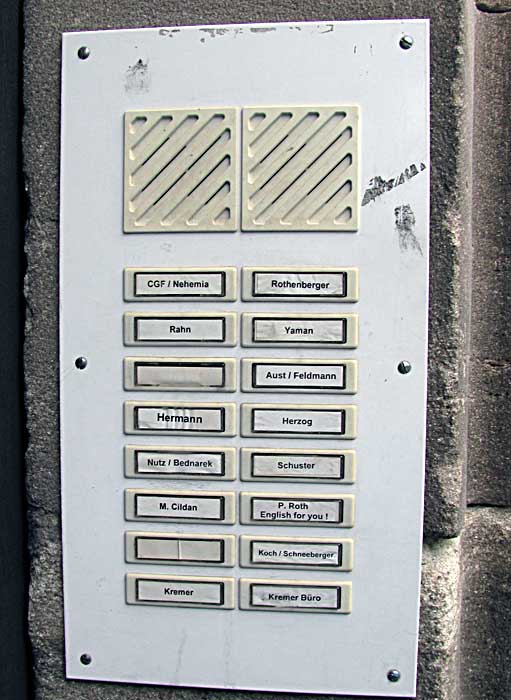
More Fürth doorbells.
English for you:
Keine Werbung bitte, with variations:

An American in the attic:
