Pictures of English deeds/Beispiele englischer Urkunden

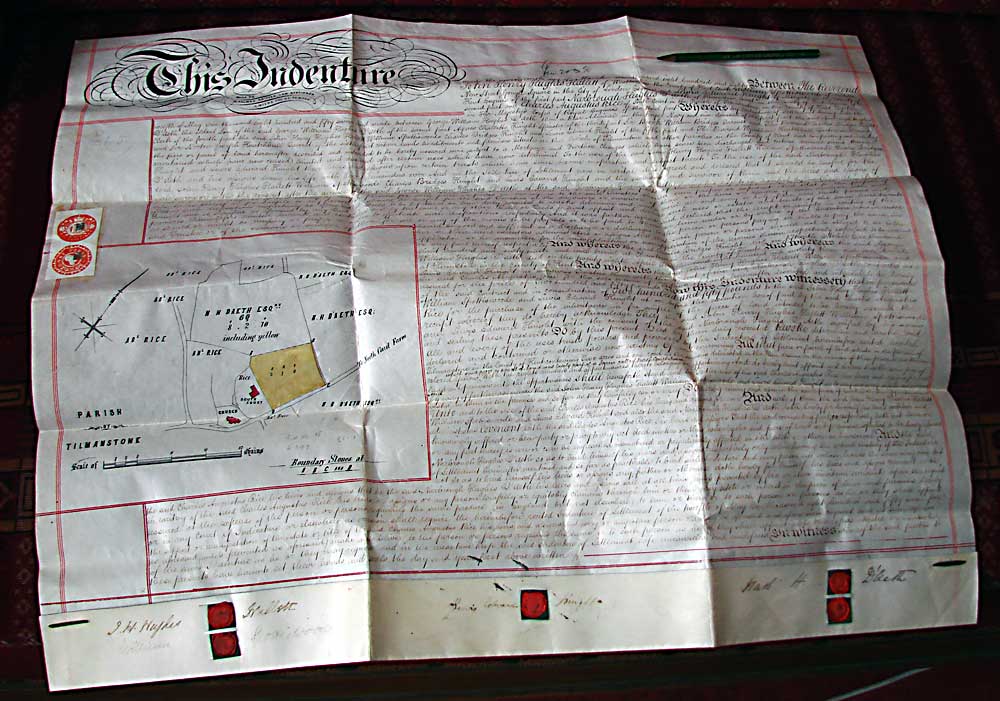
Here’s a bird’s-eye view of an 1880 conveyance (click to enlarge):
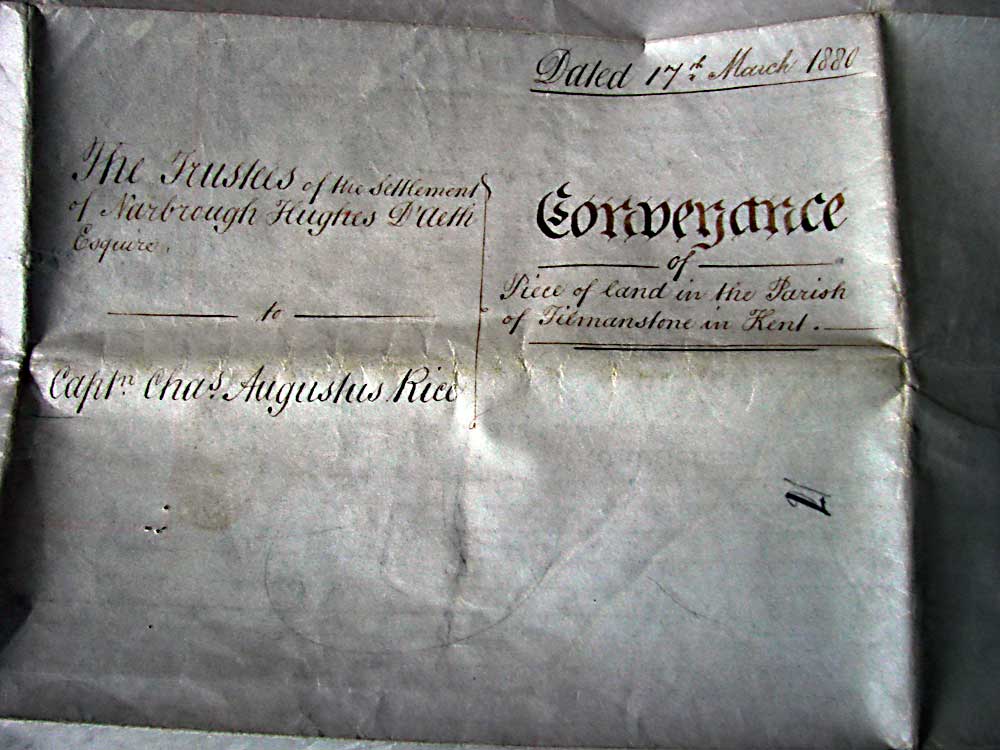
and here’s the backing sheet:
and here a small extract:

I put a pencil at the top right to show the size.

The parchment was pre-printed with the word ‘Indenture’. The rest was written in hand by a clerk. You can see how important the large words are to orient the reader. You can tell that ‘Whereas’ always refers to preliminary information, whereas ‘Now this Indenture witnesseth’ is the beginning of the operative part, and ‘All that’ precedes the definition of the land being sold (‘All that piece or parcel of land situate in the parish of ..’).

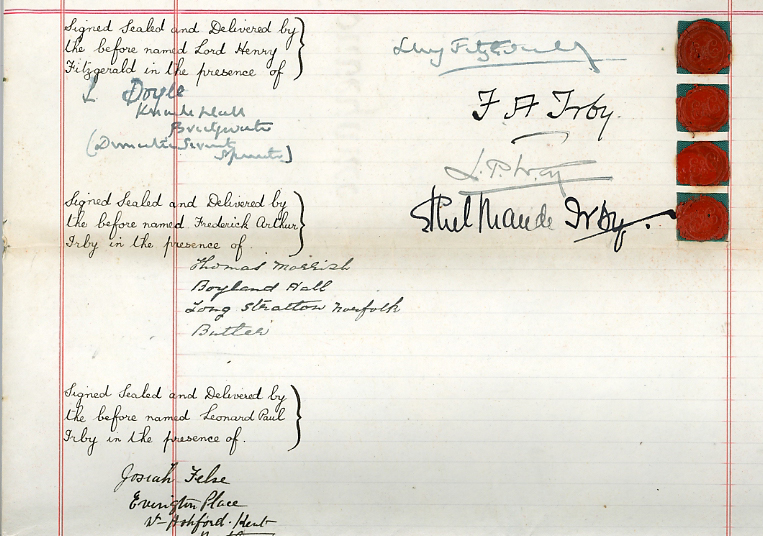
Only the really traditional connecting words are written in a different, italic script, but other words are written larger and darker (Two hundred and fifty ounds, Revoke). ‘Deed’ is capitalized but does not stand out – this is reminiscent of the current capitalization of Claimant, Plaintiff and so on. The red lines on the margin should be completely filled out, to prevent additions. You can see the stamps on the left showing that fees have been paid, and the witnessed signatures below, with a standard red seal on green ribbon.

There are photocopy shops near the Law Courts in London where you can photocopy this size of document, but it isn’t easy to read.

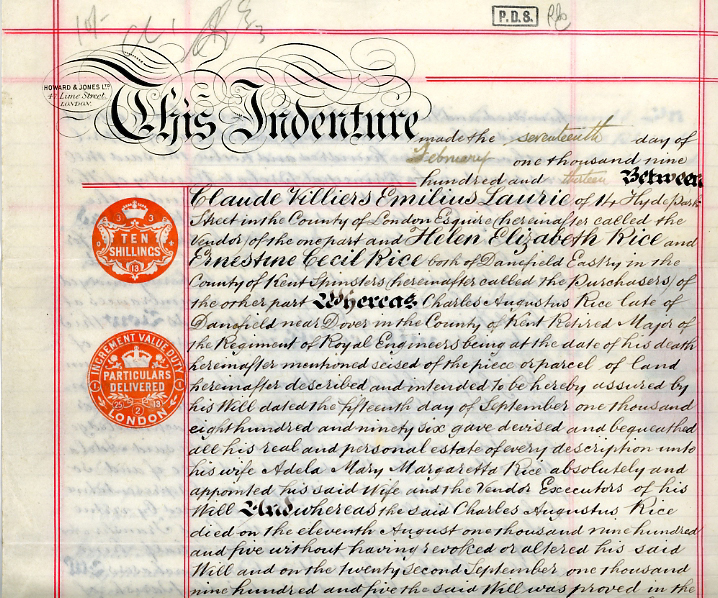
Here’s part of a 1913 document on the same land, now on foolscap paper:
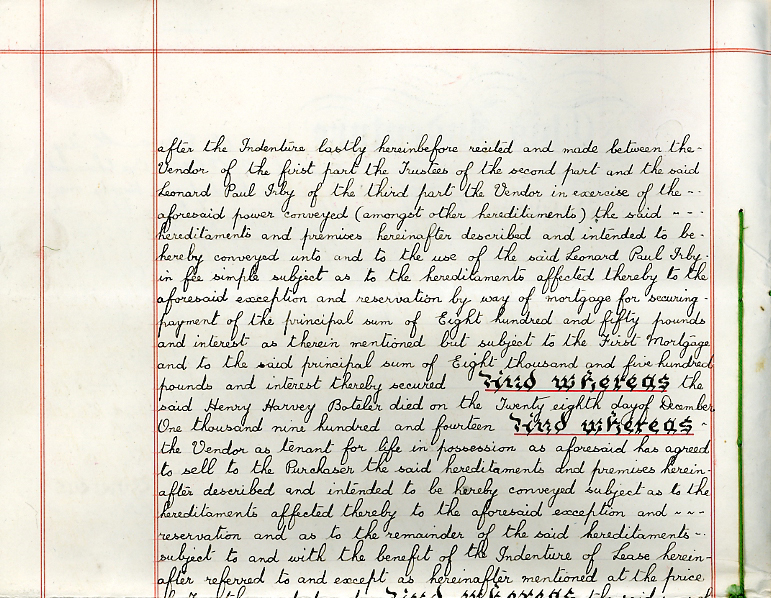
and here a 1921 one, on which you can see the typical sewing of documents with green cord (notice the little squiggles filling up the ends of lines on the right):
and finally, a close-up of some of the signatures on the last one:
Urbi et Orbi

Do you need something to add to your model railway for Easter? There are transparent Easter eggs containing carriages, or this figure of the Pope (note red shoes):

Discussion (in German).

Vollmer offers the house where Pope Benedict XVI was born.

Preiser, which made the figure.

Märklin

(Photographed in window of local model railway shop)

LATER NOTE: when I took this photo on April 15, the Easter eggs with trains in them had been reduced in price. Whether the Pope had been reduced I don’t know – certainly he seems to be worth less than he was here.

Prenups in the UK/Eheverträge in GB

The UK Supreme Court will be making a decision in the case of Rademacher v. Granatino on the question of whether a prenuptial contract is valid under English law.

This has been in the public eye for some time now. If you’ve missed it, it might be interesting as an example of English law’s attitude to marriage contracts. It may or may not make prenuptial agreements more binding in England and Wales.

It’s quite common for marriage contracts to be recognized in German law, and also in French law. The parties are of German and French nationality, but because they mainly live in London, their divorce went to the English courts.

In Germany a person who does not want a notional 50-50 sharing of all marital property can enter into a prenuptial contract. But both spouses have to get legal advice. The contract will normally be binding.

In England and Wales, there may be a prenuptial contract, but the court will not feel bound by it. It retains discretion to divide the property fairly. It may follow the prenup if it seems fair.

Radmacher and Granatino agreed that if they divorced they would not make any claims against each other, only for the two children. There was neither independent legal advice (which there would have to be in Germany) nor did Katrin Radmacher disclose the millions she was about to inherit. Granatino also argues sexism in the current state of the proceedings (his award at first instance was greatly reduced by the Court of Appeal) because, he argues, a woman who had given up a well-paid job would have been treated more generously.

Guardian article
More links from John Bolch.

British and American corpora/Korpora für britisches und amerikanisches Englisch

I have a link to the British National Corpus in my sidebar. But that is for a simple search. I gather from separated by a common language that Mark Davies has an interface which can be used to compare the BNC and COCA, the Corpus of Contemporary American English at Brigham Young University. I will add that to the sidebar soon. Here’s a quote from Lynne today showing how it can be used – she was comparing the use of prepositions with ‘protest’ in BE and AmE (sorry, the table hasn’t come out properly):

I used (as I usually do these days) Mark Davies’ wonderful interface for the British National Corpus (BNC) and the Corpus of Contemporary American English (COCA) and searched for in protest with six prepositions: at, against, of, over, to, and about. The last two only occurred at tiny rates in both corpora, so I haven’t included them below: These are the results, expressed as percentages within each dialect:

BrE AmE
at 70 3
against 24 34
of <1 42 over 7 18