Capitalization/Großschreibung

A colleague today received some translations as reference material and was surprised to see they capitalized ‘claimant’ and ‘defendant’. Is this correct? I don’t do it myself, but I thought it was unnecessary rather than wrong.

It is definitely common in translations into English done in Germany. Is it more American?

In the BlueBook and Ritter’s Style Guide I found information about capitalization / upper case, but not this point. But Googling a combination of words such as “the defendant” “seeks an order” did get some American and UK ghits that looked correct. “The claimant” will narrow it down to the UK more or less (even in inverted commas, I don’t think Google is case-sensitive). I suspect, therefore, that it has at least become acceptable.

Or has anyone any evidence to add here?

Incidentally, last week I learnt the term camel case, which refers to words like WordPerfect that suddenly have a capital letter, like a hump, in the middle. The New York Times even had a rant against it in November.

LATER NOTE: Adrian says that all statements of case (pleadings) in England and Wales always capitalize the parties (by capitalize I mean initial capital – I don’t think ALL CAPITALS is good style). He recommends the Bar Manual on Drafting. Despite heavy recommendation I refuse to buy it without taking a look!

Organic boiling fowl/Biosuppenhuhn

This is off topic, but it made good soup. I used a recipe from a Nestles site, I think, where the chicken is simmered in salty water for two hours, some vegetables (later discarded, so I stuck to things with flavour like onions, celeriac and parsley root) join it after one hour, and after that there was a lot of meat that wasn’t too shredded up (unlike my earlier attempt with a maize-fed chicken) and I added some shredded veg for ten minutes.

This is the cross-reference, by the way (in German).

Snow/Schnee

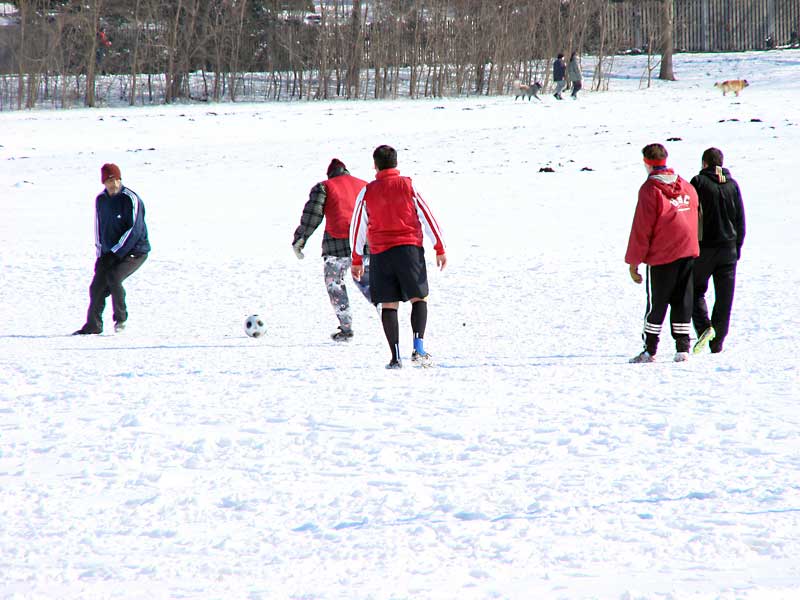
This snow isn’t actually melting. It may have been last Saturday.

Of course, it seems a bit tasteless to post this, in view of the heavy snow in places like Barcelona, which is covered by a white blob on the weather maps.

Last Sunday:

Translation blogs and links/Übersetzungsblogs und -links

I added two translation weblogs to my blogroll. I actually follow more in Google Reader. And it’s time I weeded some dead ones out.

The first new one is Patenttranslator’s Blog, by Steve Vitek (of FLEFO on CompuServe in the old days). Steve is originally from Czechoslovakia, as it then was, spent some time in Japan but has long been in the USA, for a long time in California and now in Virginia.

The second blog is MA Translation Studies News, which calls itself ‘A blog for students and graduates of the MA Translation Studies at the University of Portsmouth’. It looks interesting. I liked the entry on a dispute about how Michael Hofmann translated a Gottfried Benn poem.

Linguatools has context dictionaries between German and several other languages. I tried this, and Linguee, and MyMemory, with my word of the day, Gestaltungsspielraum, and they were all more useful than they used to be. But look at the sources! The big advantage of Linguee is giving precise URLs, and it now does it immediately beside the quote. MyMemory has only europa.eu, which I suppose is the DGT CAT database that anyone can download, and Anonymous! And Linguatools has only vague terms like Parlamentsdebatte – presumably another of those widely available databases – and in one instance Zeitungskommentar.

Here is a curious feature of Linguatools: it gives me synonyms for the source term, not the target term – actually, this could be quite useful:

Gestaltungsspielraum : freedom
wird noch übersetzt mit: Freiheit, Freiraum, Ungebundenheit, Ungezwungenheit
Gestaltungsspielraum : leeway
wird noch übersetzt mit: Abdrift, Abtrift, Rückstand, Spielraum
Gestaltungsspielraum : sphere of influence
wird noch übersetzt mit: Interessensphäre, Machtbereich

Long sentences/Lange Sätze

Here’s a sentence from a New York Appellate Court decision:

Ordered that the judgment is modified, on the law, on the facts, and in the exercise of discretion, by deleting the provision thereof dismissing the complaint insofar as asserted against the defendants M. Chris Overby and Levine Overby Hollis, M.D.s, P.C.; as so modified, the judgment is affirmed insofar as appealed from, without costs or disbursements, the motion of the defendants M. Chris Overby and Levine Overby Hollis, M.D.s, P.C., pursuant to CPLR 4401, made at the close of the plaintiffs’ case, for judgment as a matter of law dismissing the complaint insofar as asserted against them is denied, the order entered December 3, 2007, is modified accordingly, and the matter is remitted to the Supreme Court, Queens County, for a new trial as to the defendants M. Chris Overby and Levine Overby Hollis, M.D.s, P.C., on the issues of apportionment of fault and damages for past and future pain and suffering and past and future loss of services unless, within 30 days after service upon the plaintiffs of a copy of this decision and order with notice of entry, the plaintiffs shall file in the office of the Clerk of the Supreme Court, Queens County, a written stipulation consenting to the apportionment of 10% of the fault to the defendants M. Chris Overby and Levine Overby Hollis, M.D.s, P.C., and 90% of the fault to nonparties Philip Howard Gutin and Memorial Sloan Kettering Cancer Center, and to reduce the damages for past pain and suffering from the principal sum of $10,000,000 to the principal sum of $1,200,000, the damages for future pain and suffering from the principal sum of $27,750,000 to the principal sum of $6,750,000, the damages for past loss of services from the principal sum of $18,000,000 to the principal sum of $350,000, and the damages for future loss of services from $48,700,000 to the principal sum of $1,000,000, and to the entry of an amended judgment accordingly; in the event that the plaintiffs so stipulate, then the judgment, as so reduced and amended, is affirmed, without costs or disbursements.

It was quoted in Eric Turkewitz’s New York Personal Injury Law Blog.

I hope that means that into-German translators get long sentences too.

Separated by a common language/Undurchsichtige englische Tweets

Congratulations to me for winning a Twitter competition on the weblog separated by a common language against a field of six! and thanks to Lynne, who is going to send me a packet of McVitie’s ginger nuts, thus bypassing the many expat British food sellers.

The test was to find a tweet that was either in American English and incomprehensible to speakers of British English, or vice versa. I went for the vice versa.

As Lynne writes, it’s often easier for British speakers to understand American English, because they hear so much on TV or in the cinema. I did try to find some incomprehensible American tweets, by searching for words like grits, but nothing was really convincing:

I had the “Going to bed alone” dog. Lots of kraut, garlic, red onion sauce and pastrami.// well done, well DONE!

I found one American who’d been on Chatroulette and asked a British person what crumpets are. The answer: they are like ‘English muffins’ but sweet. (Sweet?) Not good for international understanding.