Antitransblawg on Twitter: how not to translate from German to English, mainly legal vocabulary.
Tweets should appear in the right-hand margin (still working on that).

Antitransblawg on Twitter: how not to translate from German to English, mainly legal vocabulary.
Tweets should appear in the right-hand margin (still working on that).
Every few years I get a text with an environmental element and I have read so many people using the non-existent English word immissions that I begin to wonder if I am going mad.
German has this nice contrasting pair, Emissionen and Immissionen, for pollution emitted and pollution received. I gather that the big problem began when some years ago the Bundesimmissionsschutzgesetz was translated as the Federal Immission Control Act. At all events, according to a colleague of mine who may or may not wish to remain nameless, a translator tried to deal with the problem by introducing the word immission into English, but the meaning never followed.
Actually, some websites use the title Federal Emission Control Act, which is interesting (I discovered this by entering a typo). I have a suggestion to translate it as impact, but I still don’t think it captures the German dichotomy, and of course I don’t have to translate it that often so I have never had to distinguish the two. (Volkswagen: Federal Emissions Protection Act, European Environment Agency, Federal Emission Control Act).
I have it on excellent authority that native speakers of English who talk about emissions from power plants never ever use the word immission.
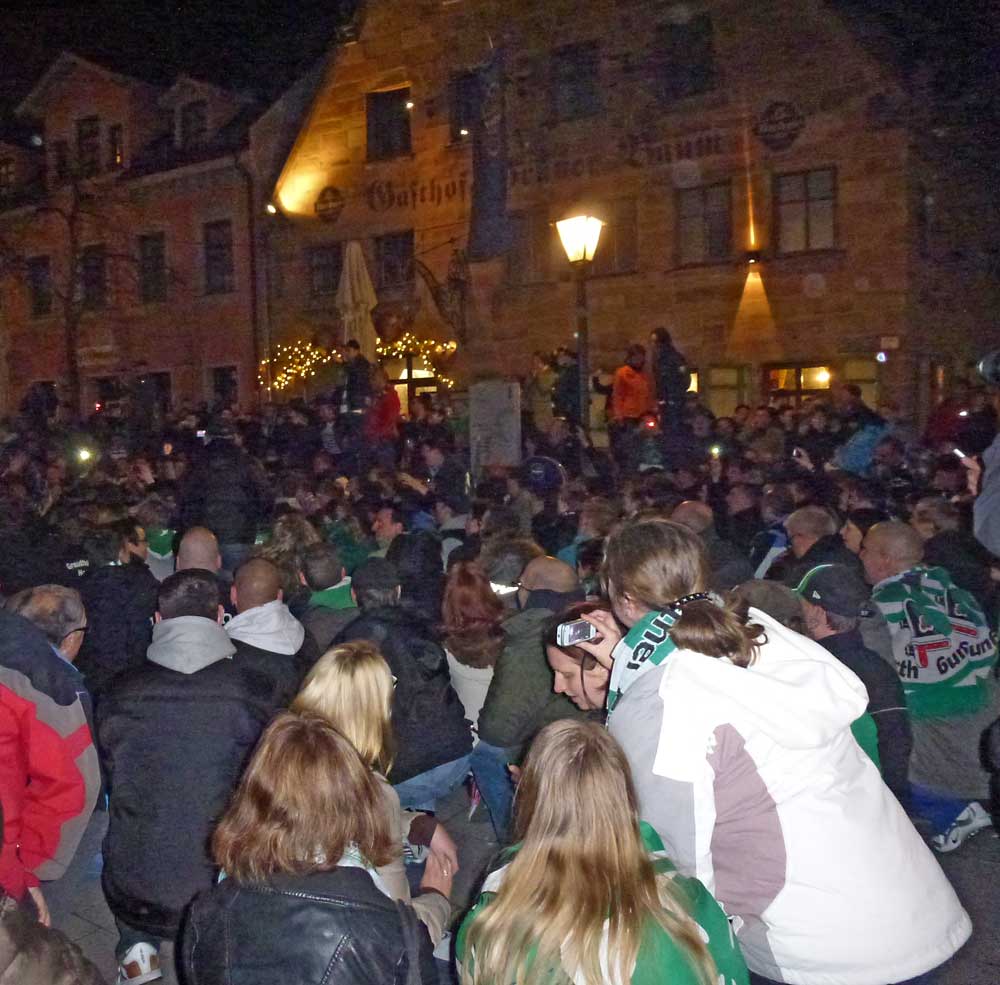
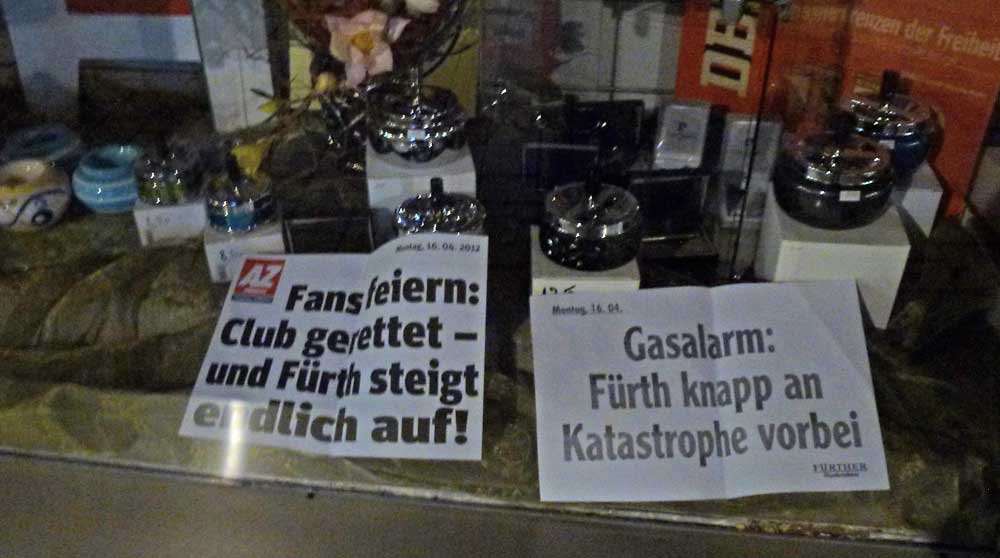
This evening, scenes of extraordinary jubilation on the streets of Fürth ostensibly marked the football team’s ascent to the first division. But readers know they were really celebrating Transblawg’s ninth birthday (I forgot about the eighth in 2011). The song was ‘Nie mehr zweite Liga’.



Quick reaction from a lotto shop in the Schwabacher Straße:
(I see Sinosplice is exactly one year older, but has curious ideas about what day the week begins on).
Newspaper article and pictures here.

Here’s a photo showing the story on the front of the local paper. But the really good photo of this scene is inside the paper – see the article Noch ist es dem Spargel zu kalt. I wish I’d been there to take that second photo, showing an asparagus photoshoot with numerous walk-on parts in very cold weather, but as I wasn’t, I’m not allowed to publish it direct.
Instead, here is an offer for a reduced-price asparagus plate and matching tongs, so you can pick it up carefully.

I won’t be needing one of these myself. Unfortunately, as reported here every year, we will be hearing little except effusions about asparagus here for the next several weeks.
On China Law Blog, in a post titled The Legal Faults With Faulty China Translations, Dan Harris suggests you need a good legal translator to do business in China, preferably ‘a truly bilingual attorney who works just for you’:
My favorite (which I have seen at least a half a dozen times) is to do an English language contract that says “A” and a Chinese language contract that says “not A.” The Chinese language contract then makes clear that in any dispute it will prevail. The American party thinks it just signed a contract that says “A” but in reality it just signed a contract that says “not A.” We have twice dealt with situations where a company came to us believing that its joint venture agreement required the joint venture to use the American company as the exclusive US distributor of the Joint Venture’s products, but the contract actually made the US company the exclusive distributor of the Chinese joint venture partner’s product. The problem in both cases was that the Chinese company joint venture partner had never and was not making the product for which the US company believed that it had become the exclusive distributor. Then there are the countless times a word like “must” is changed to “may.”
I wonder whether these contracts provide that the Chinese language and Chinese law govern. Sounds like it. When I translate contracts they’re in German and the German language and German law govern, and my translation into English is just a gloss. I believe one of the biggest German law firms used a watermark on their translations into English saying ‘For information only’ – and those were practising (and therefore insured) lawyers involved. Whatever is going on here involves legal work, as far as I can see. In my situation, if I happened to translate the opposite to what the contract said, firstly the client normally checks in, but in the last instance the German prevails. From my regular reading of China Law Blog (I get the RSS feed), things are not so rosy in China.
William Wilson, as reported here before, was the British driver of the first train that travelled between Fürth and Nuremberg. There isn’t much about him in the internet in English, but a Wikipedia article in German, and more in the franken-wiki. One learns that he didn’t speak a word of German when he came, but he spent the rest of his life in Germany. His health was affected by standing at the front of the train in a frock coat and top hat in wind and weather.
The franken-wiki reports on letters from the consul in Cologne, where Wilson first arrived in Germany, to the Ludwigs-Eisenbahn railway company:
„Gleich nach dem Abgang unseres Briefes zur Post erschien Wilson, ein Stück Beefsteak. Wir mussten einen Dolmetscher nehmen, um uns mit ihm zu verständigen.“ und: „Der Engländer sitzt hier und verzehrt gutes Geld – er sagte mir schon gestern, dass ihm Herr Stephenson nur sparsam mitgegeben habe, er von mir also Geld und Beförderung erwartet.“
(Wilson is described as ‘a piece of beefsteak’ – ‘We had to use an interpreter to talk to him’ – and spending good money because Stephenson gave him so little for the journey).
Today the Nürnberger Zeitung reports at length on Wilson, who died 150 years ago (on 17 April 1862).
Curiously, Wilson, who was born in Walbottle, now a suburb of Newcastle on Tyne, has become a Scot in the article, and Walbottle been transplanted to the Highlands. Having called him ‘ein worthy gentleman from England’, the article immediately ‘corrects’ itself and says that ‘on the British islands’ people take such things as whether one is English or Scottish very seriously. He is referred to as ‘a Scot who can stand up to the Highland winds’ and my favourite:
Am 18. Mai 1809 in Walbottle geboren, versuchte Wilson sein Glück jedoch nicht in den heimischen Hochlanden, sondern beim Nachbarn in den tieferen Gegenden: er lernte beim Eisenbahnpionier George Stephenson im englischen Newcastle und brachte es dort zum Maschineningenieur und Lokführer.
(Born on 18 May 1809 in Walbottle, Wilson tried his luck not in his native Highlands, but in the lower regions of the neighbour(ing country): he trained under George Stephenson, the railway pioneer, in Newcastle in England and became a mechanical engineer and train driver).
The Highlands of Walbottle in Google Maps.
The article is quite detailed in other respects, about how Wilson accompanied the train and supervised the reconstruction – students made sketches of all the parts first (why does this remind me of Germany selling high-speed trains to China?), how popular he was with passengers and how much he earned in Nuremberg.
LATER NOTE: A day later, the text has been changed. Must stop commenting on local paper websites. Why should I mind if the population of Nuremberg can’t tell the difference between Mao and Zhou?