Legalese

A nice witty judgment to read – see Words to good effect:

So judges can be just as flummoxed as we are by legalese. Here is one of the “astonishingly informative” definitions Sir Alan was referring to:

(1) An hereditament is anything which, by virtue of the definition of hereditament in s. 115(1) of the 1967 Act, would have been an hereditament for the purposes of that Act had this Act not been passed.

The judgment is here. It’s about a houseboat on which council tax was levied after its owner wrote to the council offering to make a payment in lieu – a move he surely regretted later. It’s about settlers and wayfarers.

The Northrop’s houseboat, a former Thames tug built in 1953 has many of the features that prospective house buyers look for. There are two good-sized bedrooms, two open fireplaces, gas central heating, a large sitting room and kitchen and several flat screen TVs. Old admiralty maps decorate the ceiling and there is even a grand piano and dedicated music room on board.

Ombuds

Further to the post on gender-neutral language, Johnson at the Economist links to a Washington State statute removing all traces of masculinity from its legislation.

But the Washington overhaul has pressed into service some awkward coinages. “Fishermen” will now be “fishers”, a word I can recall only ever having seen in the Bible (“Come and I will make you fishers of men”), and even then only to avoid the awkward “fishermen of men”. An “ombudsman” will now be an “ombuds”. “Ombudsmand”, a Scandinavian word, has the etymological meaning a “man who is asked for something”, ie, help or redress. Washington has shorn the title down to a meaningless “ask-for”.

Substitute Senate Bill 5077 (PDF) is 475 pages long and you can see crossed out all the amended terms.

It appears that the term ombuds instead of ombudsman is already in use outside Washington State, often in the term ombuds office at a university. I wonder whether it is singular or plural. Wiktionary says it is an abbreviation of ombudsman and is singular, and offers the anagram dumbo.

A commenter on the Johnson piece says that ombud is a perfectly good Scandinavian term. LATER NOTE: but I’m told that it is a good Scandinavian term with a different meaning!

LATER NOTE: It appears that the term ombud was introduced in Norway as a neutral form of ombudsman – see comments.

Nachtbriefkasten/Night postbox at court

A colleague was wondering how to translate this term – Nachtbriefkasten or Fristenbriefkasten. I’ve often seen them but it had never struck me how peculiar they are to the German-speaking world. They are designed to recognize items posted up to midnight of a deadline date. Earlier, there must have been someone who did this, but seemingly it is done electronically now. Here is a small postbox which produces another shelf when the clock strikes twelve. A Google image search for Nachtbriefkasten will show many more.

I don’t think there’s a special translation – you would have to explain it if it was important.

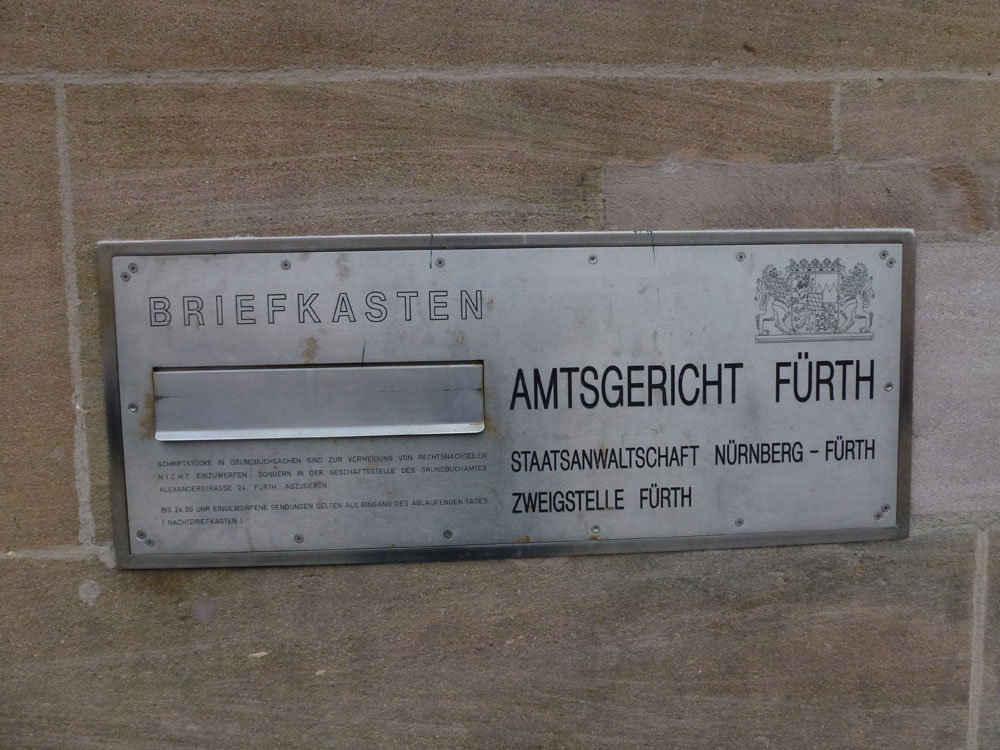
Here is the local Amtsgericht one, photographed this evening:

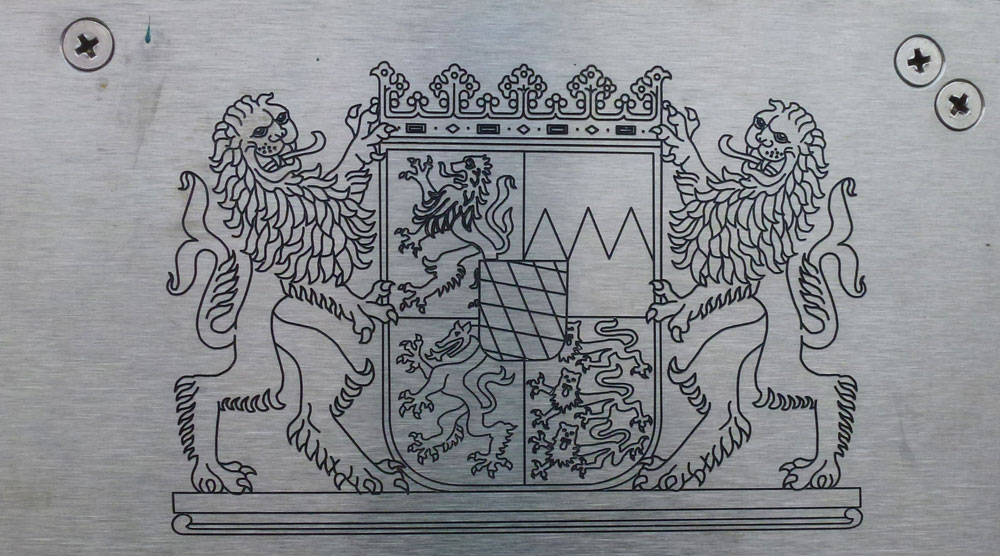
And here’s an explanation in English of the coat of arms of Bavaria (you have to click through to see the colours).

The modern coat of arms was designed by Eduard Ege, following heraldic traditions, in 1946.

The Golden Lion: At the dexter chief, sable, a lion rampant Or, armed and langued gules. This represents the administrative region of Upper Palatinate. It is identical to the coat of arms of the Electorate of the Palatinate.
The “Franconian Rake”: At the sinister chief, per fess dancetty, gules and argent. This represents the administrative regions of Upper, Middle and Lower Franconia. This was the coat of arms of the prince bishops of Würzburg, who were also dukes of Franconia.[3]
The Blue Panther: At the dexter base, argent, a panther rampant azure, armed Or and langued gules. This represents the regions of Lower and Upper Bavaria.[2]
The Three Lions: At the sinister base, Or, three lions passant guardant sable, armed and langued gules. This represents Swabia.[2]
The White-And-Blue Heart Shield: The heart shield of white and blue oblique fusils was originally the coat of arms of the Counts of Bogen, adopted in 1247 by the House of Wittelsbach. The white-and-blue fusils are indisputably the emblem of Bavaria and the heart shield today symbolizes Bavaria as a whole. Along with the People’s Crown, it is officially used as the Minor Coat of Arms.[2]
The People’s Crown: The four coat fields with the heart shield in the centre are crowned with a golden band with precious stones decorated with five ornamental leaves. This crown appeared for the first time in the coat of arms in 1923 to symbolize sovereignty of the people after the dropping out of the royal crown.[2]

Gender-neutral language for lawyers

Gender-neutral language is a big topic. I’m just thinking of a couple of points here.

One client wants to use the masculine to include the feminine. This applies to the German original, using Student to include Studentin, for example. This problem doesn’t arise in the English translation, though. What if there is an explanation at the beginning of a long document that the masculine will be used to include the feminine, and yet there are only three places where this happens in the English translation, and those could be elegantly amended to be non-sexist – and what’s more, it might be expected for the English to be non-sexist? Of course, that’s assuming the translation is intended for an Anglo-Saxon audience.

Second point is the suggestion of following the style guidelines at Kent Law.

The key rule of thumb is to avoid using gender-specific language; resort to alternatives like “he or she” only if there is no way to write the sentence without the pronouns. In most cases, one can rewrite any sentence to avoid the need for gender-based pronouns. There are three methods explained below. The first of the three is the most desirable. Do not use “their” as an alternative to his or her; “their” should be used only when referring to a plural subject. Each of the rules here offers a method of avoiding gender-based language.

1. Rewrite the sentence to avoid the need for any pronoun at all. One can often substitute the words “the” or “a” for the pronoun.

Incorrect: A good judge takes their job very seriously.

Undesirable:A good judge takes his or her job very seriously.

Better: A good judge takes the job very seriously

I agree that one might try to avoid their as a singular, because it is unpopular with many. As a translator, I tend to compromise if the client has a particular opinion on usage. But I am unhappy with the suggestion that their is actually wrong. I was going to ask if anyone knows how old this document is, but I see now that it is version 1.1 for a law class in 1994. I haven’t got my books with me, so I don’t know what the newest recommendations for legal English might be.

Christopher Williams, in a longer article which I haven’t got (but would like to have – but now, thanks to a kind reader, I have) says that the masculine rule was introduced by Bentham and was preceded by different usage:

According to Petersson (1998: 103), the masculine rule first appeared in British legislation in 1827, partly thanks to the influence of writers such as Jeremy Bentham who advocated letting ‘the masculine singular comprehend both genders and numbers’ so as to avoid the ‘evil of longwindedness’ (cited in Petersson, 1998: 102).3 This policy ended almost 300 years of using female terms to represent women in legislative texts, a policy which emerged during the Elizabethan period, at least in the field of vagrancy legislation (Petersson, 1998: 96).

Footnote: notes from the Canadian Department of Justice:

The need to deal equally with men and women highlights the desirability of drafting using gender-neutral language. Laws that exclude references to the female gender do not promote gender equality. For this reason, gender-specific language should not be used in legislation. Gender-specific words should be replaced with gender-neutral words that have the same meaning. In addition, the following writing techniques should be considered to avoid using a gender-specific pronoun:

use the singular “they” and its other grammatical forms (“them”, “themselves” and “their”) to refer to indefinite pronouns and singular nouns;
replace the masculine pronoun with an article;
use both pronouns “he” and “she”;
use the plural;
use a neutral word or phrase such as “person”, “any person”, “every person” or “no person”;
repeat the noun;
rewrite the sentence in order to eliminate the pronoun completely.

LATER NOTE: See also Charlie Bavington’s detailed discussion of how to handle gender when translating from French to English (though applicable to other language combinations).

German car numbers/Autokennzeichen

German car number plates are based on location, but some are forbidden. The combination of FÜ and CK is not forbidden (I’ve posted a photo of this before), although I prefer FÜ and MM. But some number and letter combinations are described as unerwünscht. The Motor Vehicle Licensing Order (Fahrzeug-Zulassungsverordnung) prohibit numbers which are against public morals. It recommends not to issue the following: HJ – Hitlerjugend, KZ – Konzentrationslager, NS – Nationalsozialismu, SA – Sturmabteilung, SD – Sicherheitsdienst, and SS – Schutzstaffel. There are also combinations in specific registration districts, for instance Nuremberg has the letter N and this can be combined to produce Nazi abbreviations.

Weitere nicht vergebene Buchstabenkombinationen sind in Stuttgart S–ED (Sozialistische Einheitspartei Deutschlands), in Nürnberg N–PD (Nationaldemokratische Partei Deutschlands) und N–SU (Nationalsozialistischer Untergrund)[38], im Kreis Warendorf WAF–FE, im Kreis Steinburg IZ–AN („Nazi“ rückwärts gelesen), im Kreis Dithmarschen HEI–L (nur bei Neuzulassungen). Die Stadt Regensburg in Bayern vergab entgegen den Weisungen der Bundesregierung bis Anfang Oktober 2012 noch das Buchstabenkürzel NS. Erst nachdem eine lokale Zeitung die Behörde darauf aufmerksam gemacht hatte, wurde die Vergabe eingestellt.

Thus it was that in connection with the NSU trial (see recent entry) there were complaints in Nuremberg that the town drainage lorries had numbers starting with N-SU (this was reported last November). It was eventually decided that those 35 city vehicles would have their numbers changed and anyone else who had that sequence (450 of them) could have it changed free of charge. The city has applied for a ban on future use and meanwhile only those with a justified interest, e.g. names beginning with S and U, can get it.

It was pointed out that Audi took over a company called NSU, whose logo decorates a number of vehicles in Neckarsulm.

Bee sting cake/Bienenstich

Bee sting cake seems to be what it’s called in the USA, when translated from the German.

Deb Perelman of Smitten Kitchen (the blog) has created one, but it doesn’t look quite like the one I know:

The Bee Sting Cake (Bienenstich) is a German specialty and while my mother’s parents came over in 1935 and 1936 respectively, the areas once known as German epicenters (the middle of Queens, where my mom was raised, and Yorkville, in the Upper East Side of Manhattan) have now mostly dispersed, and most of the accompanying stores have shuttered. Calls to German bakeries to see if they sold it were almost futile, until I found one in Ridgewood, Queens that sold us a whole one that was rather awful; let’s not speak of it at all. The only thing left to do was go it alone, researching obsessively along the way.

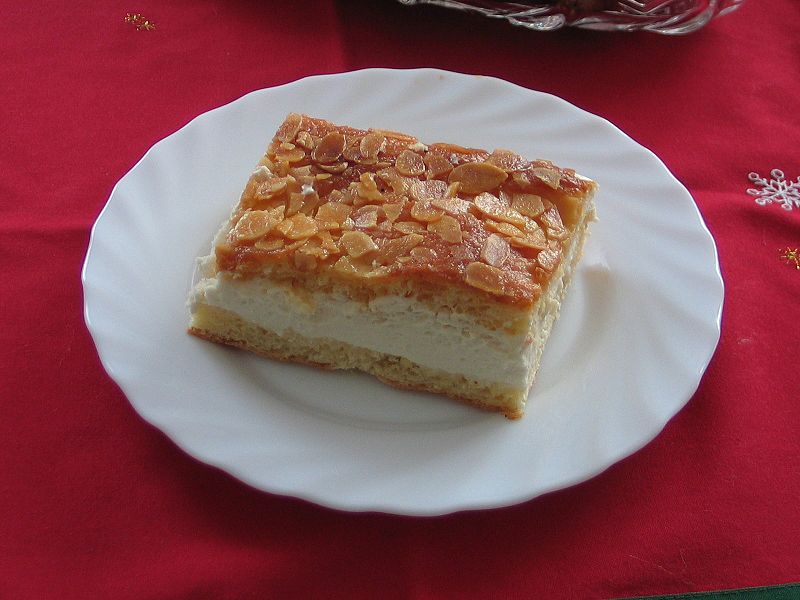
It actually looks to me as if the proportions of filling and pastry are reversed. this Wikimedia Commons picture looks closer:

I haven’t had Bienenstich often. I don’t like the blancmange-type filling, but confectioners’ custard is OK.