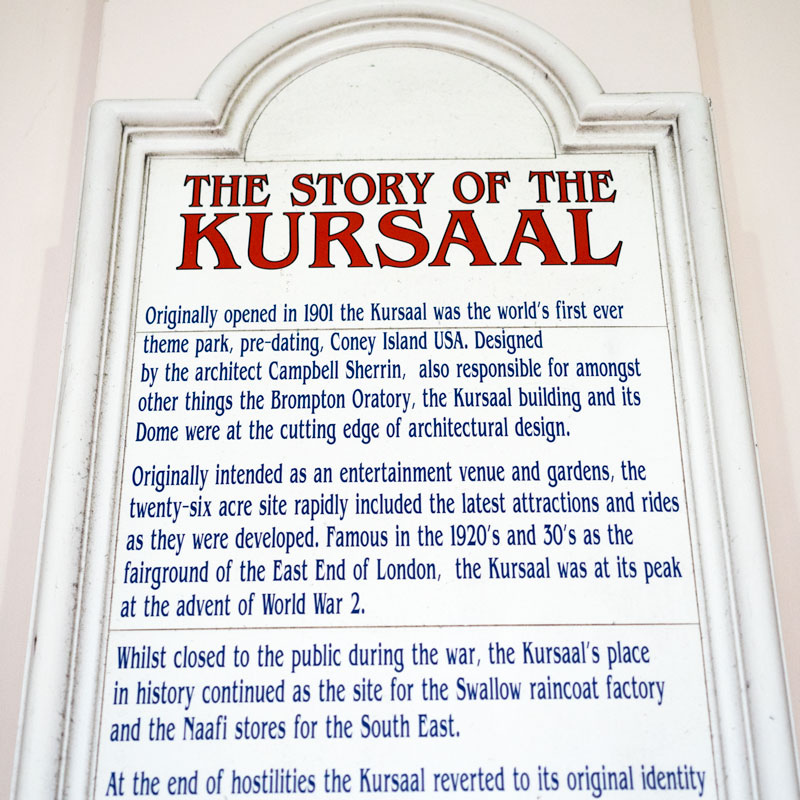
Kursaal

kursaal-info

Kursaal must have been the first German word I learnt, although I didn’t know it was German and I didn’t know what it meant, and nor do most visitors to Southend.

kursaalweb

I like the ceiling in the foyer. I don’t know if it was like that originally.

kursaal-ceiling

The dome is more familiar:

kursaal-dome

Language and Law – Linguagem e Direito

I posted about the journal Language and Law / Linguagem e Direito when it first appeared. I forgot to report (from From Words to Deeds blog) that the latest edition is about legal translation. That is, the journal is always about language and law, but not specifically on legal translation. Actually I got part-way through the first article, so this is a rather rushed account.

You can download it here.

The first article, by Karen McAuliffe, ist:
Hidden Translators: the Invisibility of Translators and the Influence of Lawyer-Linguists on the Case Law of the Court of Justice of the European Union. Here’s the abstract:

Abstract. Since the mid-1990s, when Lawrence Venuti published his book The Translator’s Invisibility, there has existed, in the field of literary translation, a debate on the (in)visibility, power and influence of translators on literature and academic theory. This paper shifts that debate to the field of legal translation, focusing on the role of and work done by lawyer-linguists at the Court of Justice of the European Union (ECJ) in terms of their (in)visibility in the process of text production of that court and in the texts themselves. Data presented here demonstrate that, in the ECJ itself, as in other fields, translation tends to be “a largely misunderstood. . . practice” (Venuti, 2008: vii), but that recent shifts in dynamics within that institution are leading to changes in perceptions of translation and more ‘visibility’ for translators in the process of production of that court’s case law, although they remain largely invisible in the context of the texts themselves.
However, the invisibility of translators in this context necessarily leads to a certain amount of power and influence on the texts they produce. Since those texts, in particular judgments of the ECJ, are intended to have force of law and to be applied uniformly throughout the 28 EU member states, that power and influence is not insignificant. This paper analyses some examples of such ‘influence’ on ECJ case law, and thus on EU law more generally. If we are to develop a full and nuanced understanding of the case law of the ECJ, the power of translators should not be ignored.

I was interested in this article, more in what I found out about the ECJ translators than in Venuti (I have got Venuti on my shelf but he has remained there). I had forgotten that French is the main language of the court.

One of the biggest difficulties, cited by almost every lawyer-linguist interviewed, is caused by the fact that those drafting the judgments are working in French, a language which for most is not their mother tongue

The translators tend to be lawyers, and above all lawyers without translation training. The translation they do has the force of law if it is judgments declared to be ‘authentic’, and this distinguishes their work from a lot of other legal translation.

Very few (only three of the 56 interviewed) had any experience of translation prior to working at the Court of Justice. Thus, the translating aspect of the role of lawyer-linguist appears to be one largely learned ‘on the job’. While that does, of course, have benets in terms of developing institutional translation norms and maintaining the consistency of the house style, it also runs the risk that translation ‘guidelines’ are interpreted as hard and fast rules of (ECJ) translation:
“I had no experience of translation prior to coming [to the ECJ], but that makes it easier to follow the rules of translation here, which are quite strict”. (lawyerlinguist)

With regard to the role of translation: a case can be brought before the ECJ in any one of the 24 official languages of the European Union, and each case has an official ‘language of procedure’19. Unlike EU legislation, which is ‘authentic’ in every language version in which it exists, with regard to ECJ judgments only the version of the judgment in the language of procedure is considered to be ‘authentic’. For practical purposes, the ECJ works in a single language: French. When an application is lodged before the Court (in any of the 24 official EU languages), all of the relevant documents are translated into French.

Interestingly, not a single one of the 56 lawyer-linguists interviewed for this paper was content to describe themselves as ‘translators’. Those who did initially refer to themselves as translators immediately qualified their statement by pointing out that as translators of judicial texts, with law degrees, they are “much more than simply translators” and that having a legal qualification “set [them] apart from ‘mere’ translators”.

I haven’t actually finished reading this article yet. But I found it particularly interesting as I was once part of an initiative to get more freelances working for the court. I was sent a huge pack of really interesting information and previous translations. Although I was using the internet and translation memory myself, it appeared that the lawyer linguists had a database of prior texts and EEC/EU documents which was not made available to me, so I spent an awful lot of time searching for and pasting existing English versions of the legislation and case law quoted. I also put a lot of effort into adapting my first translations, which were seen as a paid test, to the style of the materials sent me, and yet precisely that vocabulary was found lacking and was corrected minutely in red ink. I was told by another translator that that is what the court lawyer linguists are like: they give you a hard time until they get used to you. However, the initiative came to an end when the lawyer linguist who was promoting it died unexpectedly in his late forties. It really was not much fun translating because the work was three-quarters searching to find out what others had done. But if the lawyer linguists have not been trained in translation or had practice in it before they are employed, they will have no experience of revising other translators’ work. However, this is just my guess based on very little evidence.

Another article I have skimmed is by Vigier Moreno, F. J. – Teaching the Use of ad hoc Corpora. It’s about the problems of creating corpora for students learning to translate legal texts into their second language, so it’s close to my own experience of teaching legal translation. It’s a down-to-earth account of the subject. It has attached text examples and a useful bibliography.

Various links, including IALS and statute translations

1. The Institute of Advanced Legal Studies in Russell Square has occasional meetings with talks by lawyers and others. The meetings are free but you need to register – you can join their mailing list for information. Although the target audience are lawyers rather than translators, they can be very useful.

There has just been a meeting on Why is legal language so complicated? and on the From Words to Deeds blog there is a guest post by Danaë Hosek-Ugolini with a report on the event, a very useful warning as to the mental stamina you need to attend such an event. I must say I would not have expected so much on the problems of EU legislation, which are a field of their own because of the language problems and are already fairly familiar to me. I do like the term ‘the EU legislative footprint’, though!

I am curious about the work of Dr James Hadley, which (understandably) is not reported in detail :

Dr James Hadley, from the School of Advanced Study, presented the early stages of his research on equivalence and legal translation. He sought to demonstrate that if relationships between people are reproduced in different countries, equivalence could be reached in legal translation despite the differences in legal systems and concepts.

His research profile reveals little in this connection.

2. Buying essays online. Some time ago (thanks, Barbara!) the Guardian published an article with the heading An essay I bought online was so bad I want a refund – but the firm won’t pay up . The article is curiously illustrated with a full-bottomed wig shown from the back. I can’t say what exam you have to cheat in to get a full-bottomed wig.

The Guardian was, unsurprisingly, rather po-faced about this.

We phoned the website (apparently not the only one reached by the phone number) and a spokesman said he had no record of any account in your name. He also insisted the essay-writing done for students like you was “within the law”. Universities are having to invest in internet plagiarism filters to detect fake work such as this. Students, avoid these websites – you will not only lose money but could also jeopardise your academic career. You have been warned.

Plagiarism filters have been around for ages.

I wonder how this works in Germany, where so many courses are now run and tested in (global) English, which seems to be a case of the blind leading the blind. Could one get better English by using an English online service, and if so would one be marked down for using good English which was not recognized as such?

It seems that cheating may be on the increase since the increase in numbers of universities in the UK.

3. English translations of German statutes.

I’m not saying anything new when I list the ways of finding translations online, but here is a refresher (and I don’t mean the refresher you pay a barrister for a further day’s work in court).

Firstly, if it’s ‘officially’ translated you can find it under ‘Translations’ on the left-hand side on the online site run by juris (juris is a proper name and does not get translated – it confuses some non-legal translators when they first encounter it in a text, but you have to realize that many Germans love to use small letters in proper names).

I believe that to be ‘official’ a translation has to be vetted by a qualified German lawyer. Unfortunately not all these translations are wonderful, though many are.

Secondly, there is the Centre for German Legal Information site which collects translations from all over the Web. It is a fantastic collection and you can click through to search for a statute by its German name, which clearly may be what you have.

However, the cgerli site does not keep outdated statutes, even though you might still have to translate them. It also never has everything. You can inform it of dead links and new links and you should do that.

There is also the German Law Archive site. originally at Oxford University, run by Gerhard Dannemann, which is in the process of being upgraded. There are a lot of statute links there.

If this all fails, translations can often be found elsewhere by any internet search. They all have to be taken with a pinch of salt. But they can be very useful.

Here’s an example of a curiosity I found recently when I was translating something about assembly rights. The police in Frankfurt am Main have a page all about assembly rights. It even contains a translation of the German assembly Act, albeit into Denglish:

Dictate of peacefulness

Regarding the Constitution, every assembly deserves protection as long as it is peaceful (means nonviolent), and carried out without weapons. In this connection you have to bear in mind that an assembly in its totality (means majority) has to be violent to be called “non-peaceful”.

As long as it’s comprehensible, this can be useful for clients.