Harry Potter translators and WB/Urheberrecht der Harry-Potter-Übersetzer und der 350-Kilo-Gorilla

Via Katy Derbyshire in love German books, a sad tale of how an Israeli translator of Harry Potter didn’t even get a ticket to the press screening of the film, let alone recognition of the translation, which was used in the subtitles.

The whole sad story is told by Gili Bar-Hillel, who writes a blog usually in Hebrew, but in this case an English post:

Though I was not employed by Warner Bros. and not contractually obligated towards them, such was the power of this company that they were able to threaten me by proxy. As far as I was able to figure out, Warner Bros. bullied the Christopher Little Agency into bullying the various international publishers to bully their translators into retroactively waiving all rights to their translations, under the threat that otherwise the publishers would not be sold translation rights to future books in the series. This is how it happened to me: I was invited to a chat with the Israeli publisher after I had already translated the first three books in a series. He met me in a café and required me to sign a memo, which I was not allowed to read in advance or show to anyone else, and of which I was not allowed to retain a copy. I was told I must sign on the spot or the job of translating future Harry Potter books would be given to another translator. As far as I was able to understand, the memo was a promise to Warner Bros. that I would not claim trademark on any of the translated terms I had invented. I could sign or be cut off from Harry Potter forever. I signed.

It later became apparent that to Warner Bros. this memo was tantamount to a complete waiver of any and all intellectual rights I may have thought to lay claim to. When the Harry Potter films were distributed in Israel, my translation served as the basis for the subtitles and dubbing scripts of the film, without my permission or that of the Israeli publisher. I never received any compensation for this. I was never thanked or credited. In fact, the translator who was responsible for the Hebrew titles complained that her contract from Warner Bros. obliged her to use my translation.

Read the whole thing.

In comparison, Sharon Neeman had it easy – when I think of translators in Israel, I remember her song on YouTube, 5,000 words, all translated for lawyers, of course (and let me repeat that a normal day’s work is nearer 2,000 words).

5000 Words (video)

Apparently there is a CD too – order5000words@gmail.com for details (at least, this was the story in February 2009).

Seminar on legal English: Contract Law

This was a great seminar on legal English and contract law given by Stuart Bugg, who is a NZ and English lawyer (he was born in Yorkshire, which I didn’t know) and run by the Regensburg section of the BDÜ. It was on March 24th and lasted all day.

Actually I have stopped writing up seminars, because it can be invidious: one finishes up either being unintentionally nasty or stealing all their good material. So I will be brief. Everything about this seminar was excellent, especially the good materials and the relaxed atmosphere which allowed us to have a good discussion on a number of points while at the same time snaffling about 100 pages of good stuff. Probably seminar leaders know that we translators never find time to read them afterwards. The organization was also very good – coffee and lunch breaks on time and ran very smoothly.

Here are some pictures of the venue (Thon-Dittmer Palais) and the place for lunch:

Stuart Bugg is one of the authors of the Langenscheidt-ALPMANN Fachwörterbuch Kompakt Recht, which has come out in a second edition since I referred to it. He has also published Contracts in English – an introductory guide to understanding, using and developing “Anglo-American” style contracts. I had a look at this in advance and was impressed. You can see the table of contents at the link above. Stuart specializes in contracts and contract law and refers to all common-law jurisdictions. My only criticism of the book so far is that over one-third of it consists of texts like the Law Reform (Frustrated Contracts) Act 1943 which can be found on the internet. The reason for this, as I have mentioned before, is that the book is partly directed at lawyers, and German lawyers are often kept on a short leash as far as using the internet and CD-ROMs is concerned, so they like to have stuff in books. Stuart confirmed this and said the software can mess up the internal IT systems.

Now I don’t want to go into any detail, and indeed, I’ve got to find time to process all my notes and the materials while it’s fresh in my mind. But some notes, partly on things I need to think about:

1. Stuart said that when he translates a German contract into English, English lawyers tend to think it’s wrong. Exactly! If an English lawyer thinks your translation sounds like an English contract, something is amiss. We also discuss liability. I don’t translate a contract unless it says the language and law governing it are German – because if I were to convert a German text into a common-law one, I would be acting as a lawyer, and I am neither registered nor insured for that. Stuart said that there is a third clause: the jurisdiction should be Germany too, since otherwise you might land up in the Saudia Arabia courts, albeit with German law as the basis.

2. Must give more thought to the terminology of ending contracts, which has been pursuing me for a few decades now. We talked about rescission and also about cancellation (avoid the latter term).

3. Gewährleistung (a term I think the BGB has done away with), Garantie, warranty, Bürgschaft: another can of worms.

4. Must investigate what deeds are in the USA. I thought specialty contracts were only valid in England and that deeds in the USA were just smoke and mirrors for clients, but apparently I was wrong and you do need a deed in the USA to convey land. I may come back to this.

5. Got a bit tied up on how to translate §. Because of course, it’s one thing translating § in a statute, but another in a contract. I tend to leave the §, which is probably stupid, since it confuses some British people (but what doesn’t?). It comes up both in a heading and when referred to later (clause?)

6. Differences between damages (only monetary) and Schadensersatz. (I was a bit surprised to see a recent online translation of the Zivilprozessordnung using damages to mean Schäden).

7. Translating Vertragsstrafe – not as liquidated damages, because that would imply the complete sum.

8. Apparently Germans confuse arbitrary and arbitral, haha!

9. Many had no idea what bailment is. Of course, easily confused with bail and bailiff.

10. We discussed shall and will and must a lot. Agree that will and shall are both binding in contracts. Sure enough, I almost immediately got a contract a client had altered, using will in the added bits where I had used shall in the rest. Not a big problem, but I decided it would be safer to stick to one throughout.

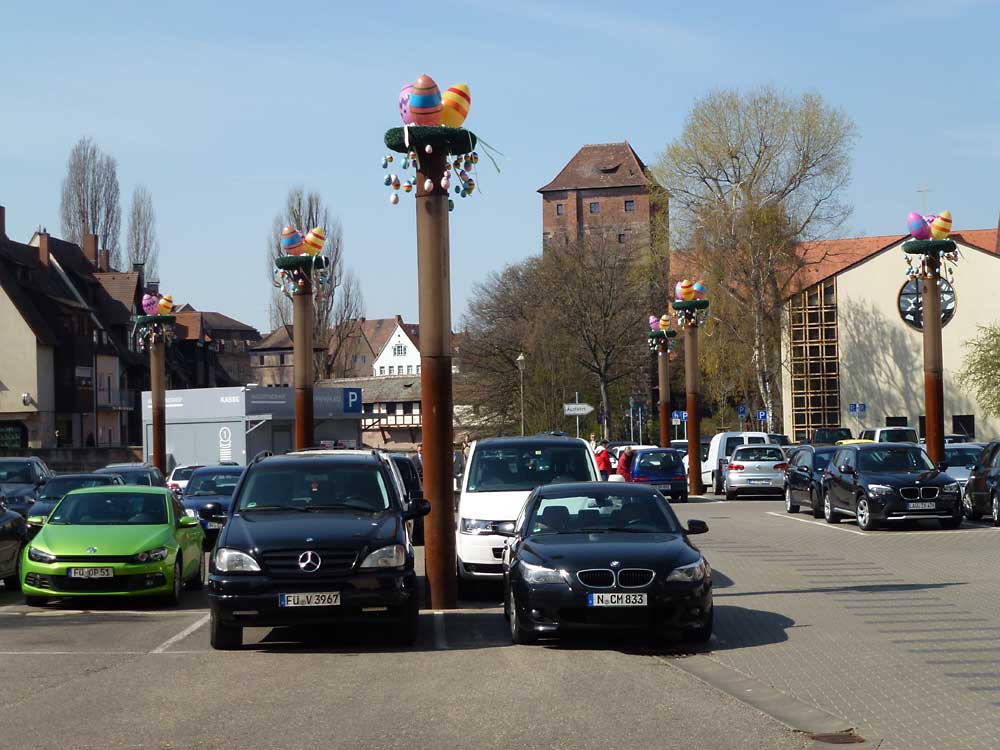
And here is a contemporary pillar at Regensburg Station (one of several):

How to succeed in business/ALS (GB) und ein Weblog zu Finanzübersetzung

Miguel Llorens in Madrid has a weblog called Financial Translation Blog, which is new to me. It’s subtitled ‘A dose of skepticism to guard against localization hype, courtesy of Miguel Llorens, an English-Spanish financial translator’

And he did a wonderful job on Gavin Wheeldon, who sold ALS to Capita in December riding on the hype of the Ministry of Justice contract for court interpreters which has since gone so badly wrong.

Wheeldon appeared a few years ago on a TV show called Dragons’ Den, where entrepreneurs try to convince a panel of potential investors to give them money. Wheeldon failed to do so, but didn’t he do well in selling last year?

Miguel has done a fantastic job on this story in a post called ALS’s Gavin Wheeldon: A Case Study in Cheap Translation, in particular giving a link to a video of Wheeldon’s performance on Dragons’ Den – and other links too.

He prefaces the story with a nice quote from The Producers:

Bialystock: Step 1: We find the worst play ever written.
Step 2: We hire the worst director in town.
Step 3: We raise two million dollars. … One for me, one for you.
There’s a lot of little old ladies out there!
Step 4: We hire the worst actors in
New York and open on Broadway and before you can say
Step 5: We close on Broadway, take our two million, and go to Rio.

(Got this link from Judith on the ITI GerNet mailing list)

RIP Tom Paine/Kater der Anwaltskneipe Seven Stars in London verstorben

It’s funny how you can walk around with a camera and be absolutely blind. A few years ago – it was 2006 – I was in Carey Street, near the famous lawyers’ pub Seven Stars. I saw a window with two barristers’ wigs on black velvet, so I took some time to photograph them. (I even blogged this at the time).

But I had a strange feeling I wasn’t alone, and after some time I saw that to the side of the wigs was a large black cat watching me.

I see he has something like a dog tag hanging from his neck.

I have now been reading about the famous pub cat Tom Paine of the Seven Stars, and I realized that was actually a side window of the pub, and in this picture you can see the view from inside the pub.

I had been meaning to go and see him, not realizing I already had. And in October 2011 it was reported he died.

The memorial poem ends with a play on Alexander Pope’s Epigram Engraved on the Collar of a Dog Which I Gave to His Royal Highness:

I am his Highness’ dog at Kew;
Pray tell me, sir, whose dog are you?

Webinars on English legal language

Juliette Scott has a blog post on Webinars in June and July 2012 on English legal language. They will be given by eCPD Webinars – here’s the link. More information there, and it also says details may change.

26 June, 11:30 am BST. Contracts and Contract Formation for Legal Translators (1 x 1 hour webinar) £20
Covering: contract formation, remedies for breach, some common contract clauses and Terminology, litigation terminology.

28 June, 9:30 am and 11:30 am BST. The English Legal System for Legal Interpreters and Translators (2 x 1 hour webinars) £40
Covering: background, the legal profession in England and Wales, proceedings in court, litigation terminology … and more

3 July, 9:30 am and 11:30 am BST. Criminal Law and Procedure for Legal Interpreters and Translators (2 x 1 hour webinars) £40
Covering: the required elements for criminal liability, capacity, principals and accessories, magistrates and Crown Court proceedings and appeals … and more

Book all five for just £90.00.

Our speaker is David Hutchins of Lexacom, who teaches these subjects at face-to-face workshops and seminars. If you are unable to travel to these, or just cannot spare the time to do so, these webinars are an ideal way to save time and cost and learn from a true expert from your own home or office.

David Hutchins has more on his website, Lexacom, including links to articles that have appeared on his seminars.

I’ve attended (?) two eCPD webinars and was pleased with them, particularly the one on using a corpus for translation research.

One of the best things about webinars to me is that they have brought more variety to the menu. Most of the local translators’ seminars are not personally interesting to me. Of course, there are always introductions to people’s favourite CAT programs, but that doesn’t include Transit. Why can’t someone do a seminar on that? Well, even if they did, who’s to say I would be able to attend it?

The BDÜ has also done some webinars and they are available later online for members. I see that at eCPD too you can purchase access to some past webinars.

CJEU – ECJ/EuGH

I’m a bit late in recognizing the new abbreviation of the Court of Justice of the European Union, CJEU, rather than the earlier ECJ.

There’s a useful document in the House of Commons Library – Standard Note SN/IA/3689: The European Union: a guide to terminology, procedures and sources, last updated 16 March 2011.

Here’s the page where you can download it.

EC or EU law? Treaty of Rome or Treaty of Lisbon? First, Second or Third Pillar? Acquis Communautaire? Court of Justice or Court of Human Rights?
This Note aims to clarify some of the terminology used to describe the institutions, laws and procedures of the European Union. It also provides links to useful sources of information on the EU.

It’s 14 pages in length. It contains links for further research and reading.

9 European Courts
There are two main European Courts. Media reports sometimes confuse the two, alleging that the EC/EU has ruled on something when it is in fact the Court of Human Rights that has ruled, and vice versa.
• The Court of Justice of the European Union (CJEU) is the EU court which rules on alleged breaches of EC law and the Treaties. CJEU judgments (by convention not spelt with an ‘e’ as in ‘judgements’) can be found on the CURIA website..

The European Court of Human Rights is the Council of Europe court which rules on alleged breaches of the European Convention on Human Rights. ECHR judgments can be found on the HUDOC website.

Another point this document mentions is that since the Treaty of Lisbon, all EU legislation can be called EU law. This has been a point of contention in some sections of the ITI, because apparently at a talk they were advised not to use the term ‘EU law’ (although there are books on the subject).

4 EC law or EU law?
Former Article 281 of the Treaty of Rome as amended (and similar articles in the ECSC and Euratom Treaties) gave the EEC ‘legal personality’. That is to say, only the then EEC and its successor, the EC, had rights and obligations under international law allowing it to adopt laws and treaties. Former Article 282 of the EC Treaty conferred upon the EC “the most extensive legal capacity accorded to legal persons” under the national laws of the Member States. The EU did not have this status, and so strictly speaking we should have referred to ‘EC law’ and not to ‘EU law’ in most instances until December 2009.
Until November 1993, when the TEU came into force, the EU’s Official Journal (OJ) references were to ‘EEC’ law. After 1993 the OJ used ‘EC’. The OJ distinguished between EC laws and CFSP or Police/Judicial Cooperation Decisions, which were Second and Third Pillar (EU) instruments. For example, a Council Regulation was written as ‘Council Regulation (EC) 850/2005’ in the Official Journal; a Commission Directive was written as ‘Commission Directive 2005/37/EC’.
All these instruments are now EU instruments. Since the granting of “legal personality” to the EU under the Treaty of Lisbon, it is now technically and legally correct to refer to EU law and EU Treaties.

We still write those Directives and Regulations with ‘(EC)’ etc., but it seems that retrospectively they are all EU documents.

Via Jaanike Erne ideas on europe and Grahnlaw

LATER NOTE (June 2012) – perhaps this is clearer, from the UK parliament site:

9. The CJEU is the collective term for the European Union’s judicial arm,[8] but the single institution consists of three separate courts, each enjoying its own specific jurisdiction. Generally speaking the three courts’ jurisdictions are defined by the types of cases they hear or by the status of the litigant bringing the action and whilst the CJEU does not operate on a formally hierarchical framework like, for example, the UK court structure, it is nevertheless split into three tiers. Forming the upper tier is the Court of Justice (CJ) which was formerly known as the European Court of Justice (ECJ); beneath the CJ is the General Court (GC) which was formerly known as the Court of First Instance (CFI); and the third tier consists of the Civil Service Tribunal (CST), which in the words of the Treaty constitutes the EU’s single “specialised court”.[9] Francis Jacobs, former Advocate General at the Court of Justice and presently Professor of Law at King’s College London, considered this structure a good one.[10]

The term for the court as a whole is CJEU – the term ECJ used to be used both in this collective sense and to refer to the Court of Justice. Now, the collective abbreviation is CJEU and the Court of Justice abbreviation is CJ (sometimes ECJ, I imagine).