Anwalt englisch in Düsseldorf/Autotext

Sie sollten es nicht versäumen, Ihren Anwalt englisch nach den Erfolgsaussichten des Verfahrens zu befragen. Informieren Sie Ihren Anwalt englisch möglichst detailliert über den entstanden Schaden. Der Name des Schadensverursachers ist eine wichtige Information für Ihren Anwalt englisch. Für alle Tätigkeiten, die der Anwalt englisch im Rahmen des gerichtlichen Verfahrens vornimmt, sind sowohl gesetzliche Gebühren als auch Individualvereinbarungen relevant. Für die Durchsetzung Ihrer Ansprüche sollten Sie Ihrem Anwalt englisch auch alle vorhandenen Beweise zur Verfügung stellen. Ein zuverlässiger Indikator dafür, wie gut Ihr Anwalt englisch Ihre Sache vertreten wird, ist auch immer sein Erfahrungshorizont und der seiner Rechtsanwaltskanzlei. Bereiten Sie sich darauf vor, von Ihrem Anwalt englisch genauestens nach Zeugen befragt zu werden. Zielsetzung des ersten Gesprächs sollte sein, Ihren Anwalt englisch so gut es geht über Ihr Anliegen in Kenntnis zu setzen.
…weitere Keywords

This text was automatically generated on the site of a Düsseldorf lawyer when I did a Google search for anwaltlich englisch. This reminds me of those dictionary sites that respond to a query with ‘No precise equivalent found’.

I was actually wondering if anyone had a good idea for the old chestnut ‘es wird anwaltlich versichert, dass…’ (we lawyers guarantee that …). Probably a waste of time.

Incidentally, I have the impression that Google has started searching very widely – I did not want the word Anwalt, but anwaltlich. I would have to put it in inverted commas now. I did find some discussion at dict. cc., but nothing sensible. One Peter informed the questioner that attorney is ‘American dialect and not English’. Good for you, Peter, helping show the world that British people aren’t necessarily polite or educated. Derek Gill Franßen made more sense at ProZ.

Signs/Schilder

Yesterday was a public holiday, at least in Bavaria. Here are some signs you would see if you went for a walk by the canal (near the harbour). For the insects at the top, see earlier entry. The bottom sign indicates that this is where search and rescue dogs (Rettungshunde) train.

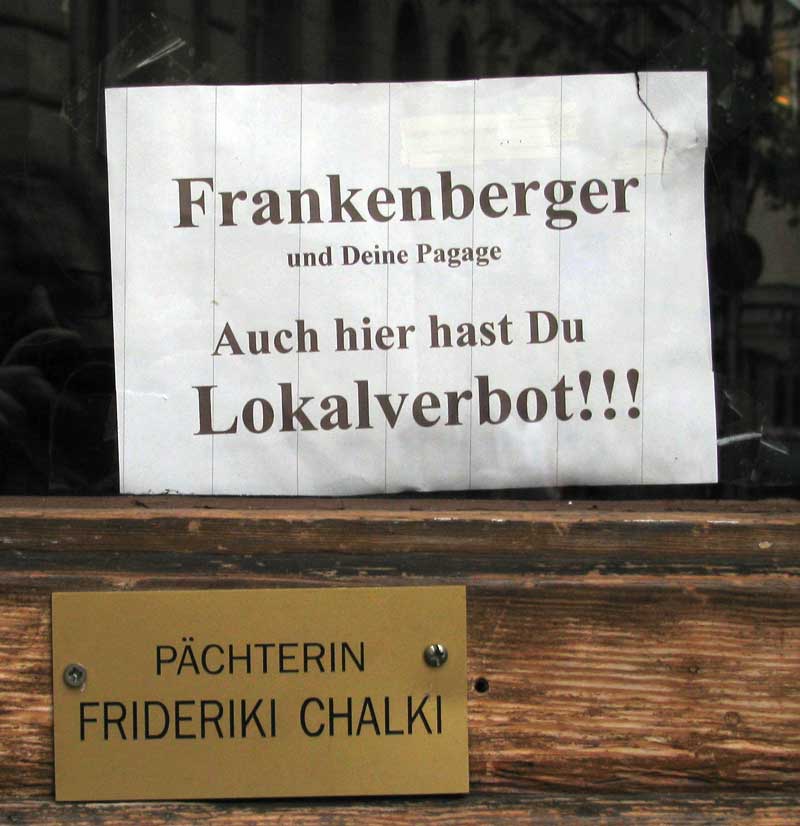
And here is another person using the Pagage text. I doubt whether Herr Frankenberger visits Fürth.

Case law/Rechtsprechung

This came up on a legal translators’ mailing list, and I can’t resist blogging it.

Apparently it has been argued that the German word Rechtsprechung should not be translated as case law, because the term case law implies the whole common-law system of judicial precedent, and German law has nothing like that. (This is an imprecise quotation: the suggestion was said to be that it is inappropriate to refer to court decisions of countries like Germany and Austria, which emphasize codification, as case law).

I disagree with this: there are differences between the importance of cases in German and English law, but the term case law can still apply to both. And it is applied to both, for instance by Markesinis, by Raymond Youngs, by other writers on German law. A search on German case law in Google Books will produce many examples, some of them good. Markesinis uses precedent too. That is probably a clearer term for non-English speakers, but it certainly does not suggest that cases are not law in Germany.

Anyway, the upshot is that for me, German Rechtsprechung and English case law are close enough to allow the translation. The translation of legal terminology often hinges on how close the translator finds two legal institutions. (I don’t translate Rechtsanwalt as solicitor, unlike many, because I think it’s too narrow – I prefer attorney, even though the term may be seen as historical or American).

Incidentally, German case law was relied on by judges when the Civil Code was first introduced: it was not a blank slate or Stunde Null as far as civil law was concerned. Cases are used to fill gaps in codes and statutes, and in some cases this happens by the legislature’s design. Commentaries on codes and statutes are full of references to cases. Of course, a court is not obliged to be bound, but it often will follow cases. The Federal Constitutional Court binds itself too.

The source of the opinion, which some other legal translators agree with, was a seminar by Russell Miller preceding the current ATA conference in Denver. Here is the summary:

Contending Legal Traditions in German Law
Russell Miller
(Wednesday, 9:00am-12:00pm; All Levels; Presented in: English)

The law is an inherent part of legal translation. With this truism in mind, this seminar aims to introduce German-language translators who work with legal translations to some of the traditions vying for influence in German law and legal culture, particularly the civil law tradition and the constitutional law tradition. It is hoped that a better grasp of the spirit and substance of German law will improve and enrich the work of translators dealing with German legal materials.

I wish I could have been there – it must have been interesting. Has anyone got some materials? Russell Miller is well qualified in German and US law, but one can still disagree on terminology.

Here is a quotation from a book on Google Books by Martin Vranken, admittedly a Belgian, who teaches at Melbourne University, which illustrates a use of case law which I find perfectly acceptable and which is common:

…the dogmatics of the BGB has not prevented the German law of tort being shaped heavily by case law. …the courts use Para 823, I BGB as the legal basis for important developments in tort law.

Incidentally, one of the suggestions for an alternative given on the mailing list was jurisprudence. It’s in the title of ‘The Constitutional Jurisprudence of the Federal Republic of Germany’ by Donald P. Kommers. And I’ve now seen it used in the German Law Journal. There’s an article there by Antonio K. Esposito and Christoph J.M. Safferling entitled Report – Recent Case Law (sic) of the Bundesgerichtshof (Federal Court of Justice) in Strafsachen (Criminal Law). The first sentence is:

Reporting on one year of the Bundesgerichtshof’s (BGH – Federal Court of Justice)
jurisprudence in criminal affairs is always a delicate matter.

I find this use of jurisprudence really weird. To me it means legal scholarship – Rechtswissenschaft. It seems it may have come via Lousiana.

Alternatives to case law, for those who object, are: court decisions, judicial decisions. Adjudication was also suggested.

Legal English blogs/Blogs zur englischen Rechtssprache

I’ve mentioned weblogs on legal English before, I think, and I’ve certainly mentioned Jeremy Day’s blog on English for Specific Purposes, Specific English. But I haven’t yet put them on my blogroll, although I think they must be highly relevant here.

Here is a link to the legal English entries on Jeremy’s blog. The latest one, My first and worst legal English lesson, is a great description of what can go wrong when you present yourself as more expert than you are – certainly a risk not only for non-lawyers teaching legal English, but for lawyers too. If you’re helping lawyers to improve their English, you don’t have to be the source of legal knowledge, but the facilitator.

The entry earlier than that, Legal English blogs, is a whole year old and gives links to other blogs on legal English (including Transblawg!).

And here’s another one: English for Law, by CKL, with many suggestions for teaching materials sources.

Proofreading/Korrekturlesen

Excellent Practicle Guide, 18 Dec 2009
By …
This review is from: The Pocket Book of Proofreading: A Guide to Freelance Proofreading and Copy-editing (Paperback)
I am studying proofreading and copy-editing via a correspondence course, which is fine, but I was searching for additional help and practicle exercises without having to pay a fortune. I found it in this neat, concise and easy to read book. The writers style is very positive and even some of the more complex areas are handled with ease. The exercises included are worth the price alone. If you are thinking about becoming a proofreader,already studying through a course and/or just want some information about the whole subject look no further. I looked at many alternatives and eventually chose this after reading the reviews. I hope you do the same. If like me you live outside of the UK try Amazon.fr for this book, in the English books section, it’s cheaper because the price is already in euros.

(amazon.co.uk customer review of The Pocket Book of Proofreading)

Cheaper because the price is already in euros?