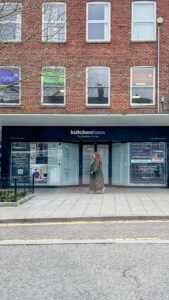
Seen in Brentwood: Coming soon – kütchenhaus – the German kitchen.
Apparently these have been around for a while. They seem to be a brand from nobilia and to exist in Germany as Küchenhaus.

Seen in Brentwood: Coming soon – kütchenhaus – the German kitchen.
Apparently these have been around for a while. They seem to be a brand from nobilia and to exist in Germany as Küchenhaus.
Michael Moritz grew up in Wales as the son of Jews who left Germany in the 1930s but many of whose relatives did not escape the holocaust. He was diagnosed with a genetic form of cancer whose risk is greater for male Ashkenazi Jews. This perhaps concentrated his interest in the experiences and emotional life of his parents, which he had little considered when he was growing up. The book is an investigation of his history and life as a Jew.
There is a good extract at Granta.
The threat that so rapidly materialized in 1930s Germany is reflected for Moritz in Trump’s America. What he had heard as a young boy whenever his parents sensed disturbing political trends:
If it did happen, it can happen.
If it did happen, it will happen.
If it did happen somewhere, it can happen here.
It will happen here.
He is applying for German citizenship. One reason is the increasing anti-semitism in the UK, another the access to other EU countries he enjoyed before Brexit.
Part of it reminded me of Uwe Wittstock, Februar 33. Der Winter der Literatur, which shows how the literary life of Germany in Weimar was aggressively attacked in a period of a few weeks.
When this blog was in an unintended hiatus, it was possible to retrieve the posts through a reader’s feed reader. But this one comment that appeared at that time was lost – but the commenter, the blogger of Language Miscellany, has now been found. His interesting post was about the possibility that Tower Hamlets council might declare Cockney one of the local languages – for International Mother Tongue Day on 21 February (not long to go now). This was reported in 2023. Cockney in Tower Hamlets is the post:
On 15 March 2023, Tower Hamlets Council discussed a petition started by Grow Social Capital CIC and Bengali East End Heritage Society and signed by 31 people. The petition asked the Council ‘to ensure that the Cockney language, identity, and its unique cultural heritage related to the East End of London be recognised as a community language and be celebrated annually on 21st February on International Mother Language Day, and for Cockney to be included in any community language provisions by the Council.’
It does not seem to me that Cockney is a language, and even Estuary English is not. I should say I may be a Cockney myself, as I was born in the Mothers Hospital in Hackney, just before the NHS came into existence, but at that time the bells of Bow Church were not actually ringing for a few years after WWII, or so I was told. The exact dates and which bells were ringing is confusing. But new bells were ringing from 1961.
When I started re-reading Der Zauberberg last year, I was disappointed that I couldn’t get an edition with bigger print. I have a Kindle version too. But it seems that now that Mann’s works are out of copyright, new editions have appeared. There is also an expensive volume full of notes (in German), and even a posh Reclam version. My edition was by S. Fischer Verlage, and now other publishers have appeared, and there are new translations coming out. I am not fully informed of the situation but here is a superficial account.
I saw ads for them when I was reading a Perlentaucher newsletter.
Suhrkamp Verlag Literaturklassiker von Thomas Mann in hochwertiger Neugestaltung
There are new covers by Andrew Davidson.
Der Zauberberg – Der Jahrhunder-Roman prachtvoll illustriert in einer exklusiven Schmuckausgabe (Reclam)
Thomas Manns Jahrhundertroman – erstmals als Retroausgabe im Taschenbuch (S. Fischer Verlage) – yes, there was no paperback before.
It can be read free of charge in Project Gutenberg too and in the German Projekt Gutenberg, which is apparently being restructured.
Is it normal for books to be so restrictedly available while in copyright?
I live in Upminster – there was once a pearly king of Upminster, and the image on the front page of this weblog shows part of his costume, including the windmill at the left. Upminster, Hornchurch, Romford and Rainham have been the London Borough of Havering since 1965, although my address says Essex. A vociferous core of locals are convinced we actually are in Essex. Not so Andrew Rosindell, the Romford MP, who must know we are in London, as he wants and has always wanted (he was born after 1965) the borough to become part of Essex. Excellent article on Rosindell and Havering by diamond geezer. The occasion is Rosindell leaving the Conservative Party and joining Reform, where he hopes Nigel Farage will help him.
diamond geezer nicely sets out how London would change without Havering:
A huge lump would be chopped off London’s eastern edge, reducing the area of the capital by 7%. The easternmost point in London would become the Dartford Creek flood barrier rather than a muddy field far beyond the M25. London would be five miles narrower than before. One-sixth of London’s Green Belt would vanish overnight.
London would lose 260,000 residents, reducing its population by just 3%. It’d become a younger city, a more left wing city and a less white city. A greater proportion of its residents would rent. It might also become a happier city because the moaners had left.
Continue reading
Before all my latest posts were lost – and they have been recovered – there was a new comment on my site that was interesting, but that comment was lost for ever. I had replied to it. It was from a regular follower and blogger who had read something about Cockney as a dialect. I think I attempted to follow his blog and I did intend to write something about that. But I have lost all the references to it. So a new comment would be welcome.