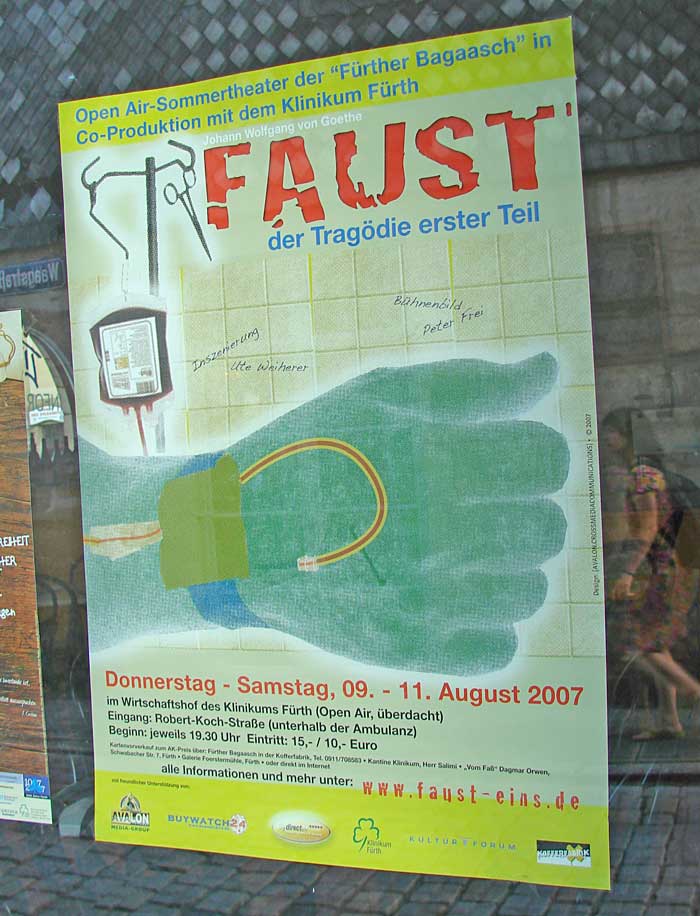
Missed this, but like the poster.

Missed this, but like the poster.
Legislative drafting in plain English is the topic of Clarity for May 2006 (PDF file), the latest online issue. (Shallower link for Clarity the organization)
I have been busy so I offer this for further reading, but I haven’t read much of it myself.
This is a report on a workshop at the 2005 Boulogne conference, at which instructions for a bill to regulate queueing were given and a number of people prepared draft bills (I expect at a later date), three of which are given as examples of plain English drafting.
Part of the instructions:
The government is of the view that the time has come when in all appropriate circumstances queues must be formed and that they must be regulated to promote fairness and avoid confusion and violence. Draftsmen are therefore requested to draft an appropriate Bill to be put before the legislature. It may be entitled The Queues Act , 2005.
Non-British readers should note that this is not a serious intention.
Not all translators want to translate into plain English, but this offers everyone food for thought, especially the summary at the end by Vicki Schmolka, who compares both these three drafts and some (unpublished) drafts on concealing information as to noise when selling a house.
She discusses and gives examples of the title, table of contents, definitions (if any), he/she etc., notes and examples, placement of penalty provisions, section numbering, use of lists and and/or, and must/shall.
Note, for instance, on definition:
None of the drafters used a system, such as italics, underlining, or an asterisk, to indicate a special meaning when a defined word or term was used in
the draft Act.
Many translators in Germany argue that once you define, say, the seller, you should not only write Verkäufer in German, you should capitalize/uppercase or italicize it so it stands out the way Seller does in some English contracts. The argument is that there may be other Verkäufer referred to who are not italicized. That obviously depends on the source translation. For those of us translating into English, however, it’s worth noting that it’s not just plain English advocates who don’t capitalize defined terms (then again, some contracts are enormous and these aren’t).
And here’s something to mull over: the examples of approaches to he/she:
The drafters were consistent within their own drafts, but among the six drafts, each of the
following styles occurred. …
‘Each person in a queue must make sure that he is no more than 50 centimetres away from the person in front of him.’
‘A police officer may order any person whom they believe …’
‘A person in a queue may invite one other person to take a place in the queue immediately in front of
him or her.’
‘A solicitor or estate agent is retained by a client if any firm of which he or she is a member or by which he or she is employed is retained by the client.’
‘If a seller uses a lawyer to sell the Property, and the lawyer knows that the seller has not done
what section 8 requires, the lawyer must tell the buyer before the buyer enters into any contract to
buy the Property.’
‘You, the buyer may [only] make a claim for an award of damages for intentional non-disclosure
or stn [statutory troublesome noise] by taking the following steps: …c) step 3 if you really want …’
Incidentally, no-one used shall.
Anwaltskanzlei Georg W. Busch in Münster.
I’ve added him to a list of funny law firm names on the WSJ law blog.
(Via RA-Blog under the heading Anders vorgestellt)
The weblog transubstantiation discusses translating the Polish term for Studentenfutter into English:
An interesting phrase is the Polish mieszanka studencka which is the well-known and popular mix of peanuts, hazelnuts, cashews, almonds and raisins. A logical equivalent would be student mix, however, this term does not exist in English.
One American equivalent is trail mix, also known as gorp, or (says World Wide Words) scroggin, in the Antipodes.
It seems that many people believe gorp is an acronym (for good old raisins and peanuts, or for Granola, oatmeal, raisins and peanuts, or even grape, orange, raspberry and pineapple) and even scroggin is believed to be an acronym for sultanas, currants, raisins, orange, ginger and nuts).
Incidentally, transubstantiation says that student food is the term in Britain. I haven’t encountered it. Wikipedia says it refers to mixtures of nuts only. And there is a place where a locally sold mixture of chocolate (M & Ms, raisins and peanuts) is called crap.
I fear that treating it as an acronym would narrow one’s mix. That needn’t be the case if you order your own muesli from the German startup www.mymuesli.com. They do have an English site but they don’t (yet) ship outside Germany.
This isn’t a weekly terminology roundup at all, it’s a test to see if I want to do something like this.
What I wonder is, if I read various mailing lists and forums, how far I should acknowledge them. I imagine some want a link, but others want privacy protected. I think I’ll make a list of regular sources, and keep that separate from the list, which would mainly contain my remarks.
The first example is a term that was hard to solve online:
verantwortliche Vernehmung: this term came up on one list in March, but context was lacking and there were no useful replies. Questions on legal terminology should contain context, and even a list of words is a context – there is no such thing as ‘no context’! And they should say if the term is German, Austrian or Swiss, and if the target is the USA, Britain or elsewhere.
This time, on an ITI list, there was a suggestion from someone who knows the police: interview under caution.
Problems here: someone suggested responsible, because there are plenty of ghits on reponsible interrogation. But without knowing what the German means, that is not conclusive. Googling the German term did not produce a specific definition, nor did my public prosecutor’s book by Heghmanns. But there was plenty of indirect evidence. I found a reference that said you can’t have an erste verantwortliche Vernehmung of a child because the child could not be convicted – which sounds like ‘you can’t caution a child because a child cannot incriminate itself’.
I didn’t pursue it further, but I think it may be a term used in police practice to refer to something defined under a different term in the Code of Criminal Procedure.
AZR: no, this does not stand for Allgemeines Zivilrecht in Revision, but it does refer to Revisionen at the BAG: if it is part of a file number like 2 AZR 754/97 there’s no need to expand it, let alone explain it in a footnote.
(For correction see comments: all these file no. abbreviations are listed in the back of Dieter Meyer, Juristische Fremdwörter, Fachausdrücke und Abkürzungen, which is a small guide to abbreviations for students and very useful – for statutes use Kirchner / Butz, Abkürzungsverzeichnis der Rechtssprache, and in Austria AZR (!), Abkürzungs- und Zitierregeln der österreichischen Rechtssprache und europarechtlicher Rechtsquellen)
legal eagle: a discussion on ProZ came up with: Topjurist, Spitzenjurist, Spitzenanwalt, Rechtsguru and Starjurist
public law can mean öffentliches Recht, but in the context queried it meant a statute that had been passed but had not yet been incorporated into a code – it has the abbreviation PL as a reference. It comes up in the middle of a Wikipedia entry:
Congress
A Public Law, or P.L., is designated by the number of the Congress, a hyphen and the order in which the law is enacted. P.L. are later signed into law by the U.S. President.
I wonder if this is another reason why I associate the word law meaning a statute particularly with the USA (see earlier entry).
LATER NOTE (see comments) A public law remains so named even after it is in the Code. Black’s says (inter alia):
Federal public laws are first published in Statutes at Large and are eventually collected by subject in the U.S. Code.
Merriam Webster’s Dictionary of Law says:
bq. an enactment of a legislature that affects the public at large throughout the entire territory (as a state or nation) which is subject to the jurisdiction of the legislature or within a particular subdivision of its jurisdiction.
Kaufmann: In connection with a query on the word Kaufmann, I gather (I should have known this) that the new Austrian Commercial Code has replaced Kaufmann by entrepreneur. The definition is not the same, though. Anyway, here’s a nice English-language reference on the topic from legalweek.com: Central and Eastern Europe: a universal code
The term kaufmann (merchant) has been replaced by unternehmer (entrepreneur) as the main subject of the code. This is more than merely cosmetics. In accordance with the Austrian Consumer Protection Act, the new commercial code defines an entrepreneur broadly as any economic enterprise being performed permanently and independently in an organised manner, even if not aimed at making a profit. This results in the long-overdue harmonisation of the definition of entrepreneur in both the consumer protection and commercial laws. As a consequence, small enterprises now generally fall under the new commercial regime
.
Of course, this doesn’t mean that even in Austria you can now translate Kaufmann as entrepreneur. It still needs to be merchant.
LATER NOTE: the Yahoo group finanztrans is now having a poll as to how to translate the new Austrian Unternehmensgesetz. The choice is as follows: Austrian Companies Act, Austrian Commercial Code, Austrian Enterprise Act, Austrian Business Code, Austrian Corporation Code, or Austrian Firm Code.
I would prefer Enterprise Code (one’s allowed to suggest one’s own alternative) or (new) Commercial Code.
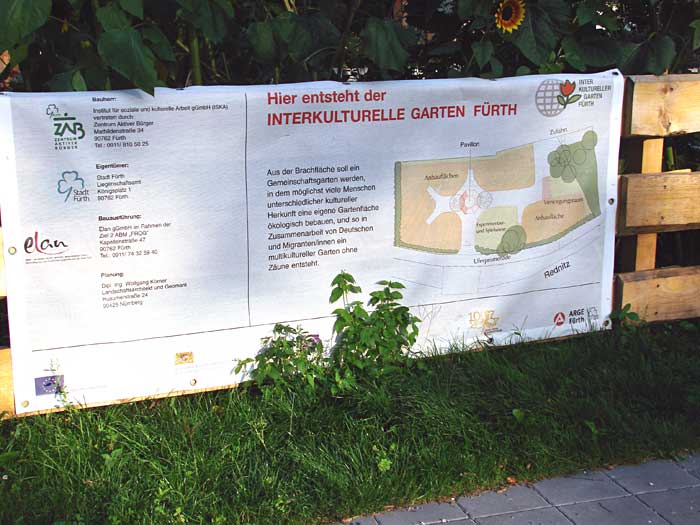
I didn’t think I’d find myself praising an initiative for immigrants here, but I am impressed by the intercultural garden near the River Rednitz. It is like a set of allotments with no fences in between. 28 gardeners of 19 nationalities have plots 25 metres square. Some children from two multinational kindergartens use it too. The man from Kosovo plants squashes and honeydew melons (only from the Balkans) and a banana tree, the Vietnamese teach others how to cook squash leaves, there are frames constructed of branches to carry pumpkins that have spread from one plot to another. Many immigrants come from a farming background and live in flats without gardens.

A young watermelon plant (what chance has it got?):