NEW/Website für Notare in England und Wales

NEW, NotaryTalk of England and Wales, is a website/forum run by Gregory Taylor, a notary public, not a scrivener notary. There are sections for links, news, German, French and Spanish pages and much more. A large number of articles both introduce the various notary professions and current problems. An important topic is the potential recognition of notaries from England and Wales in Europe.

I have had a few entries on notaries in the past – search for ‘notary’ in the blog. Not long after I started this blog in 2003, I went to a conference where I encountered Spanish-speaking lawyer-translators from South America who did not believe me when I told them about scrivener notaries in the UK.

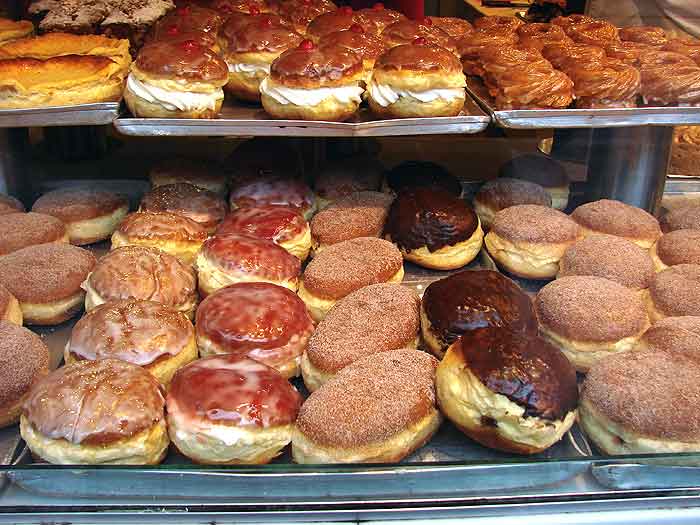
Doughnuts/Faschingskrapfen

The German equivalent of pancakes on Shrove Tuesday is a proliferation of different kinds of doughnuts in bakeries.

20070206nue00w8.jpg

These were seen at Confiserie Neef in Nuremberg.

20070206nue010w.jpg

According to their website they have:
Hagebuttenkrapfen
Zwetschgenkrapfen
Eierlikörkrapfen
Schokoladen-Nougatkrapfen
Himbeerkrapfen
Cappuccinokrapfen
Champagnerkrapfen
I had a Zwetschgenkrapfen (zwetsche jam, or rather powidl), the oval ones in the middle.

German literary translators in the press/Die SZ und die Literaturübersetzer

An article in the Süddeutsche Zeitung on 2 February 2007 by Thomas Steinfeld, the editor of the arts pages, is no longer available except for subscribers: Ein Haus für Rechthaber.

It’s described in an article by Burkhard Kroeber on perlentaucher.de. Apparently Steinfeld says the huge decline in literary translations into German over the past year is directly attributable to the desire of literary translators for more money: they see their work only as a financial and bureaucratic reality and give no thought to ‘cultural dialogue’, its most important feature.

Further reactions by literary translators can be found on the website of the VdÜ, the professional association for literary translators.

(Via …is a blog)

Accessibility / Barrierefreiheit

Jeremy Keith of Adactio went to Berlin last December for the BIENE website accessibility awards and wondered about the German language, under the heading ‘The language of accessibility’:

… I was thinking about the German word being used to describe accessibility: “Barrierefreiheit”, literally “free from obstacles.” It’s a good word, but because it’s describes websites by what they don’’t contain (obstacles), it leads to a different way of thinking about the topic.
In English, it’’s relatively easy to qualify the word “accessible.” We can talk about sites being “quite accessible”, “fairly accessible”, or “very accessible”. But if you define accessibility as a lack of obstacles, then as long as a single obstacle remains in place it’s hard to use the word “barrierefrei” as an adjective. The term is too binary; black or white; yes or no.

This also relates to the fact that creating an accessible website is not such a problem as keeping it accessible, and ensuring a client has an accessible website is not a question of expensive extras, but of fewer extras.

He was also a bit concerned that he might have offended jury members by calling them all du (I presume not).

(Transblawg is a not a barrier-free website)

LATER NOTE: Transblawg may well be more barrier-free since its move to Serendipity.

Kinds of goods /Waren und Güter

Wikipedia has an entry headed Final good, which subsumes all kinds of things as goods. For example, the public good and private good are listed as types of goods.

I am in a quandary. I don’t feel like correcting the article, because it is about economics terms and not language. I also feel that people like the Language Log bloggers would see me as a prescriptivist.

But for me, the public good is an abstract, only ever used in the singular, and consumer goods always has an s on the end, and never the twain shall meet. That is, goods is an example of pluralia tantum – nouns that in a particular sense occur only in the plural.

However, there is also a technical meaning of good: a particular article that is produced in order to be sold. So it’s not part of everyday English, but it fits in that article. I’m still not happy with the heading – it’s not a disambiguation article, after all.