Altalk Blog, the ALTA Literary Translation Blog, looks good. Although unfortunately it doesn’t look any better than it did six days ago.
Thanks to Gail.

Altalk Blog, the ALTA Literary Translation Blog, looks good. Although unfortunately it doesn’t look any better than it did six days ago.
Thanks to Gail.
The new Dietl-Lorenz German – English CD-ROM is now out. It’s still under the Acolada interface. (Creifelds has its own interface and is really clunky).
Unfortunately, I can’t find a way to change the red colour that Beck Verlag seems to have taken as its trademark.

I emailed Acolada (the link is given with the CD), and they sent me a small file to reduce the colour in part.

The Guardian has introduced a free RSS reader, NewsPoint, today. For Windows and IE or Firefox.
When I was about to pick up my update of the Dietl Lorenz CD-ROM at Büttner in Nuremberg, even before I asked for it, I was given this Luchterhand advent calendar with jelly (gummy) sweets in it.
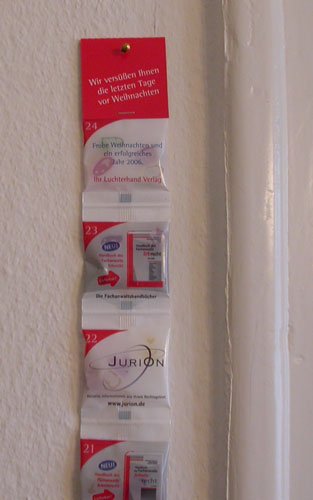
They seemed to be hard to hang up in the bookshop, so anyone else thinking of going to a German law bookshop might considering scrounging one too.
I wanted to advertise a book by Luchterhand so I looked on my bookshelves and all I found at a glance was Jakoby/Kruse, Handbuch für Rechtsanwaltsgehilfen, and they don’t publish that any longer. Well, never mind, I will eat their sweeties anyway.

At the legal translation seminar in Munich I learnt that people at the European Patent Office don’t mind whether they or I write trade mark or trademark. (I had learnt that trade mark is British and trademark is American – perhaps I’m too much affected by the neue deutsche Getrenntschreibung).
I also gathered that everybody always says patent as in cat (I will call that ‘short’), rather than paytent (I will call that ‘long’ – does the IPKAT, as a cat, do that too?). This is worrying, as I always use the long pronunciation, but persons close to the patent office only say that for patent-leather shoes.
Longman’s Pronunciation Dictionary (first edition) says the standard BrE pronunciation is the long one, and the standard AmE pronunciation is the short one. It also says that when the short A is used in BrE it is mainly restricted to technical use (which is the use I’m concerned with), and when the long A is used in AmE it is only in the sense of ‘open, obvious’ (as in the latent / patent contrast).
Collins English Dictionary has an equally long note to the same effect. It does say that even in the technical sense, the long A pronunciation is commoner in BrE. So am I not alone?
If you book a Lufthansa flight online, this is your choice of titles:
Mr.
Mr. Dr.
Mr. Prof.
Mr. Prof. Dr.
Mrs.
Dr. Mrs.
Mrs. Prof.
Mrs. Prof. Dr.