Purity of German beer/Reinheitsgebot in Deutschland

s_a.gif

Bundesverwaltungsgerichtentscheidung zu Schwarzbier (Az. BVerwG 3 C 5.04).

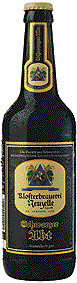
The German Federal Administrative Court today decided that a German beer to which sugar was added can be called beer nonetheless. It overruled a decision of the Frankfurt an der Oder Administrative Court.

A brewery in Neuzelle applied ten years ago to market its ‘Schwarzer Abt’ (Black Abbot) as a beer. Traditionally, beer may contain only hops, malt, yeast and water. The brewery argued that special beers are permitted, and that there was discrimination against domestic firms, since under EU law beer brewed outside Germany can be sold as beer in Germany even if it doesn’t comply with the Reinheitsgebot (purity law). Apparently, however, the provision for special beers applies to herbs rather than sugar.

Schwarzer Abt is based on a traditional recipe and sweetened with sugar syrup.

LATER NOTE: Streitsache quotes Beck Aktuell, which gives a more detailed report.

The court said that the Reinheitsgebot does not protect health, but tradition and quality. It was necessary to be generous with exceptions. The Schwarzer Abt beer is brewed using malt. The sugar is added only after the brewing is complete. 2 – 3% sugar syrup is added. The beer is permitted as a special beer. And if the brewery is allowed to brew it, it must also be allowed to market it.

German legalese

In an earlier entry I linked to a site showing how to create a long German legal sentence. I believe that must have been a plagiarism, because jurabilis now quotes a file with that material in it as being by Oliver Elzer.

Elzer shows how to get from this:

Vielen Dank für Ihren Brief. Wir beantworten Ihre Fragen, sobald wir mit Herrn Müller darüber gesprochen haben.

to this:

Bezugnehmend auf das vorgenannte Schreiben möchten wir unseren Dank aussprechen. Die Unterfertigten werden in alsbaldiger Erledigung der darin aufgeworfenen interessanten Fragen umgehend auf diese Bezug nehmen, sobald unsererseits die unverzichtbare Rücksprache mit dem derzeit auf einer Reise befindlichen Mandanten gehalten werden konnte.

According to the comments, Elzer is very widely known among law students in Germany. There is a lot of useful material on his site, for instance on civil procedure.

Portuguese law blog portal/Portugiesisches Blog-Portal

Wahrscheinlich die weltgrößte Sammlung von Links an Lawblogs.

The Instituto Politécnico de Beja in Portugal has a portal (possibly the world’s largest) for legal weblogs in several languages. Here’s an entry page in English.

Deutsche Einführungsseite zur Site. Dieser Internetauftritt soll als Grundlage für Unterricht im WWW dienen.

Thanks to Professor Manuel David Masseno for the information.

In dubio pro reo: translation

New comment added and comments opened temporarily on an earlier entry:

On May 12 2004, I wrote an entry which now seems a complete mess to me. The springboard was the question, ‘Are the words “In dubio pro reo” (Im Zweifel für den Angeklagten) used in English?’, and the answer is ‘No’, because the Latin used in one legal system is often different from the Latin used in another legal system. It would be possible to make a list of Latin terms used in England, the USA, Germany, Austria and Switzerland (to name but a few), and I have a small collection of books from various jurisdictions for this purpose.

How to translate it into English? ‘Giving the defendant the benefit of the doubt’ seems a bit colloquial but certainly does the trick.

The conclusion of the entry was, or was meant to be, that the Latin words ‘in dubio pro reo’ are not used in English, nor can the principle of ‘in dubio pro reo’ be translated as ‘the presumption of innocence’.

I gave details of Google results on the term, and there was some discussion, in the comments too, about the myth among common lawyers that Continental Europe has no presumption of innocence (this point was originally mentioned by Clemens Kochinke in an article to which I refer).

The latest commenter takes issue with what he sees as the suggestion that common law is superior to civil law in this respect. What’s more worrying is that I didn’t think I or anybody else had actually said that! But perhaps the first comment did – it is rather cryptically worded.

If anyone wants to join the fray they should look at the original article and comments.

Bush, Schröder, interpreter

I accidentally watched ten minutes of George W. Bush and Gerhard Schröder at lunch in Mainz on TV (ARD). Schröder made a short speech, and it was interpreted. He apologized in quite a few words to the interpreter for having added stuff, which I suppose is good and bad. She had a copy of the speech before additions and presumably he saw her adding notes – but this is standard. (Hence ‘Es gilt das gesprochene Wort’: ‘Check against delivery’, written at the top of these speech drafts handed out to interpreters or press).

It is good to hear speeches held and interpreted, and for trainee interpreters a good chance to record them on videotape as practice material. The TV presentation seemed a bit of a mess. Bush didn’t react while Schröder was speaking German, obviously. When the interpreter began, he began his series of facial expressions. Then the English was faded out and we went back to the winter sports. Now, they had already said it was time to go back to sports, but did someone in that studio say, ‘It’s English, no-one will understand it, let’s leave’? I would have thought that Bush’s reactions to the speech were the most interesting thing, whether genuine or rehearsed.