
Judicial Committee of the Privy Council

Here is the Judicial Committee of the Privy Council in action in 2023. (Brick Court Chambers just call it The Privy Council).

privy council quashes a conviction for armed robbery in the bahamas based on a confession allegedly obtained by police oppression

A horrifying story.

The Privy Council has today quashed the conviction of Mr Vinson Ariste for armed robbery on the ground that the confession on which the conviction was based should never have been admitted into evidence and rendered the conviction unsafe.

Mr Ariste was 20 years old in 2010, when the robbery happened. He looked much better before his police confession than after. In 2012 he was sentenced to 15 years’ imprisonment on the basis of this confession. He appealed unsuccessfully to the Bahamas Court of Appeal, and thereafter to the Judicial Committee of the Privy Council, which has now quashed the conviction. He was in prison for 12 years.

Paul Bowen KC, Emma Mockford and Jagoda Klimowicz acted pro bono on behalf of the Appellant, instructed by Simons Muirhead Burton / the Death Penalty Project.

Here is the trial.

I notice that the appellant is Mr Vinson Ariste and the respondent is The King.

The Judicial Committee of the Privy Council (JCPC) is the court of final appeal for the UK overseas territories and Crown dependencies. It also serves those Commonwealth countries that have retained the appeal to His Majesty in Council or, in the case of republics, to the Judicial Committee. The judges are usually the justices of the Supreme Court. The Bahamas is an independent country, and member of the Commonwealth, which has decided to retain the Queen, now King Charles III, as head of state.

This leaves the question of what is the Privy Council itself? A question much asked when Penny Mordaunt appeared as a swordbearer at the coronation, in her capacity as Lord President of the Privy Council. Anyone who wants details of that can find it on the web.
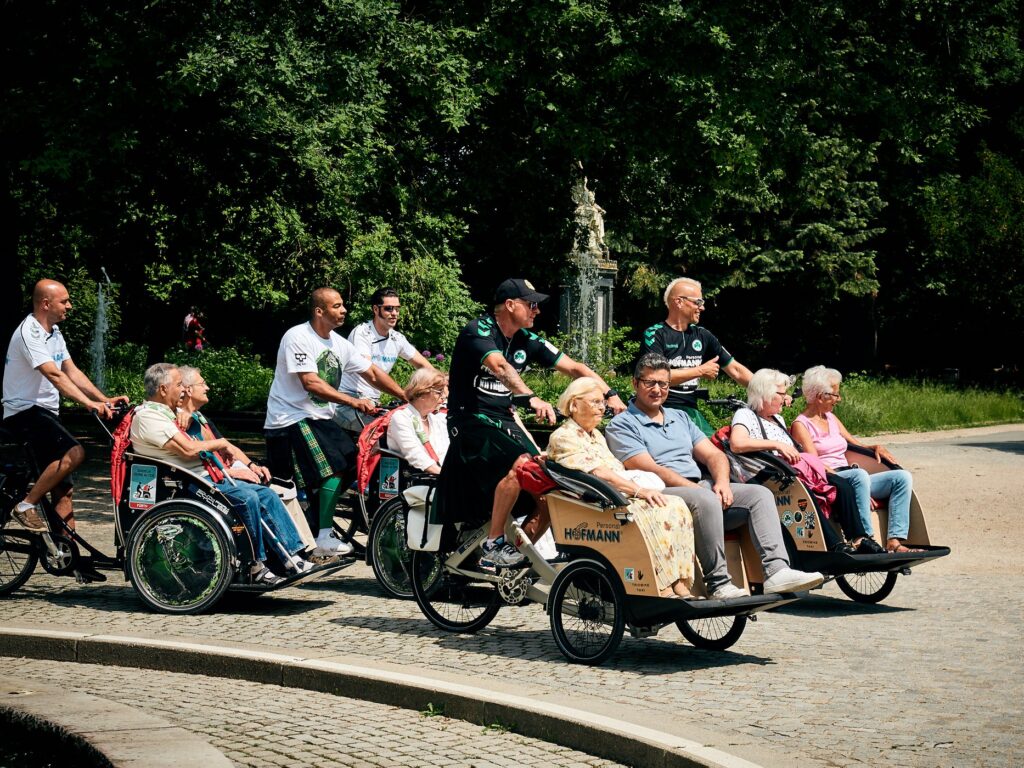
United Kiltrunners e.V.

United Kiltrunners e.V. is a charitable organization founded in Fürth in 2015. I can find no Scottish connection for the kilts. Possibly when they run for charity their kilts make them more noticeable.

One of their current projects is providing rickshaw rides for senior citizens. This is called Radeln ohne Alter – cycling whatever your age, although it is more like being transported. There are definitely some nice green areas around the confluence of the Rednitz and the Pegnitz. The Kiltrunners have eight e-rickshaws, which I suppose are electrically assisted.

Kiltrunners und Senioren on tour


Fürth Wiki entry

ChatGPT in the news for lawyers in Germany too

Great excitement has been caused by the case reported in the New York Times (and elsewhere): Here’s What Happens When Your Lawyer Uses ChatGPT – a ten-page pleading submitted by a law firm for its client

cited more than half a dozen relevant court decisions. There was Martinez v. Delta Air Lines, Zicherman v. Korean Air Lines and, of course, Varghese v. China Southern Airlines, with its learned discussion of federal law and “the tolling effect of the automatic stay on a statute of limitations.”

But all these decisions had been invented by ChatGPT, which the lawyer had used to help him write the pleading (US brief).

There’s been some discussion about German lawyers using AI in the beck-community blog.

ChatGPT – Nutzungen durch Anwälte: gefährliche rechtliche Klippen sind zu umschiffen is an entry by Dr. Axel Spies. It refers to an article which I don’t have access to. The main conclusion is that it is a violation of the GDPR (German DSGVO) to enter a client’s name, for example, into ChatGPT. It’s hard to imagine this happening in Europe. But obviously, even in the USA the judge soon noticed the problem. I suppose ChatGPT could devise deceptive arguments, but once it invents facts, it should be obvious it is false.

One commenter on the blog entry actually asked ChatGPT what lawyers should think of a chatbot’s legal advice:

Das meint ChatGPT selbst zu dem Thema:

Als KI-Chatbot kann ich keine Rechtsberatung geben, aber ich kann Ihnen allgemeine Informationen zur Verfügung stellen. …

Zweitens müssen Rechtsanwälte sicherstellen, dass die von ChatGPT bereitgestellten Informationen korrekt und aktuell sind. Rechtsanwälte können sich nicht allein auf ChatGPT verlassen, um rechtliche Fragen zu beantworten, sondern müssen ihre Recherchen sorgfältig prüfen und zusätzliche Informationen sammeln, um eine vollständige und zuverlässige Antwort zu erhalten.

Peter Winslow reports on the US case in German on the beck-community blog too.


Von Amts wegen

I was always pleased with myself when I recognized whether von Amts wegen was to be translated as ex officio or as of (the court’s) own motion.

But I never asked myself why. Recently, someone has asked why!

It seems that the term ex officio is used in more situations in German than in English. Here is the von Beseler/Jacobs-Wüstefeld dictionary of 1991 on von Amts wegen:


ex officio, by virtue of (one’s) office; because of one’s position; officially; proprio motu (Lat.); upon (of its) own motion; upon/of the court’s (own) motion; in ordinary

I think if someone does something by virtue of their office, ex officio works. But if a court comes to a decision, perhaps because it usually deliberates about it, then of its own motion is appropriate.

I looked up both expressions in the big Oxford English Dictionary, but they don’t add anything much to this.

I have one other excellent law dictionary but I don’t speak much Italian so I have never read the introduction, which I am sure is wonderful. I must scan it and run it through DeepL. It is by, Francesco de Franchis, Dizionario Giuridico English-Italian, 1984

He even says where ex officio would not be used in English. It is the bilingual law dictionary every translator wants, but it is in the wrong language.

Di ufficio; si dice, ad es., che il Lord Chancellor (v.) è un giudice della Court of Appeal ex officio, come pure il President della Chancery Division e il Lord Chief Justice. Ma si noti che quando si vuole alludere ad una iniziative di ufficio e ad una istanza di parte si parla, rispettivamente, di suo officio e di its own motion e di at the instance of the parties.


Basil Markesinis obituaries

Sir Basil Markesinis died on 23 April 2023. There was an obituary in The Times today and in the Daily Telegraph two weeks ago. Telegraph:

The multilingual, cosmopolitan son of a former prime minister of Greece, Markesinis held, successively, the chairs of European Law and then Comparative Law at the University of Oxford, where he founded the Oxford Institute of European and Comparative Law.

Moving to London as Professor of Common and Civil Law at University College (UCL), he established the Institute of Global Law (“exceeded only by galactic”, observed one wag), holding the position simultaneously with a part-time chair at the University of Texas at Austin, where a legal colleague was quoted as describing him as “one active b—-r and as wise as a tree full of owls”.

It was quite an exciting read. If you have access to the Times or the Telegraph, you can see a photo of him wearing red trousers.  I only knew his comparative-law books on The German Law of Contract and The German Law of Torts, both several times revised and updated. I used them a lot but I regret I have never found time to read them at length. But I have long been looking forward to doing so.

Just last week the ITI German Reading Group was reading the novel “Corpus Delicti” by Juli Zeh, who under her real name is an honorary judge (proposed by the SPD) in the constitutional court of Brandenburg. I didn’t think the legal vocabulary in this science fiction novel would be a big problem for translators, but I noticed the term überholende Kausalität and wondered how I would translate it, if it were essential to the plot or to a legal text. And so I looked at Markesinis on the German law of torts. He refers to overtaking causes. An example is a medical practitioner who blinds a patient who would have subsequently become blind in any case. He queries whether overtaking is the less appropriate adjective than overtaken, which is something I was trying to get my own head around.

At all events, those two books are a really full and useful read, with plenty of references to German sources.