Banksy stages almost-secret exhibition in Bristol, because he ‘wanted to give something back’ to the city (pictures).
Banksy in Bristol
Reply

Banksy stages almost-secret exhibition in Bristol, because he ‘wanted to give something back’ to the city (pictures).
Rory MacLean (who grew up in Canada) writes in a Goethe Institut weblog, Meet the Germans – his Rory’s Berlin-Blog is apparently only part of it -, in which he currently sits on the fence about sausages in Germany and Britain, with many quotes.
I can understand people enthusing about Nuremberg Bratwürste (found the WPA password here), although I often wonder how they get by without rusk to carry the flavour in the fat, and I find Nürnberger and Fränkische – a larger version – can be too salty to be versatile. But calling Currywurst glorious seems to me inappropriate as a comparison.
I am away from the office and I can’t get my laptop on the internet because some people have forgotten their WPA password. Hence slow or non-existent blogging.
On Saturday June 6, I went to a one-day course on term extraction and terminology management at Imperial College. It was actually a well-paced introduction to two programs, Lexterm (which is free) and Lingo (which is cheap).
Ah – Lexterm – a Catalan program! and Lingo by Lexicool.
I must say that looking at the results of term extraction of bilingual files immediately reminded me of Linguee, which is obviously the same technology at work, hence the occasional bolded words.
There were thick handouts with deliberately redundant information. I was happy with what I learned, although I would like to meet someone else who has ideas about recording legal vocabulary in a terminology program. It would be easy enough to disambiguate in a monolingual database, but not in a bilingual one. Perhaps one should have a German database, an English database, maybe even more to distinguish England and Wales, the USA, Germany, Austria, Switzerland etc., and then a messy and unscholarly bilingual database cross-referencing it. I mean, it’s all very well to say you need one entry for bank meaning a financial institution and another one for bank meaning a river bank, but that assumes they have equivalents in the other language.
I was able to complete the day with a visit to the British Film Institute to see Ukulelescope with the Ukulele Orchestra of Great Britain.
Via the pt translators’ list at Yahoogroups, Eurozone Translations tell it like it is.
They refer those who require less to their subsidiaries, Rumpelstiltskin Translations and Vindaloo Translations.
Eurozone Translations bases its success on a very simple premise:
We know more about translating than the customer does.We don’t tell our customers how to make their widgets and we’ll be damned if we’ll let our customers tell us how to translate.
We don’t hesitate to reject documents that don’t meet normal standards of coherence, grammar and common sense. If the source document is crap, why should we break our necks to turn out something better than the original? If you want that type of work, please contact our subsidiary, Rumpelstiltskin Translations.
But Eurozone Translations are in the USA, I suspect, and don’t actually exist as a translation company. Are they just trying to run Indian agencies down? Whois didn’t help much.
I’m not sure what good this site does anybody except to create cheap laughs about translators and increase the justified suspicion that an awful lot of them are no good.
On 18 June, five lawsuits by literary translators relating to appropriate payment will be heard by the German Federal Court of Justice (Bundesgerichtshof).
beck-blog reports:
Die Honorare für Literaturübersetzer sind seit Jahrzehnten meist katastrophal: Bei der letzten, nicht repräsentativen Honorarumfrage ergab sich ein Durchschnittshonorar je Manuskript-Normseite mit 30 Zeilen zu maximal 60 Anschlägen (die also keineswegs mit l 800 Zeichen gleichzusetzen ist) in Höhe von 17,83 Euro; allerdings sind für „einfache” Übersetzungen Normseitenhonorare von unter 10 Euro im Taschenbuch keine Seltenheit. Das Paradox bei den Seitenhonoraren ist, dass Qualität „bestraft” wird: Je mehr Aufwand der Übersetzer betreibt, desto weniger zahlt sich die Arbeit für ihn aus.
The concept of ‘appropriate/adequate compensation’ has been contained in the German Copyright Act since 2002. The translators have not seen an improvement of their situation. The June 18 decision will be interesting.
For further information: http://verguetungsstreit.literaturuebersetzer.de/
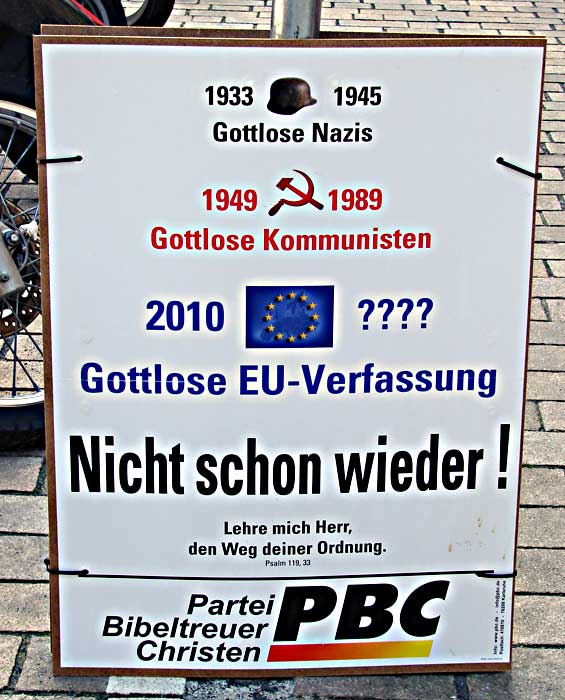
This is one of the parties I won’t be voting for: