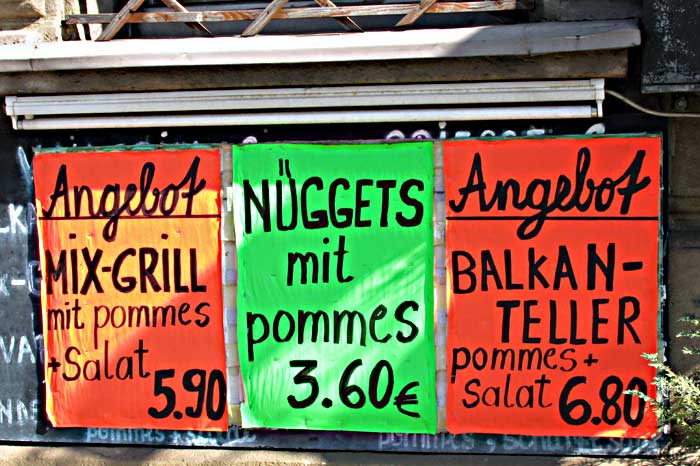
Nüggets
Reply

The Alpine Schunklers Oompah Band, with its accordionist Ken Gordon, presents ‘Music and song from the Bavarian beer festivals’ (note that what the British think of as ‘Roll out the Barrel’ is ‘Rosamunde’ in German).
Our repertoire consists of music and song from the bier festivals, marches, waltzes and polkas. We integrate many audience participation spots such as the Ladies Horn Blowing Competition followed by the men’s Yodelling session. Lili Marlene followed by the music man and Al Jolson pops up frequently for an up tempo sing-along accompanied by a Singalongamax ditty.
Schunkling and Ein Prosit’s throughout marching back to the bier kellar scene for more authentic polkas and some beautiful Strauss waltzing and cuckoo waltz, Alte Kameraden, Radetski march, Drinking song, In Munchen Stheit, Trink Trink Pruderline Trink, etc etc.
(sic)
For even more exciting accordion playing see Charles Magnante and his Trio (at least partially deceased) and – coming soon – the Baldie.
When I read at Swordplay about the Times Spelling Bee, I thought they meant the New York Times – but no, it’s the so-called London Times Spelling Bee site.
Mind you, if you write ‘higher’ instead of ‘hire’ you’ll get thrown out, and similarly if the speaker mumbles so you write ‘boo’ instead of ‘booth’.
There are various levels, some very easy.
Ich werde ein Berliner seems to take Nothing for Ungood a step further.
The year is 2009. Berlin is hip. Germany is hip. Are you struggling to make some German friends? This blog will teach you how to blend in “wiz ze” Germans.
When you ask a German person why he likes to go to Aldidl, he or she will give you a surprised look and say “because they have the exact same product as other supermarkets, only in another packaging!”. As German people are always eager to 1-up others on bargains, they will happily buy whatever is on sale that week, needed or not. Then they will drive back to their house via the Autobahn at 120 mph, burning 3 times the amount they saved on gasoline. Back home, they will compose a bunch of text messages on their “Handy’s” at 25 cents a piece, bragging to their friends about the great bargains they found again at Aldidl.
(Via …jurabilis!
From Wikimedia Commons:
Starting on Thursday Dec 4, 2008, Wikimedia Commons witnessed a massive upload of new images. We received nearly 100,000 files from a donation from the German Federal Archives. These images are mostly related to the history of Germany (including the German Democratic Republic) and are part of a cooperation between Wikimedia Germany and the Federal Archives.
Vom Bundesarchiv:
Wikimedia Commons wird vom Bundesarchiv um 100 000 historische, zum Teil einmalige Fotos bereichert. Wikipedia wiederum unterstützt das Bundesarchiv bei der Zuordnung von Nummern der sogenannten Personennamendatei (PND) zu den Einträgen in der Personenliste des Bundesarchivs und bei der Erschließung von noch nicht identifizierten Bildern. Dadurch ziehen Bundesarchiv und Wikipedia gleichermaßen Nutzen aus dieser beispielhaften Beziehung.
Here’s an example: the ‘zeppelin on rails’ (Schienen-Zeppelin) arriving in Berlin on 21 June 1931.

(Thanks to Trevor)
My attention was drawn to the reviews of Littell’s The Kindly Ones in the USA. Take this one from the Los Angeles Times, for instance (thanks, Isabella!), and better-known very harsh reviews in the New York Times and the Literary Saloon (for a different view, see here). The reception was much more positive in France, I read – and it certainly was in Germany. I haven’t read the book but the temptation is growing. I don’t like the sound of the past life Littell has given his main character, but I can’t help feeling the reactions have something to do with distance from Europe. Then again, the book was written in French by an American who grew up in France, so I can’t judge it as if it were a German book. Part of the German reaction was that it needed a non-German to actually put the holocaust into a novel.
I just recently finished W.G.Sebald’s Austerlitz, another book about the holocaust. Sebald seems to have emigrated from Germany to some extent because of the silence about the recent past in 1950s and 1960s Bavaria (people kept quiet about the past in Britain too in those times, but what they kept quiet about did not have the same dimensions). He seems to have believed that the holocaust could not be written about directly, only indirectly. Maybe that’s why it takes such a very long time for Austerlitz to put its cards on the table.
Searching for people writing about Sebald in English on the Web, it’s striking how much adulation there is in English-speaking countries. It’s odd how Sebald is taken on as if he were an English-language writer (fortunately the translators, Michael Hulse and Anthea Bell, do get some praise). One person even expressed surprise that Sebald, whose English was so good, decided to write in German. But they are very German books, to my mind. In Text und Kritik no. 158, on Sebald, Rüdiger Görner considers this aspect:
Seltsam genug, aber vielleicht nicht unbedingt verwunderlich: Sebalds durchaus kritisches England-Bild und das beinahe auf Kritik verzichtende Bild, das sich (vor allem) englische Kritiker von ihm gemacht haben, sind nur bedingt deckungsgleich.
The first thing of Sebald’s I read was Die Ausgewanderten (The Emigrants), when it first came out in the Andere Bibliothek in 1992. That was his second novel, but the one that led to the breakthrough, especially when it first appeared in English in 1996. It’s not actually about four Jewish emigrants, as is often said – one of the stories is about relations of Sebald’s, Germans who went to the USA. In the last story, of Max Ferber (still called Max Aurach in my edition), the diaries of the artist’s mother conjure up a world where Jewish life and German life could mean the same thing – this is another indirect evocation of the horror of the holocaust. (And this book might be the best place to start reading Sebald).
Last year I read Die Ringe des Saturn (The Rings of Saturn), enjoyed it at the same speed as I had Die Ausgewanderten. I reread Die Ausgewanderten this year to see how it stood up to the test of time.
(The only other Sebald I have read is part of Logis in einem Landhaus – essays on Robert Walser, Hebel, Keller, Rousseau, Mörike and Tripp).
Two things that struck me about Die Ausgewanderten: in connection with the theme ‘The dead are always returning to us’, there is a clear reference to Hebel’s Unverhofftes Wiedersehen, a story unlikely to be known to an English reader. That almost needs a footnote, but I suppose it is not essential. (I see that a translation appeared in Penguin Books in 1994, translated by John Hibberd: The Treasure Chest: Unexpected Reunion and Other Stories). Another thing is the topos of the butterfly collector, a reference to Nabokov and presumably to his autobiography Speak, Memory. That would be far too obvious in an English novel, but in German it may work.
Wikipedia has a list of all the influences on Sebald. Adalbert Stifter strikes me as the strongest. And I think a good description of both Stifter and Sebald is ‘Boring, but in a good way’. I can’t remember where I came across the word ‘boring’ in connection with Sebald, but it struck me as a good one immediately. Boring and yet hypnotically fascinating at the same time. I can see the Bernhard influence now, at least in the language as well as in the sentence length, but their subjects don’t seem closely related.
Five Dials is an online literary magazine (PDF file) from the publisher Hamish Hamilton. The fifth edition features W.G. Sebald.
dovegreyreader on The Emigrants
Via Vertigo
Interview with Sebald, interviewer Michael Silverblatt, dated 2001.